

Transformer Specifications: A Practical RFQ Checklist
Understand transformer specifications, compare ratings and guaranteed values, and use an RFQ checklist covering electrical duty, drawings, losses, and tests.

Transformer specifications define the electrical supply a transformer accepts, the output it delivers, and the conditions under which its ratings apply. For a useful request for quotation (RFQ), connect those ratings to the project: load, operating environment, cable connections, required performance, and acceptance documents. A kVA rating and voltage ratio alone leave too much open to interpretation.[1][10]
For distributors and contractors buying distribution transformers, the priority is to establish a compatible design before comparing prices. The same capacity can be offered with different connections, insulation requirements, losses, and physical layouts. The RFQ should make those differences visible.[10]
Start with the supply and the required output
Specify the primary supply voltage, secondary voltage, number of phases, and frequency together. Also state the winding connections and whether the secondary requires an accessible neutral. A wye connection has a common neutral point; a voltage number alone does not describe how the load will connect.[1]
For example, a project calling for 480Y/277 V service needs both the line-to-line supply and the line-to-neutral supply represented in the connection arrangement. Writing only “480 V secondary” leaves that requirement unclear.
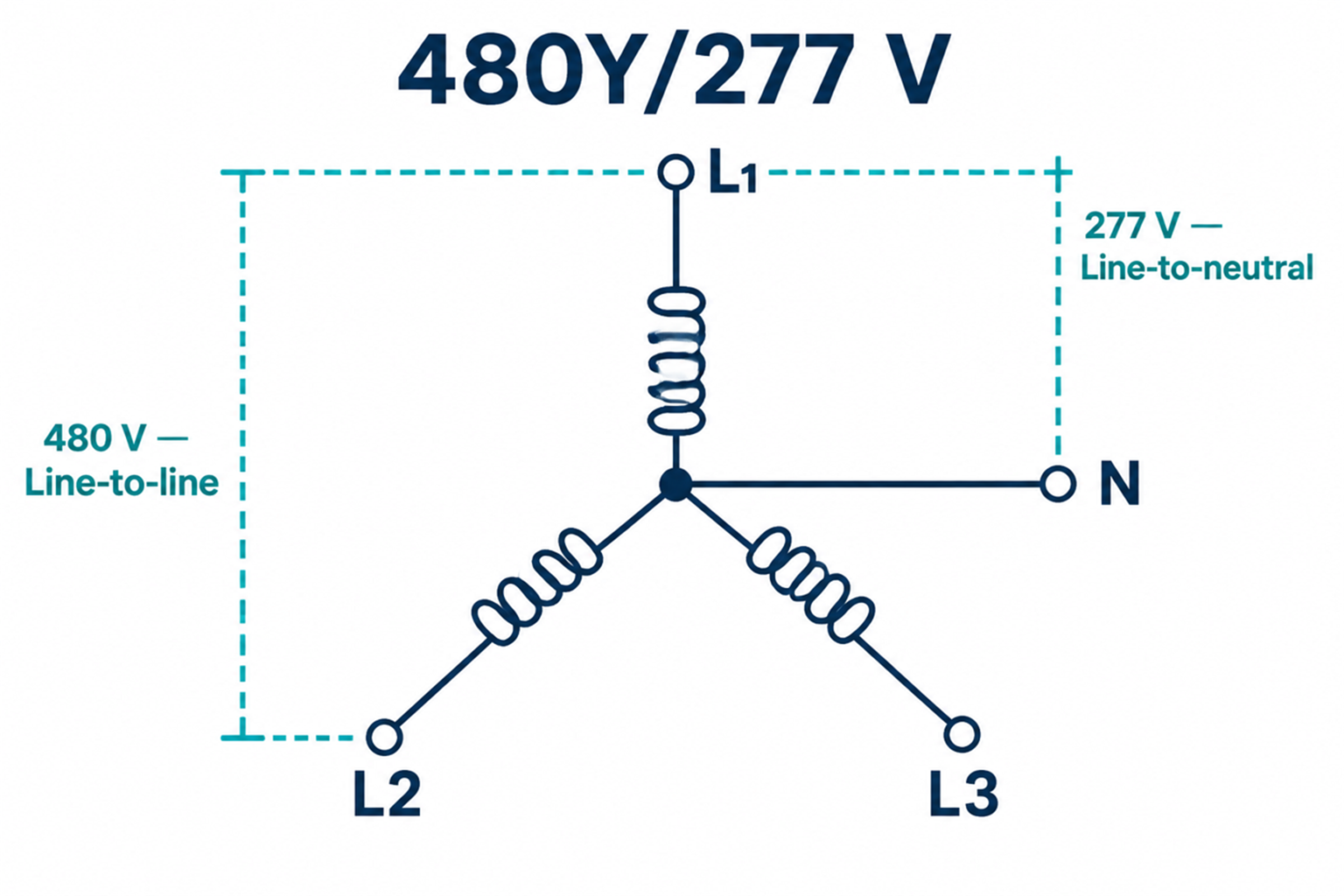
Attach the project single-line diagram so the supplier can relate the transformer to the upstream supply and downstream equipment.[10]
Frequency belongs in the initial specification. A conventional transformer changes voltage at the supply frequency; it does not convert 50 Hz into 60 Hz. HPS also warns against operating a 60 Hz-rated transformer on a 50 Hz supply because of core saturation, increased losses, and heating.[1]
Where voltage adjustment is required, state the tap range, step size, and tap-changer operating method. Taps change the winding ratio; their presence does not mean the transformer automatically holds a constant output voltage as the load changes.[13]
For a U.S. project, include the utility specification and any applicable energy-efficiency requirement. DOE coverage has defined limits and exclusions, so a general “distribution transformer” label does not establish whether a particular unit falls within the regulation.[3]
Size the transformer from the load, not from a chart alone
Transformer capacity is expressed in kVA. When electrical input power and power factor are known:
Required load kVA = electrical input kW ÷ power factor
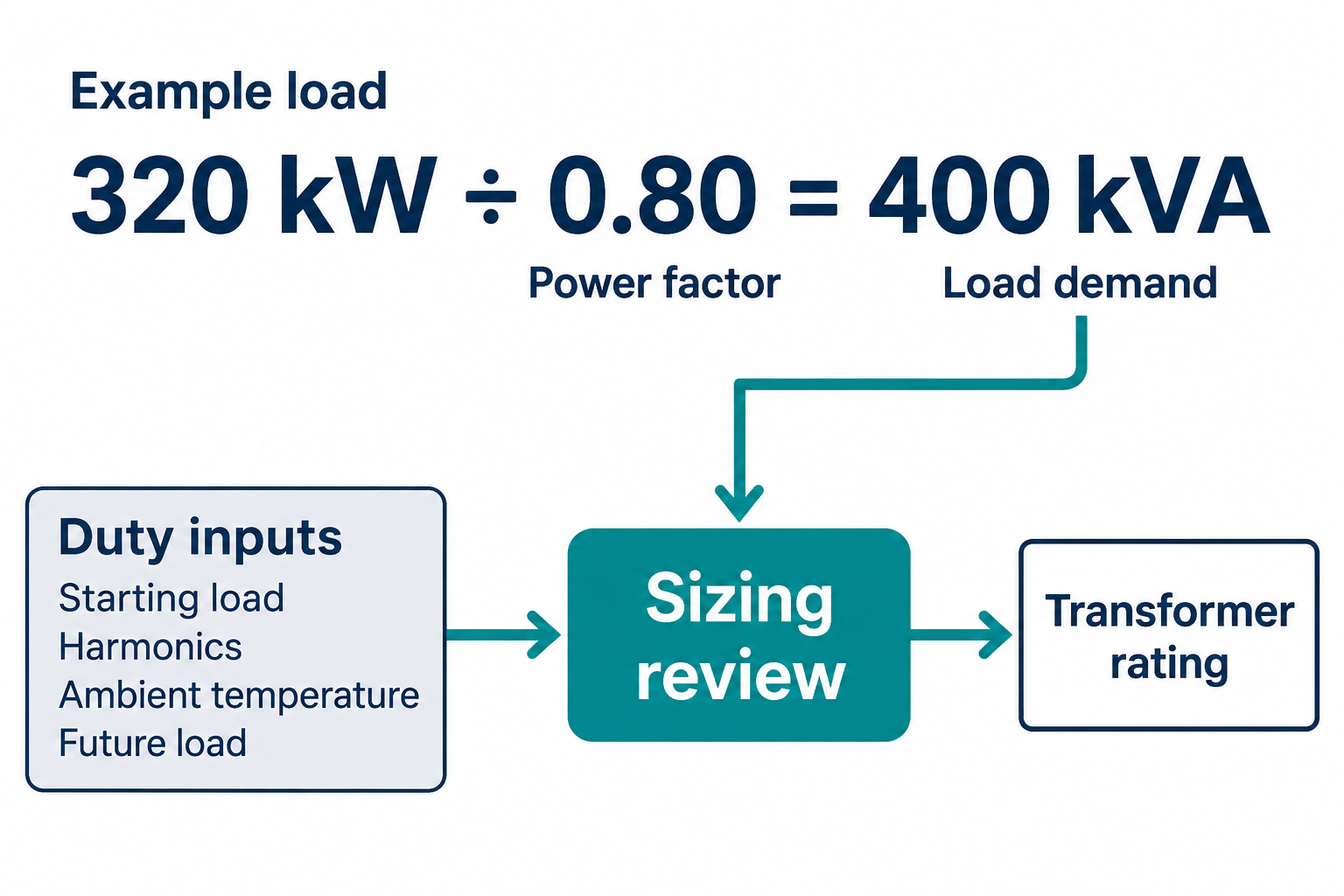
As a hypothetical example, a simultaneous load of 320 kW at a power factor of 0.80 represents 400 kVA. This calculation describes the load at that operating point; it does not, by itself, establish the final transformer rating. Power factor relates real power to apparent power, so using 320 kW as though it were 320 kVA would understate this example’s demand.[14]
When voltage and current are known, a balanced three-phase load can be expressed as:
kVA = √3 × line-to-line volts × line amperes ÷ 1,000
A three-phase transformer chart uses this relationship to convert between capacity, voltage, and current.[12] It cannot reveal the load’s starting behavior or operating schedule.
A motor starting directly on the line can create a short-duration demand that the steady-running kVA does not describe. HPS identifies load inrush, voltage regulation, harmonics, ambient temperature, and future growth as separate sizing inputs.[8] For an RFQ, a load schedule with the largest starting load is therefore more useful than an unexplained capacity allowance.
Nonlinear loads need a different description: their harmonic currents can distort voltage through the distribution system’s impedance.[6] Where drives, UPS equipment, or similar loads are significant, include their electrical characteristics rather than assuming a larger general-purpose transformer resolves the issue.
Use a manufacturer’s available kVA range after establishing the required duty. A list of common transformer sizes is a purchasing reference, not a substitute for the load calculation.
Read insulation, temperature, and impedance as separate requirements
BIL describes surge withstand
Basic impulse insulation level, commonly shortened to BIL, describes the insulation system’s ability to withstand high-voltage surges.[11] It is separate from normal operating voltage and from the insulation system’s thermal rating.
In the RFQ, associate the required insulation level with the relevant winding or terminal and the governing project specification. A kVA value does not determine BIL: output capacity and surge withstand are separate requirements.[1][11] If the utility has specified an insulation level, make it an explicit acceptance requirement rather than leaving it as an optional supplier upgrade.
Temperature rise is not insulation class
Temperature rise is the increase in winding temperature above ambient caused by energization and loading.[9] Insulation temperature class describes the insulation system’s thermal capability.[1] The two values answer different questions.
A temperature-rise value is meaningful only alongside the cooling arrangement and operating conditions. For a dry-type unit, request the insulation class and winding-rise value separately. For other transformer constructions, use the thermal limits defined by the selected project specification. Put the site’s ambient conditions in the RFQ rather than expecting a catalog rating to resolve an unusually hot installation.[8]
Impedance affects fault current and voltage regulation
Transformer impedance influences both the short-circuit current available from the transformer and its voltage regulation. For otherwise comparable designs and load conditions, higher impedance limits the transformer contribution to fault current but can mean greater voltage drop under load. HPS explicitly cautions that impedance has no direct correlation with efficiency.[7]
Specify the impedance requirement or acceptable range from the project electrical design. Treat an offered deviation as a design change to review against protection and load requirements, not as a small difference to ignore because the kVA and voltage ratio match.
Define the physical connections before approving drawings
Give the supplier a drawing of the installation interfaces: the available footprint, cable approach, cable sizes, termination arrangement, and access constraints. Ask for a general arrangement (GA) drawing that shows how the offered transformer fits those interfaces.
Consider a hypothetical replacement project where the existing conduits rise through a fixed opening in the floor. A transformer may fit within the available footprint while placing its terminals beyond the usable cable reach. Overall width and depth would not reveal that conflict; a dimensioned cable-entry and termination drawing would.
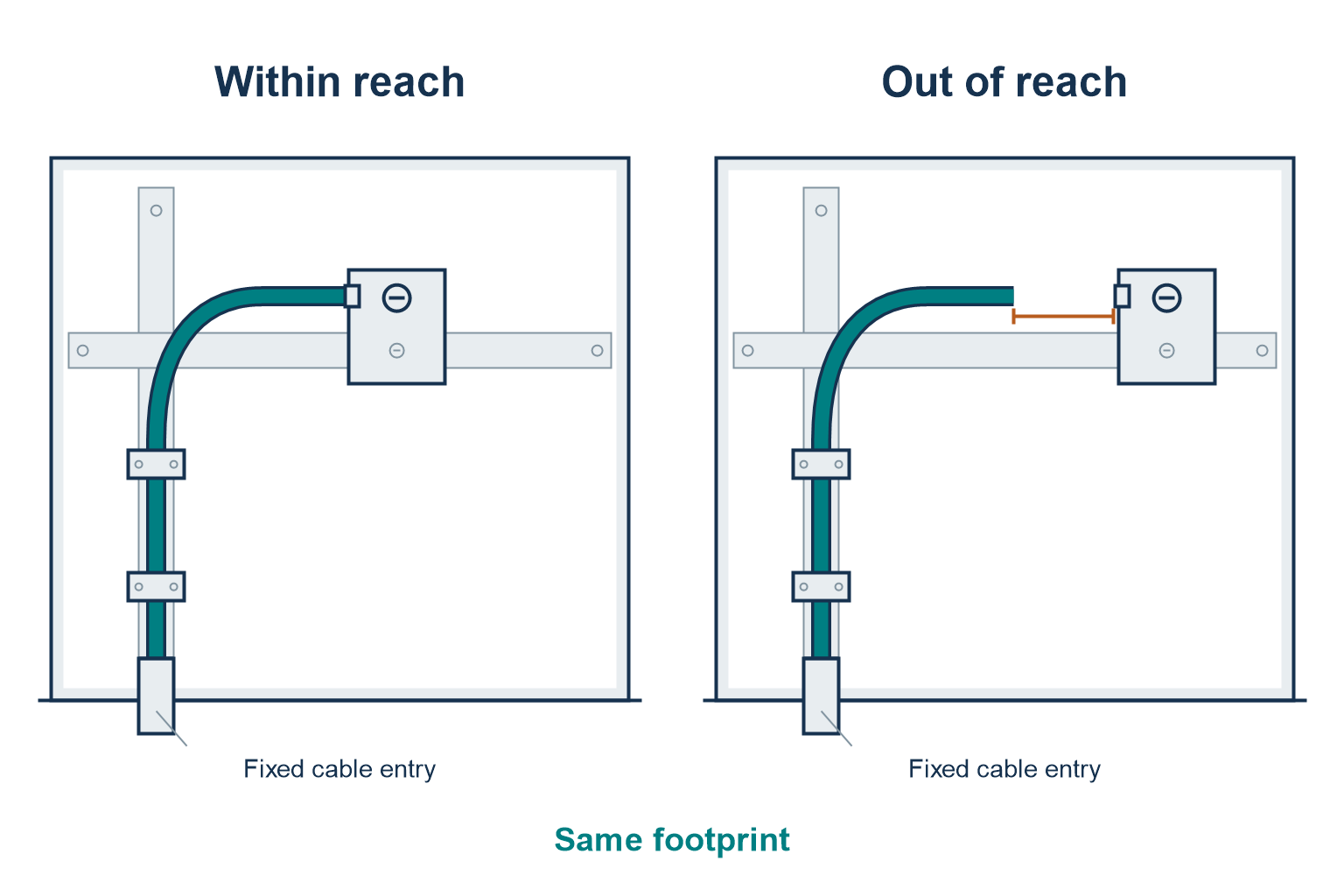
The useful document set therefore includes the GA, terminal arrangement, cable-entry details, and connection diagram. Give each drawing an identifying number and revision, and state which revision the supplier is pricing. A revised terminal layout should not disappear inside an unchanged product description.
For a replacement transformer, add the existing nameplate and drawings as reference material, then identify what the new project changes. Copying the old rating without describing a changed load or connection requirement can preserve the wrong design basis.
Separate rated values, guaranteed values, and measured results
For procurement, keep these three categories distinct:
| Information category | What it establishes | How to use it |
|---|---|---|
| Rated value | The assigned operating duty, such as capacity, voltage, frequency, or cooling rating | Define the transformer being purchased and the conditions attached to its ratings. |
| Guaranteed value | A supplier’s contractual commitment under stated conditions | Record the value, test method, reference conditions, and acceptance tolerance in the agreed technical schedule. |
| Measured result | The result obtained from an identified test | Compare it with the agreed requirement using the same measurement basis. |
Losses illustrate why the distinction matters. No-load losses occur with the transformer energized even when the secondary supplies no load; load losses arise from carrying current.[1] A project with long energized periods and light loading may therefore place more weight on no-load losses than one operating close to rated load for much of the day. This is an operating-profile comparison, not a claim that one design is always cheaper to run.
Request no-load and load-loss values separately, with the applicable voltage, frequency, loading, and reference temperature. HPS’s performance tables, for example, label their data as typical and state conditions for losses and efficiency.[10] A typical catalog number should not silently become a purchase guarantee.
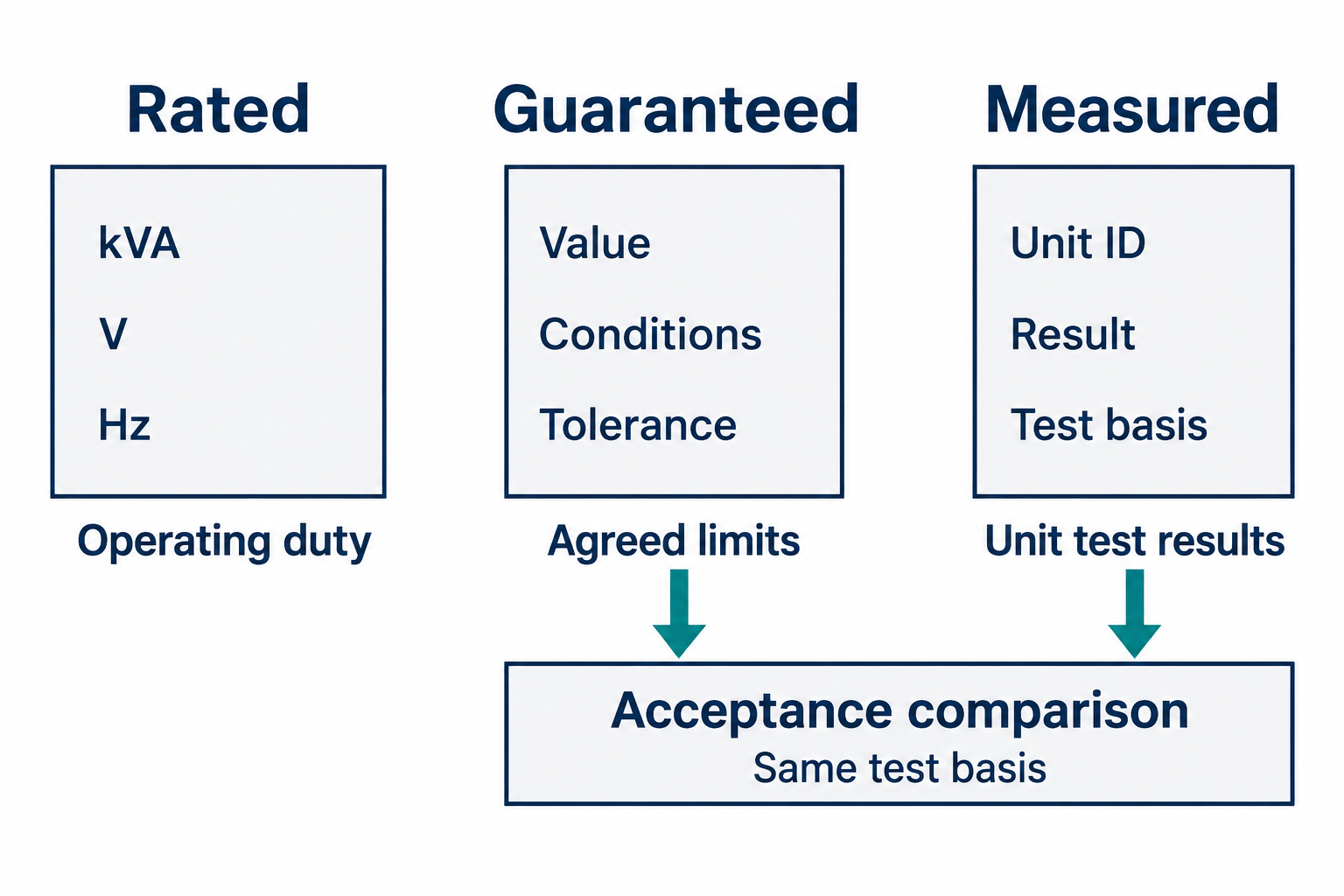
The same discipline applies to test reports. A report for another transformer may provide design-related evidence where the applicable standard permits it, but it does not record measurements from the unit being delivered. For unit-specific results, require identification that links the report to the supplied equipment.
Specify the test schedule rather than asking only for “FAT.” HPS’s dry-type catalog distinguishes production tests from type tests, illustrating why the words “factory tested” do not define the full scope.[2] A useful schedule names ratio checks, loss and impedance measurements, and dielectric tests separately from any requested temperature-rise, sound, or impulse tests. The transformer type and selected standard determine which tests belong in the required scope.[1][2] State the reports to be supplied and any project witness points in the same schedule.
Transformer RFQ checklist
Copy the fields below into an inquiry. Where the project design has not settled a value, identify the open decision and request a clearly labeled proposal. That is preferable to presenting a supplier’s assumption as an approved requirement.
| RFQ field | Information to provide or request |
|---|---|
| Project and quantity | Installation country, application, number of units, new installation or replacement, and required delivery date |
| Electrical system | Primary and secondary voltages, phase, frequency, winding connections, neutral arrangement, and single-line diagram |
| Required capacity | kVA basis, load schedule, largest starting load, significant nonlinear loads, and identified future additions |
| Construction and cooling | Required transformer type, cooling arrangement, and the capacity associated with each cooling stage where relevant |
| Site conditions | Indoor or outdoor location, ambient temperature range, altitude, exposure conditions, ventilation constraints, and project sound limit if specified |
| Insulation and thermal limits | Required BIL or impulse withstand level, relevant winding or terminal, temperature-rise limits, and dry-type insulation class where applicable |
| Taps and impedance | Tap range, steps, operating method, required impedance or acceptable range, and the applicable rating basis |
| Guaranteed performance | Separate no-load and load losses, any efficiency requirement, reference conditions, and acceptance tolerances |
| Mechanical interfaces | Space limits, cable entry, terminal details, access requirements, mounting interfaces, and existing drawings for replacements |
| Included equipment | Required protection, switching, monitoring, accessories, and explicit supply exclusions |
| Standards and approval | Governing standards and editions, utility requirements, and any required listing or certification tied to the offered configuration |
| Documents and tests | Completed technical schedule, deviation list, revision-controlled drawings, test schedule, report requirements, and any witness points |
Ask the supplier to return the technical schedule with a response to each requirement and a separate deviation list. “Complies” should refer to an identifiable requirement, not to an entire inquiry containing unresolved choices.
Before comparing commercial offers, resolve differences that affect connection compatibility, operating duty, guaranteed performance, or included equipment. Keep shipping terms, payment terms, and other commercial differences in the quotation comparison; they should not obscure whether suppliers are pricing equivalent technical scopes.
Transformer specifications FAQ
Send the electrical duty, load schedule, installation conditions, quantity, and required delivery date. Add the single-line diagram and available interface drawings. If a design choice is still open, identify it and ask the supplier to state the proposed value and its basis, rather than treating an assumption as an approved requirement.
No. In the example, 320 kW at 0.80 power factor represents 400 kVA of load demand. The final transformer rating still needs a sizing review that includes starting load, harmonics, ambient temperature, and identified future additions. The calculation is a starting point, not an equipment selection.
Use the nameplate and existing drawings as reference material, then describe any changes in load, voltage, connections, or installation interfaces. Matching kVA and footprint alone does not show that the new terminals will be reachable from the existing cables.
Name the required tests and reports rather than relying on the label FAT. Ratio checks, loss and impedance measurements, and dielectric tests should be distinguished from any requested temperature-rise, sound, or impulse tests. Define the scope using the transformer type and applicable standard, and record any witness points and unit-identification requirements.
Put the specification to work
If the transformer type is still open, view related transformers to narrow the product category. Once the electrical duty and installation interfaces are defined, send a project RFQ with the completed checklist, single-line diagram, and available drawings. Where a design decision remains open, ask for the proposed value and its basis to be stated explicitly in the offer.
Sources
[1] Hammond Power Solutions: Transformer Basics and Terminology
[2] Hammond Power Solutions: Dry-Type Medium-Voltage Transformer Catalog
[3] U.S. Department of Energy: Distribution Transformers
[6] what are non linear loads and why are they a concern today
[7] why is impedance important when specifying a transformer
[8] how do you properly size a distribution transformer
[10] Hammond Power Solutions: Sentinel Selection Guide, Typical Performance Data
[11] Hammond Power Solutions: What Does BIL Mean?
[12] Hammond Power Solutions: kVA Calculator
