Request a Quote
Share your product list, technical ratings, quantity and delivery destination.
Prepare a switchgear replacement RFQ with equipment records, site dimensions, interface details, outage limits and clear scope responsibilities.
Before requesting a switchgear replacement quotation, collect the existing equipment identification, current drawings, site dimensions, electrical interfaces and permitted outage window. State which equipment must stay, what may change, and who will approve the design and site work. These inputs let suppliers price the same scope and identify where a survey or engineering review is still needed.
Start with the reason for the project: an unsupported breaker, damaged equipment, additional load, a protection upgrade or a wider plant change. An enquiry that says only “replace the old switchgear” leaves suppliers to make different assumptions about the work.
Replacement may mean a new device inside an existing assembly, selected modifications, or a new lineup. Suppliers also use terms such as retrofit, retrofill and modernization for different arrangements. Eaton’s modernization guide distinguishes several approaches, including circuit-breaker replacement and changes to existing equipment.[1] Put the retained and replaced items in writing.
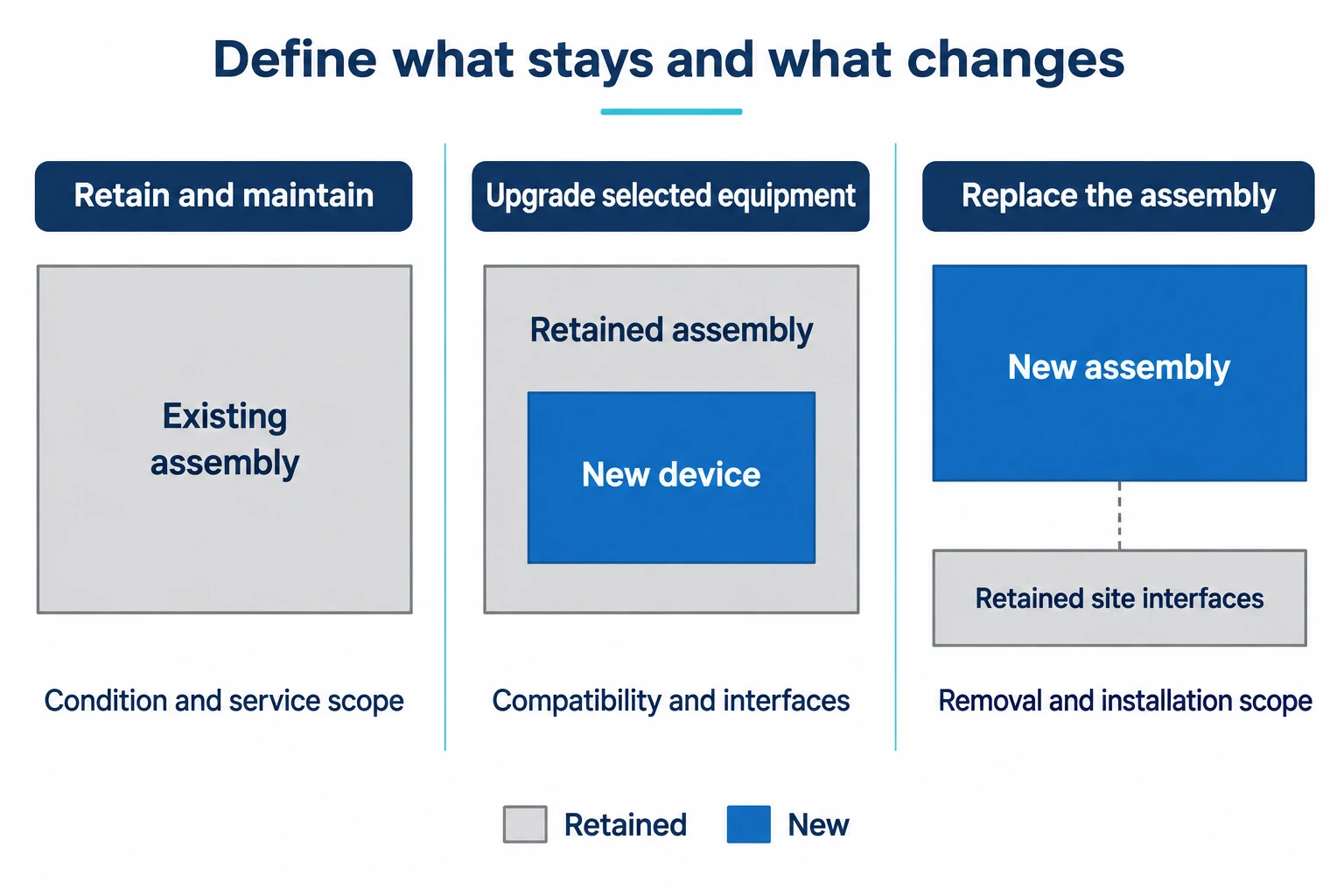
Use the following matrix to frame the discussion. The responsible engineer must confirm whether the retained equipment is suitable.
| Route to evaluate | When it belongs in the discussion | What the enquiry must establish |
|---|---|---|
| Retain and maintain | The required circuit duties are unchanged and a condition assessment supports continued use. | Condition findings, service scope, available support and remaining concerns. |
| Upgrade selected equipment | A breaker, protection or control change could meet the project need while retaining part of the assembly. | The exact retained equipment, replacement interfaces and evidence supporting the proposed modification. |
| Replace the assembly | The proposed duty, condition or layout makes a new assembly a candidate. | New equipment scope, reused site interfaces, removal work and installation responsibilities. |
Ask suppliers to identify each exception to your preferred route. A proposal that retains the enclosure but changes the breaker and control wiring needs a different scope from one that removes the entire lineup.
Build a record for each lineup and feeder. Include the assembly manufacturer, type and serial number, together with readable rating-plate photographs. Identify the installed breaker, protection relay and operating mechanism separately.
ABB’s HA retrofit brochure, for example, requests rating-plate data, serial numbers, photographs and the existing functional circuit diagram.[3] Those requirements apply to that product family, but they illustrate why a description such as “old vacuum breaker” is insufficient for a replacement enquiry.
Attach the latest available single-line diagram, general arrangement and control schematics. Record revisions and known site changes. If the drawings have not been checked against the installation, mark them as unverified and identify who will complete that check.
Include inspection findings, maintenance records and known damage or operating problems. A clear photograph can identify equipment; it cannot establish the condition of every retained component. ABB’s MNS manual calls for a detailed assembly evaluation before an extension or upgrade.[4] Arrange any internal inspection through qualified personnel under the site’s approved access procedures.
Record the required voltage, current, frequency and fault duty, with the engineer’s basis for those requirements. If the replacement serves a changed supply or load, flag the change for review. The medium-voltage switchgear guide provides background on the equipment scope and specification fields.
Measure the delivery route and the installed space as separate checks.

For delivery, record the unloading location, access openings, corridor turns and changes in floor level. Ask the supplier for shipping-section dimensions, weights and handling requirements. Have the installation contractor compare them with the route and confirm any restrictions on lifting or floor loading.
For the installed layout, record the available footprint, ceiling obstructions, foundations, trenches and existing fixing locations. Show the space needed to operate doors, withdraw equipment and perform the maintenance tasks required by the proposed design.
Schneider Electric’s Masterclad instructions relate installation to factory order drawings and include requirements for the foundation and access around the lineup.[5] Obtain the proposed model’s drawings and instructions before accepting a layout. Dimensions from a different product manual do not establish the required space for your replacement.
Include ventilation, moisture exposure and other environmental constraints in the survey. ABB’s MNS extension checklist addresses shipping sections, cable entry, ventilation and the operating environment together with electrical information.[4] A cabinet footprint alone leaves those checks unresolved.
List every cable or bus connection that the proposal must reuse. For cables, record entry direction, quantity, construction, size and the termination details available. Have the survey confirm usable cable length and routing space. For a retained bus interface, request the connection drawing and dimensions needed by the proposed assembly supplier.
Consider a hypothetical replacement with bottom-entry cables. The new cabinet fits the room, but its connection points sit farther from the existing cable ends. The enquiry should ask the supplier and installer to confirm whether the cables reach, whether terminations can be reused, and who prices any required changes. A drawing showing only the outside cabinet dimensions cannot answer those questions.
ABB describes replacement compatibility in mechanical, electrical and functional terms, including accessories, configuration and wiring.[2] Require a written interface review for the actual equipment combination.
Collect the existing relay or trip-unit details, sensing inputs, control-supply information and wiring diagrams. Identify remote commands, indications, communications and interlocks that the project must retain or change.
Assign responsibility for the protection study and settings. Ask the designer to review supply or load changes and specify the information needed for that review. ABB’s extension services explicitly include system and relay coordination studies, illustrating that integration can involve more than equipment dimensions.[6]
The RFQ should distinguish hardware supply from settings preparation, wiring changes, software configuration and site testing. A relay listed in the bill of materials does not tell the buyer who will configure it or verify its operation in the completed system.
State the maximum outage window, any circuits that must remain available and the site’s approval requirements. Ask the project team to separate preparation that can be completed beforehand from work that depends on the outage.
Request a proposed schedule with dependencies: approved drawings, equipment delivery, site readiness, installation, testing and acceptance. Record who owns each activity and who may authorize the return to service. The schedule must also address what happens if an interface mismatch or failed acceptance check prevents completion within the planned window.
Agree the inspection and test requirements before comparing prices. Distinguish factory checks on the supplied equipment from site checks on the installed system. Request the applicable procedures, reports, witness requirements and acceptance responsibilities; the selected equipment and project specification determine the details.[5]
If removal, disposal, cable work or temporary supply is required, give each item an owner. List any handling requirements identified for the existing equipment. Confirm whether these activities are included in the supplier’s offer or must be arranged separately.
Use a document index and an open-item list with the enquiry. The following template gives each unresolved item somewhere to go without hiding it inside a general project description.
| RFQ record | Attach or identify | If information is missing |
|---|---|---|
| Existing equipment | Lineup and feeder IDs, rating plates, device details and condition records. | Assign an identification or condition survey. |
| Required scope | Retained/replaced list, required circuit duties and known project changes. | Ask for clearly separated alternatives and assumptions. |
| Drawings | Single-line diagram, layout, wiring and connection drawings with revisions. | Mark unverified drawings and name the reviewer. |
| Site and interfaces | Delivery route, installation space, foundation, cable and bus connections. | State which dimensions require site confirmation. |
| Protection and controls | Required functions, supplies, settings responsibility and remote interfaces. | Identify the design owner and outstanding inputs. |
| Programme and acceptance | Outage limit, delivery constraints, test requirements and handover responsibilities. | Request a provisional schedule with dependencies. |
| Commercial boundaries | Equipment, engineering, transport, site work, removal and exclusions. | Require separate prices or an explicit exclusion. |
Ask each supplier to return a configuration schedule, layout, interface notes and a deviation list. Require any unverified site condition to appear as an assumption in the offer. For an early budget enquiry, distinguish a provisional allowance from a confirmed supply item and state what must be checked before an order.
Use HJD’s project enquiry page to prepare the enquiry, then attach the drawings in your email app before sending. Ask for confirmation of the equipment supply scope and outstanding inputs. Agree any required survey, site modification or commissioning service separately with the party responsible for it.
A device replacement or upgrade may be an option, subject to the retained assembly’s condition and verified compatibility. Request the proposed device identification and the mechanical, electrical and functional interface assessment.[2] State exactly which existing parts remain in service.
No. ABB’s replacement guidance also addresses configuration, accessories and wiring.[2] Ask the supplier to confirm the complete interface, including the operating arrangement and required protection or control functions, for the specific equipment being offered.
A useful quotation separates equipment from engineering, delivery and site work. Provide the retained/replaced list and identify removal, cable changes, testing and temporary-supply requirements. Compare the total stated scope and exclusions; an equipment-only price leaves those project costs unpriced.
Request a duration tied to the proposed equipment, site conditions and work sequence. It should identify work completed beforehand, tasks within the outage, acceptance checks and contingency arrangements. Have the supplier and site contractor resolve the dependencies before committing to the outage window.