Request a Quote
Share your product list, technical ratings, quantity and delivery destination.
Compare air-insulated and gas-insulated switchgear by installed space, maintenance, gas obligations and the evidence needed for a project quotation.
Start with the installation and the maintenance plan. Keep air-insulated switchgear on the shortlist when the room can accommodate the proposed lineup and its access requirements. Give gas-insulated switchgear alternatives particular attention when space is constrained or isolating primary components from the surrounding atmosphere matters. Then compare the actual offers: neither label establishes the better design for your project. [1][4]
A useful air insulated switchgear vs gas insulated switchgear comparison separates four questions: electrical duty, installed space, service access and lifecycle obligations. This guide addresses enclosed medium-voltage switchgear. Do not apply a space ratio from an outdoor high-voltage substation to an indoor distribution room.
In AIS, atmospheric air provides insulation around relevant live parts. In GIS, the relevant primary components sit within a sealed gas-filled compartment. Solid insulation, cable terminations and separate low-voltage compartments may still form part of either assembly. Ask which compartments use which insulation rather than treating every part of the lineup as identical. [1][2][4]
The insulation medium and the circuit breaker’s interruption medium are separate specifications.
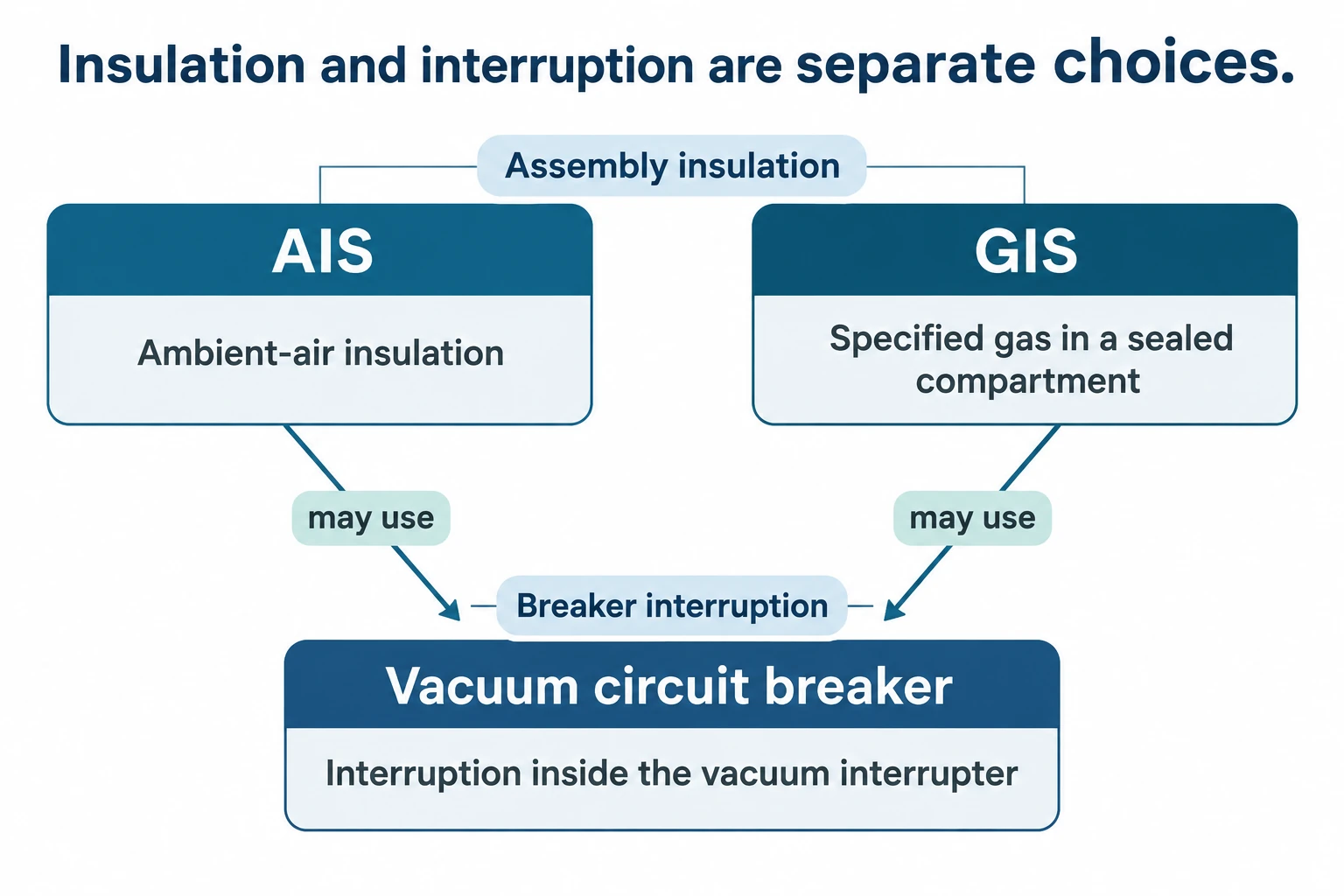
A vacuum circuit breaker describes where interruption occurs; it does not tell you how the surrounding assembly is insulated. Siemens documents vacuum circuit breakers in both its NXAIR air-insulated range and its NXPLUS C 24 gas-insulated design. These examples establish the distinction, not a specification or capability for HJD equipment. [2][3]
GIS also does not automatically mean SF₆. The Siemens example uses Clean Air, while the referenced ABB ZX2 catalogue describes SF₆ and AirPlus configurations. Record the exact gas, compartment design and operating conditions for the offered model. “SF₆-free” alone does not describe its full construction or service requirements. [2][4]
Hold the single-line diagram, voltage, continuous-current requirements, fault duties and protection functions constant. Otherwise, a compact ring-main arrangement may appear preferable simply because it provides fewer functions than the AIS lineup beside it.
| Decision point | What to check in an AIS offer | What to check in a GIS offer |
|---|---|---|
| Electrical duty | Assembly ratings and switching/protection functions | The same ratings and functions, including interfaces |
| Installed space | Lineup, operating aisles and component-removal space | Lineup plus cable, service and pressure-relief space |
| Environment | Conditions around air-insulated compartments and exposed interfaces | Sealed-compartment boundary and conditions for everything outside it |
| Planned maintenance | Accessible components, required isolation and inspection schedule | Accessible components, monitoring and sealed-compartment service scope |
| Fault recovery | Replaceable assemblies, spares and restoration procedure | Repair or replacement route for the affected compartment or module |
| Expansion | Extension interface, reserved space and outage requirements | Extension interface, gas-work requirements and outage requirements |
| Lifecycle obligations | Inspection, repairs, replacements and end-of-life handling | The same items plus the specified gas-management obligations |
The relevant construction and installation details vary between product families. The cited manufacturer documents illustrate why an offer needs a drawing and service instructions alongside its name. [2][3][4]
Gas-insulated designs can provide compact primary arrangements, but a panel-width comparison is not a room-layout check. ABB’s ZX2 catalogue separately specifies operating aisles, installation and maintenance areas, room heights and pressure-relief arrangements. Those requirements remain after the cabinet footprint has been drawn. [4]
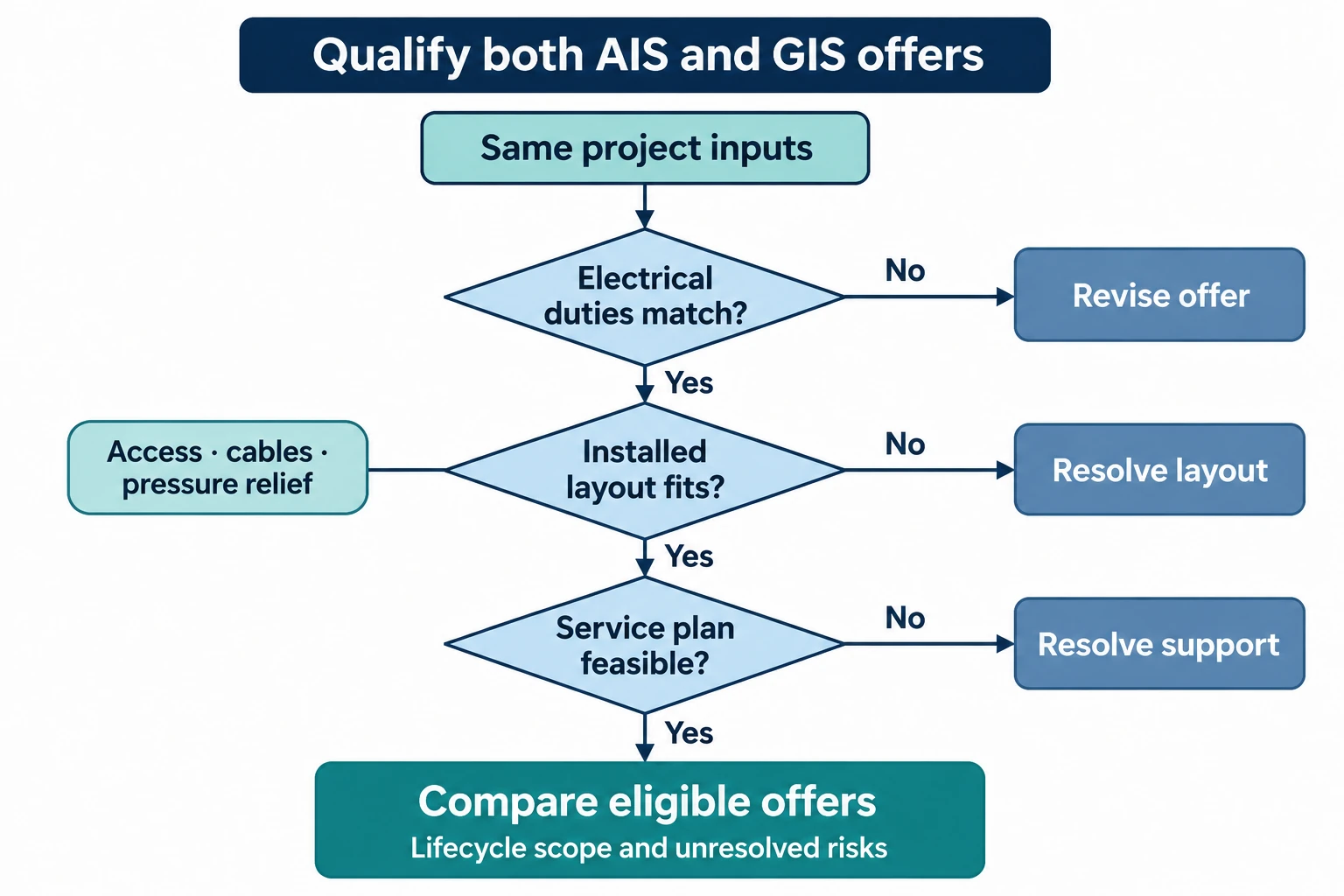
Ask both suppliers to place their offered lineup on the same room drawing. Include cable entry, termination access, door movement, the removal route for replaceable equipment, and space reserved for future panels. Identify which wall distances and access zones are mandatory for that configuration. For an occupied building, include replacement access and outage planning in this layout review.
Compare the complete installed arrangement, including access, cable interfaces and pressure relief, on one room drawing.
For example, a narrower lineup may still be unsuitable if its cable connections cannot be assembled in the available trench or its replacement module cannot pass through the doorway. Resolve those interfaces before accepting a footprint advantage. Do not invent clearance allowances; use the supplier’s installation drawing and the applicable project requirements.
Internal-arc arrangements also affect the building. The ABB guide distinguishes pressure relief inside the room from discharge outside it and identifies a hazardous area at an external outlet. Confirm the tested installation conditions, discharge route and surrounding access restrictions for the actual offer. GIS construction alone does not establish internal-arc performance. [4]
A sealed primary compartment can separate enclosed components from dust, moisture and polluted air. It does not place the entire installation inside that protected volume. ABB’s catalogue distinguishes gas compartments from cable and low-voltage areas and still gives room conditions and heating requirements for particular environments. [4]
Describe the site: indoor or outdoor placement, temperature range, altitude, condensation, salt exposure, conductive dust and any flooding risk. Ask the supplier to identify which conditions the offered assembly accepts and which require changes to the room, enclosure or equipment.
Prioritize a sealed-compartment option when atmospheric exposure is a significant project constraint and the offered design addresses it. Do not accept “GIS” as a substitute for checking cable interfaces, secondary equipment or outdoor suitability. For AIS, assess whether the specified installation environment and inspection arrangements are realistic for the site. [1][4]
“Maintenance-free” needs a defined boundary. In the NXPLUS C 24 catalogue, Siemens attaches conditions to its vacuum-breaker maintenance statement. ABB describes gas-density monitoring in ZX2. Neither document supports treating every protection, control and auxiliary function in every GIS installation as exempt from inspection. [2][4]
Ask each supplier for an itemized schedule: what must be inspected or tested, at what interval or operating count, and under which service conditions. Separate primary-compartment work from breaker mechanisms, relays, auxiliary supplies and cable interfaces. Have the maintenance owner confirm that the tasks and isolation requirements fit the site.
Then walk through a failure scenario on paper. If one functional unit fails, what must be isolated? Which component or module is replaced? Can the work be performed locally, and what specialist support, tooling and spare parts are required? Obtain the supplier’s method rather than assuming that accessible AIS is always quick to repair or that sealed GIS must always be replaced as a complete lineup.
Expansion also needs a model-specific answer. Siemens documents extension and panel replacement without gas work for the cited NXPLUS C 24 design. That is a useful question to put to other suppliers, not a promise that applies to every GIS product. Confirm the connection method, compatible future panels, outage boundary and reserved installation space. [2]
Request comparable cost schedules for the same project period and duties. Include the equipment, room or civil-work changes, cable accessories, installation, commissioning, planned maintenance, spares, specialist visits and eventual removal. Treat outage consequences separately if the owner cannot justify a monetary estimate.
Do not assign an automatic purchase-price or lifetime-cost advantage to either technology. A quotation that omits building modifications or a specialist service obligation is not directly comparable with one that includes them.
For a gas-insulated offer, require the gas designation, compartment arrangement, monitoring method, permitted operating conditions and instructions for abnormal indications. ABB’s ZX2 example uses temperature-compensated density monitoring; the alarm behavior and permitted conditions belong to that documented configuration. Do not transfer its thresholds to another product. [4]
Ask who is responsible for gas-related service, recovery and end-of-life handling where these apply. Before ordering, have the supplier and project compliance team check destination-specific rules against the actual gas, voltage class and installation date. Retain that assessment with the quotation; neither “GIS” nor “SF₆-free” is a complete compliance statement.
Provide the following inputs to every bidder:
For assemblies within its scope, IEC 62271-200 covers AC metal-enclosed switchgear above 1 kV through 52 kV, at service frequencies up to 60 Hz. Cite the applicable project standard and edition explicitly; the AIS or GIS label does not demonstrate conformity. [5]
Request a marked-up layout, offered configuration, maintenance plan, relevant verification evidence and written deviations.
Keep transformer-side inputs consistent with the upstream equipment; the transformer specification checklist can help organize that interface.
Shortlist the offer that meets those requirements with an installation and service plan your team can carry out. Where both qualify, compare their lifecycle scope and unresolved risks. Where one fails a mandatory room, duty or support requirement, resolve that failure before negotiating price.
To start an HJD quotation discussion, prepare the single-line diagram, site conditions and layout constraints. Request written confirmation of the proposed equipment, supply boundary and deviations before treating it as a compliant offer.
No universal installed-space ratio is dependable. GIS can reduce primary-equipment space, but the offered arrangement still needs operating and service access, cable connections and a suitable pressure-relief arrangement. Compare both complete installations on the same room drawing, with the same electrical functions. [4]
Specify the duties, installation constraints and maintenance requirements first. Keep either technology eligible if it meets those requirements. Ask for configuration-specific drawings and service evidence, then exclude offers that cannot meet a mandatory condition. This produces a clearer comparison than choosing a technology name before checking the site.