Request a Quote
Share your product list, technical ratings, quantity and delivery destination.
Learn what low voltage switchgear includes, how breaker and assembly ratings differ, and what to specify before requesting a project quotation.
Low voltage switchgear controls, protects and isolates low-voltage electrical circuits.[1] When buying an assembled board, you need to specify the complete system: switching devices, busbars, internal connections, controls and enclosure.[4] A circuit-breaker datasheet covers only part of that purchase.
Start with the supply voltage, load requirements and prospective short-circuit current at the installation point. Then check whether the proposed assembly, its devices and its installation conditions match those inputs. A breaker marked with a high kA value does not, by itself, establish the short-circuit capability of the complete board.[5][6][8]
For power switchgear and controlgear assemblies within IEC 61439-2:2020, the published scope covers rated voltages up to 1,000 V AC or 1,500 V DC.[2] Those are scope limits, not operating ratings for every product described as low voltage switchgear.
State the actual voltage, AC or DC supply and frequency in the enquiry. Check the declared operating voltage of each device rather than assuming that a familiar enclosure or model name establishes suitability.[6][8]
On an IEC-based project, identify the applicable assembly standard and edition. IEC 61439-1 gives general rules; conformity assessment also uses the relevant subsequent part, such as IEC 61439-2 for power switchgear and controlgear assemblies.[3] Ask the supplier to identify that basis in the quotation.
An incoming circuit receives the supply, a busbar system distributes it, and outgoing circuits feed individual loads or downstream distribution equipment.[4] The functional groups below help define the supply boundary.
The complete assembly includes the devices, busbars, internal connections and supporting enclosure.[3][4]
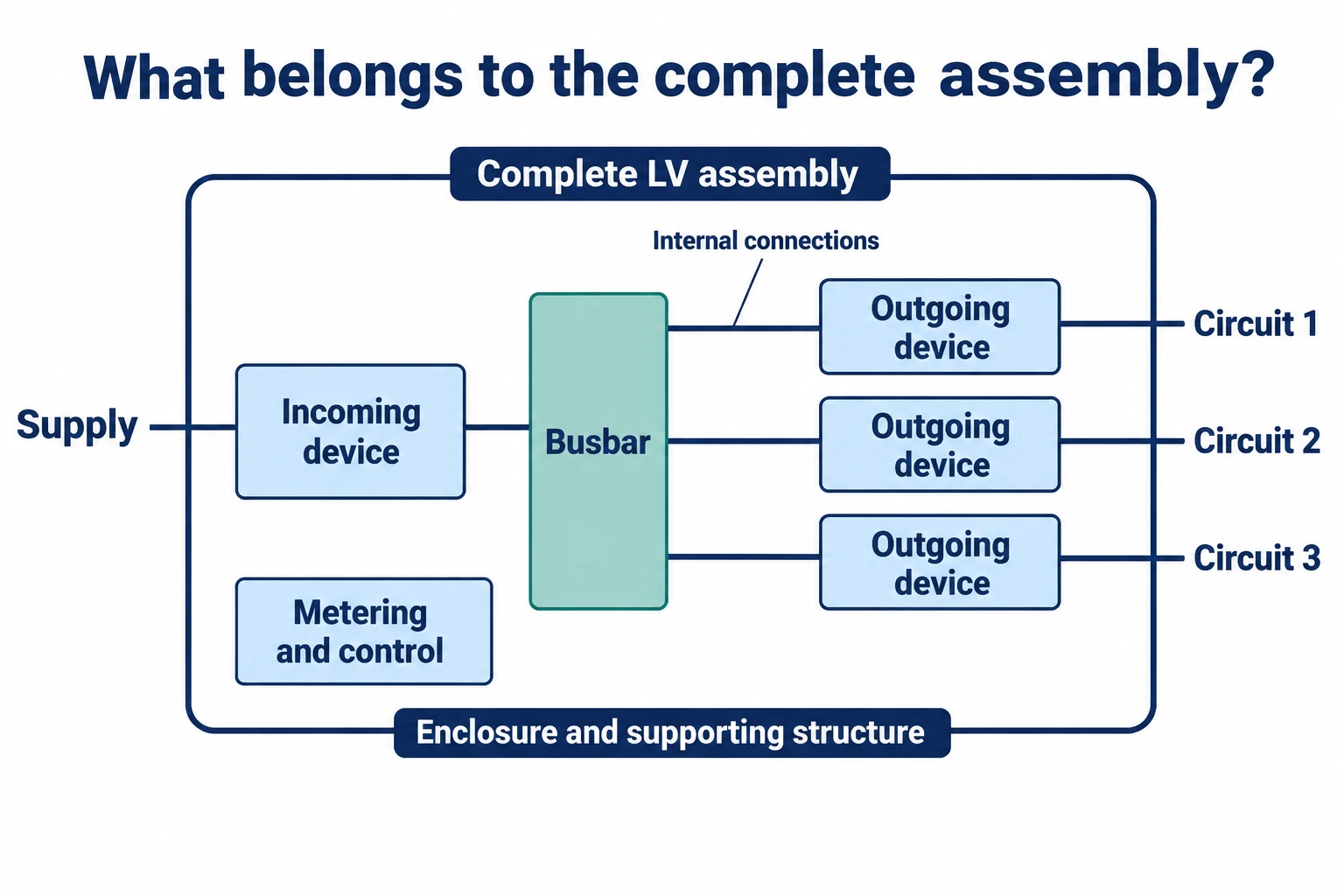
Ask for a single-line diagram and a general arrangement drawing alongside the component list. Use them to check what the supplier includes, where cables terminate and which functions need separate equipment. A list of breaker brands cannot answer those layout questions.
The terms can overlap in IEC-oriented distribution discussions. Schneider Electric describes distribution switchboards as assemblies of functional units and relates their construction to IEC 61439.[4] That makes the product label alone a weak basis for comparing offers.
For a tender, compare the stated assembly standard, construction, device arrangement and declared ratings. If two suppliers use different names, ask them to map their offers against the same specification.
Continuous current describes a different duty from interrupting a fault.[6][10] Record the quantity, the equipment it belongs to and its conditions in separate quotation fields.
The assembly’s declared current applies to its particular arrangement and temperature-rise limits.[10] A large incoming breaker frame does not establish how much current the complete board can carry under the project’s conditions.[10]
Provide the load schedule and identify circuits expected to operate together. Ambient temperature, the enclosure and the application affect device selection; avoid applying a single generic derating percentage to every configuration.[8] Ask the supplier to state the loading and cooling assumptions behind the offered assembly rating.
For industrial circuit-breakers under IEC 60947-2, Icu is the rated ultimate short-circuit breaking capacity. It concerns the device’s interruption duty under the applicable test conditions.[6] Ics is the rated service short-circuit breaking capacity, associated with a test sequence and subsequent service-performance checks.[7]
Read both at the relevant operating voltage. Keep the exact breaker model and trip unit in the technical schedule.[6][8] An Ics value is not permission to re-energize damaged equipment after a real fault; fault investigation and the manufacturer’s inspection requirements remain necessary.
For an assembly, Icw is a short-time withstand current expressed as an RMS current with a specified duration. Ipk is the peak short-circuit current the assembly is declared to withstand under specified conditions.[5]
Read breaker breaking capacity and assembly withstand as separate requirements, even when both are expressed in kA.[5][6]

Also check which equipment owns a rating: certain circuit-breakers have their own Icw, which does not automatically establish the assembly’s Icw.[7] If an assembly is offered with conditional short-circuit current Icc, obtain the specified protective-device combination and conditions on which that declaration depends.[5]
Selectivity and back-up protection need separate attention. Use the manufacturer’s applicable coordination data for the exact device combination and voltage; a larger upstream breaker or a familiar brand name does not establish coordination.[9]
Consider a hypothetical enquiry for a 400 V AC board with a calculated prospective short-circuit current of 50 kA at its incoming terminals. These are example project inputs, not HJD product ratings.
A reply stating only “50 kA breaker” leaves several questions open:
Ask for the missing declarations before accepting the offer as equivalent. Do not invent a required Icw duration from the fault-current magnitude alone. The project designer must establish the required fault duty and protection arrangement; the supplier must show how the offered configuration meets them.[5][8][9]
A board can have suitable electrical ratings and still be poorly specified for its location. Give the supplier the ambient conditions and installation environment, then confirm the enclosure and cooling arrangement used for the offered ratings.[2][8]
Use the layout review to settle cable entry, termination space, access sides and the available room envelope. Mark obstructions on the drawing instead of asking only whether the cabinet “fits.” Include the required maintenance access and the route for bringing equipment into the room.
Fixed, disconnectable and withdrawable functional units are different construction arrangements.[4] Choose against the project’s maintenance plan and permitted shutdowns. Ask what must be isolated before removal or servicing; a withdrawable arrangement does not itself authorize live work.
Request evidence covering the offered assembly design and a routine-verification record for the manufactured board. Design verification addresses the design; routine verification checks each manufactured assembly.[4] Component certificates alone do not establish the complete assembly’s conformity.[3]
Use the following checklist to turn an initial product enquiry into a configuration the supplier can review.
| Information to send | What the quotation should resolve |
|---|---|
| Supply system | Actual voltage, AC or DC, frequency, earthing arrangement and source details. |
| Single-line diagram and load schedule | Incoming circuits, outgoing duties, simultaneous loading and planned additions. |
| Fault-study inputs | Prospective fault current at the board and the required assembly short-circuit duty. |
| Protection requirements | Device models, trip units, coordination basis and any back-up protection conditions. |
| Environment and room layout | Ambient conditions, enclosure needs, access, cable entry and termination space. |
| Maintenance requirements | Functional-unit arrangement, permitted outages and required isolation provisions. |
| Standards and acceptance documents | Applicable editions, declared ratings, drawings, design-verification evidence and routine-verification records. |
If the board is transformer-fed, collect the transformer information alongside the LV enquiry. The transformer specification checklist provides a starting point for organizing those inputs; the project’s fault study must establish the fault level at the board.
For an HJD enquiry, send the single-line diagram and the available checklist inputs. Ask HJD to confirm the proposed supply boundary, declared ratings, supporting documents and any unresolved items in writing. This gives you a defined offer to assess before procurement.
No. IEC states that the relevant part from Part 2 onward applies together with the cited requirements of Part 1.[3] Ask which product-specific part and edition apply, then request evidence for the offered configuration.