Request a Quote
Share your product list, technical ratings, quantity and delivery destination.
Compare metal-clad and metal-enclosed switchgear by compartments, maintenance access, protection duties and evidence before requesting project quotations.
The useful difference between metal-clad and metal-enclosed switchgear is the declared construction and what it allows you to maintain. IEEE C37.20.2 defines metal-clad equipment around drawout circuit-breakers and grounded metal compartment barriers.[1] The term metal-enclosed needs more detail: its standard, interrupting devices and compartment arrangement.[2][3]
Choose against the project’s electrical duty and maintenance requirements. A specification that requires metal-clad construction needs an offer that demonstrates it. Where alternatives are permitted, compare the actual protection scheme, access conditions, installation layout and supporting evidence.
This guide concerns medium-voltage assemblies. Within an IEEE-based specification, the relevant distinction is usually between metal-clad switchgear under C37.20.2 and metal-enclosed interrupter switchgear under C37.20.3.[1][2] These terms should appear with the applicable edition in the technical schedule.
IEEE C37.20.2-2025 covers equipment containing electrically operated drawout circuit-breakers and compartmentation using grounded metal barriers.[1] IEEE C37.20.3-2023 covers a range of interrupting and protective devices, explicitly including circuit-breakers alongside switches and fuses.[2] It is therefore inaccurate to assume that all metal-enclosed equipment has a fixed switch and no breaker.
IEC 62271-200:2021+AMD1:2024 covers AC metal-enclosed assemblies above 1 kV through 52 kV.[3] For an IEC-based offer, request the declared service-continuity, partition and internal-arc information relevant to the project. An IEC classification and an IEEE construction designation should be checked against their respective requirements; a similar-looking cabinet does not establish equivalence.
Ask each bidder to identify the standard, edition and offered configuration on the first technical page. This gives the project team a consistent starting point for reviewing deviations.
The public scope of IEEE C37.20.2 describes barriers separating components such as the main bus, instrumentation and incoming or outgoing connections.[1] Those divisions matter because a maintenance task may require access to one area while other parts of the installation have a different permitted operating state.
Grounded metal barriers separate functional areas in the metal-clad construction described by IEEE C37.20.2.[1]
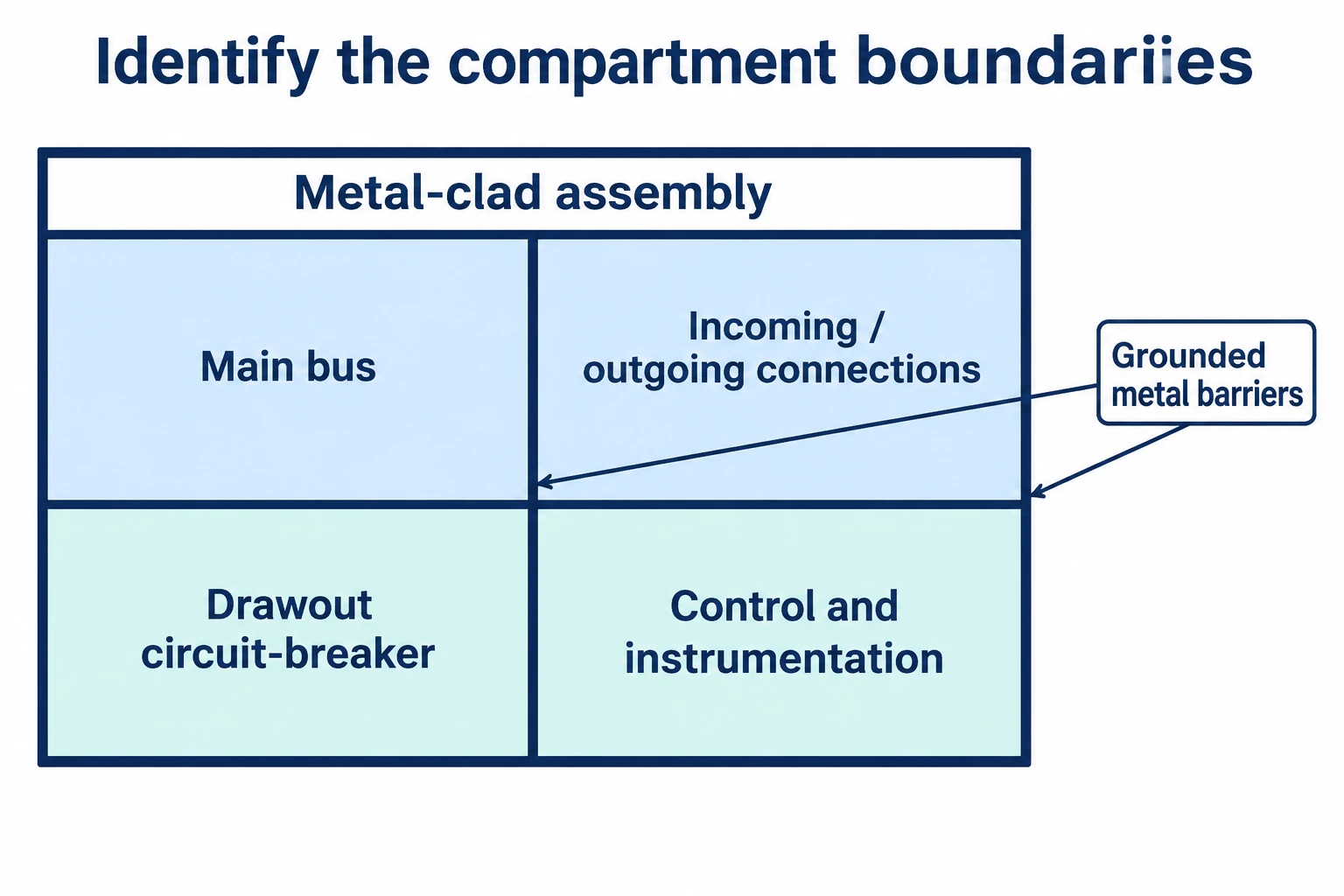
Request a compartment drawing with the offer. It should identify each accessible area, the equipment inside it and the isolation conditions for the task you expect to perform. Door count alone cannot establish where the internal partitions are or what access is permitted.
A useful counterexample comes from Eaton’s MEF design guide. It describes metal-enclosed switchgear with drawout vacuum circuit-breakers, automatic shutters and separation of low-voltage controls from high-voltage circuits.[4] That documented design shows why “metal-enclosed means no compartments” is an unreliable purchasing shortcut.
Compare a named configuration with another named configuration. If the supplier changes the breaker arrangement, cable section or access side during quotation, request an updated drawing before accepting the substitution.
Before comparing construction, establish the required voltage, insulation duty, continuous current and fault duties. Then confirm how the proposed devices detect, interrupt and isolate the required circuits. The two quotations need to address the same project inputs.
A switch-and-fuse arrangement and a breaker-based arrangement divide the work differently. Eaton’s MVS guide, for example, distinguishes the load-interrupting duty of its switch from the short-circuit interruption provided by fuses.[5] A load-interrupter’s operating rating must not be read as proof that it can interrupt the project’s fault current.
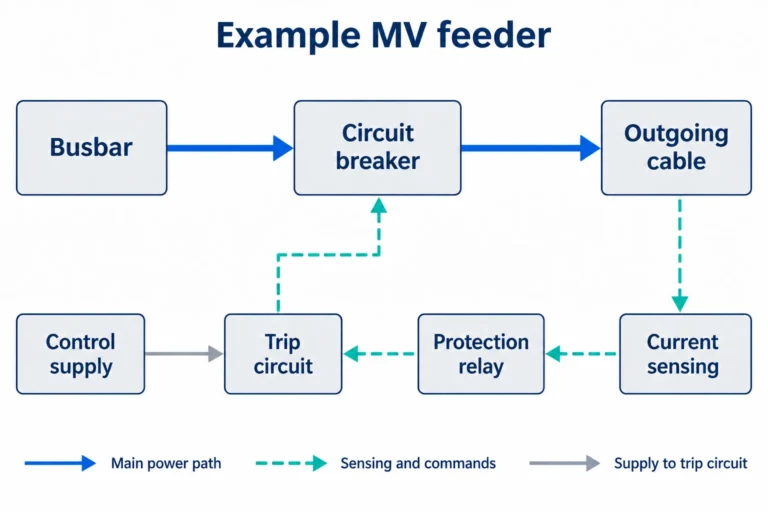
For a breaker proposal, identify the protection functions, trip arrangement and control-power requirements. For a fused proposal, obtain the selected fuse information and coordination basis. Match each solution to the load and operating duties before comparing enclosure construction.[4][5]
Use this schedule to expose differences that a headline voltage or kA number can hide.
| Review field | Metal-clad offer | Other metal-enclosed offer |
|---|---|---|
| Standard and edition | Confirm the specified construction standard. | Identify the exact assembly standard and scope. |
| Electrical duty | Declare the assembly and device ratings. | Address the same project duties and conditions. |
| Interrupting arrangement | Identify breaker, protection and control details. | Identify switches, fuses or breakers and their duties. |
| Compartment boundaries | Provide the barrier and compartment drawing. | Provide the actual partition arrangement. |
| Maintenance access | State isolation and removal conditions. | State the same conditions for the proposed devices. |
| Installation | Show access, cable space and required clearances. | Compare the complete installed arrangement. |
| Verification | Supply evidence for the offered configuration. | Identify the corresponding evidence and deviations. |
If the supply is transformer-fed, the transformer specification checklist can help organize source and interface information. The project fault study must establish the applicable fault duties at the switchgear.
Write the task before selecting an access feature. “Maintain a feeder” could mean removing a circuit-breaker, inspecting its cable termination or working on a bus connection. These tasks do not necessarily require access to the same compartment.
Schneider Electric’s guidance explains service continuity in terms of which other compartments or functional units can remain energized when a particular accessible high-voltage compartment is opened.[6] For an IEC offer, ask the supplier to relate the declared loss-of-service-continuity category, or LSC category, to the exact access task.[7]
LSC2A and LSC2B distinguish conditions within a functional unit, including the state of cable connections when another accessible compartment is opened.[7] Avoid reducing those classifications to “the whole board stays live.” The accessible compartment and the relevant conditions have to be identified.
Partition class is another field. Schneider’s explanation of its LSC2B-PM equipment identifies grounded metal partitions.[8] Record the offered partition class separately from service continuity and internal-arc performance.
For the maintenance review, ask the supplier to mark three things on the drawing: the area being accessed, the parts that must be isolated, and the other circuits permitted to remain in service. Have the project team reconcile that drawing with its operating rules. A withdrawable breaker does not authorize access to energized primary parts.
Shortlist a documented metal-clad arrangement when the tender requires the applicable metal-clad standard, or when its breaker and compartment arrangement matches the project’s protection and maintenance plan. Request configuration-specific evidence of conformity.
Where the tender permits alternatives, retain a metal-enclosed offer if its actual device arrangement meets the required duties and its access conditions fit the maintenance plan. A documented switch-and-fuse design may deserve review for a suitable transformer-feeder duty; check its switching duties, fuse selection and coordination instead of assuming it replaces every breaker scheme.[5]
If both offers meet the electrical requirements but one requires a wider outage for the planned task, put that difference into the comparison. If access information is missing, request it before assigning a maintenance advantage. Unstated conditions should remain open technical items, not become assumed benefits.
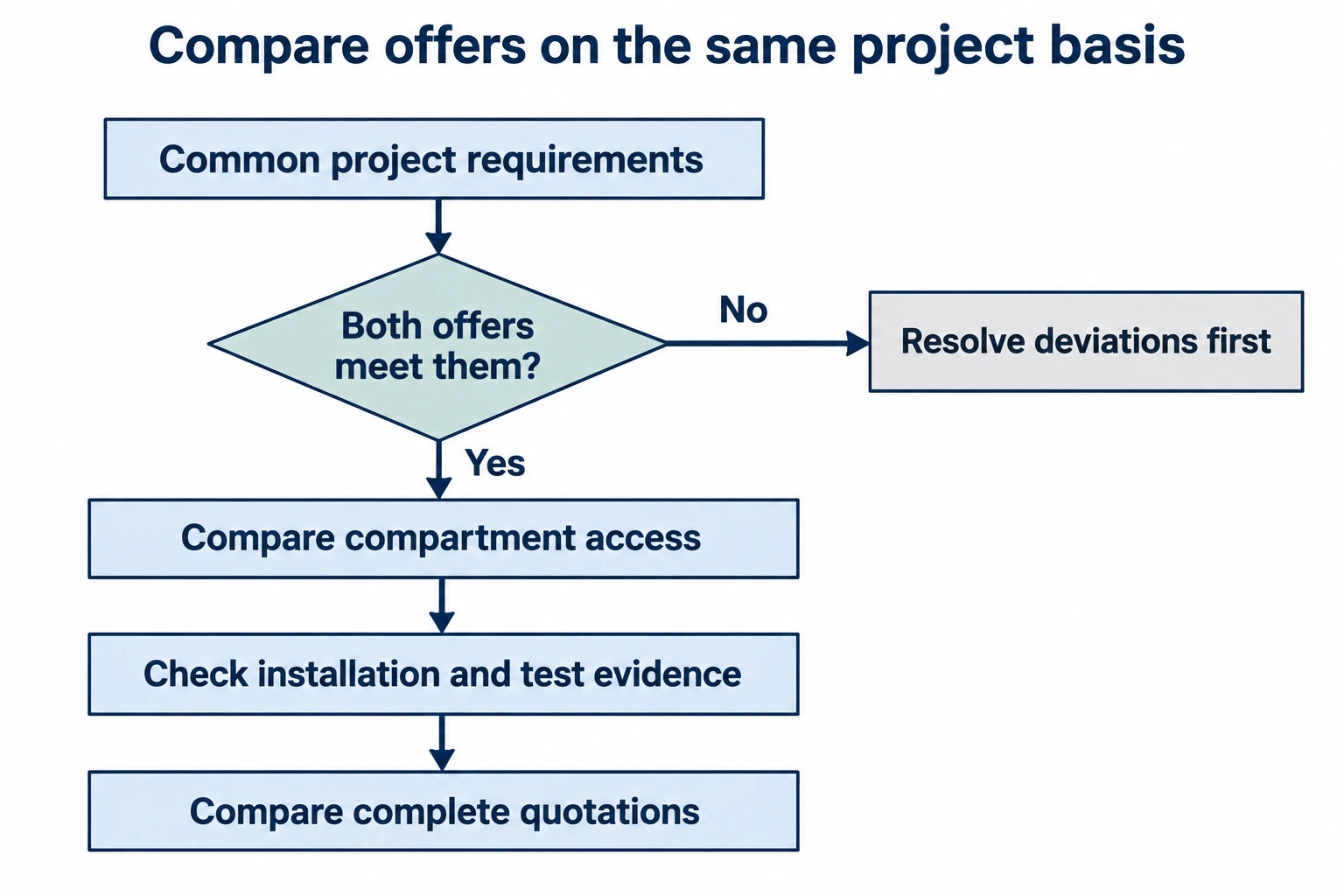
Both offers should meet the same project requirements before you compare their maintenance and installation trade-offs.
Grounded partitions and a metal enclosure do not, on their own, establish an internal-arc performance claim. IEEE C37.20.7-2024 addresses testing and evaluation for internal arcing faults, while IEC 62271-200 includes internal-arc classification and test provisions.[3][9]
If the project requires such performance, ask for the applicable classification, test current and duration, accessible sides, installation conditions and evidence covering the offered arrangement. Where the design uses pressure-relief or exhaust provisions, show them on the installation drawing. The project team should resolve any differences between the tested configuration and the proposed installation.
Keep this review separate from service continuity. LSC describes defined conditions for access and continued service; it is not a substitute for internal-arc evidence.[6][9] Likewise, an equipment fault-withstand figure should not be used as an arc-performance declaration without the corresponding basis.
Request a general arrangement drawing that shows cable entry, termination space, front and rear access requirements and the route for removing equipment. For withdrawable devices, include the space and handling provisions needed for removal.
Do not assign a universal footprint advantage to either name. Eaton’s MEF guide describes a particular front-accessible metal-enclosed design with drawout breakers.[4] That example supports checking the actual arrangement; its dimensions and access provisions cannot be transferred to a different supplier’s product.
For price comparison, list what each quotation includes: protection devices, control power, metering, accessories, documentation, spare components and installation interfaces. Identify room alterations or additional equipment separately. This makes a price difference easier to explain without inventing a percentage saving or an assumed reliability advantage.
Send the same input package to each shortlisted supplier and request a written list of deviations:
For an HJD enquiry, send this package and ask for the proposed assembly standard, compartment drawing and supply boundary in writing. Ask HJD to identify any requirement still awaiting confirmation. Review the resulting offer against the project specification.
The metal-clad designation alone does not establish that claim. Internal-arc performance needs its own applicable test and classification evidence, including the installation conditions.[9] Ask for that evidence when the project requires it.
A matching voltage rating is insufficient. Compare fault interruption, protection coordination, switching duties and the operating functions required by the project. The MVS guide illustrates the distinction between load interruption by a switch and fault interruption by fuses.[5] Any substitution needs an accepted technical review.