Request a Quote
Share your product list, technical ratings, quantity and delivery destination.
Compare switchgear and switchboards by applicable standards, fault ratings, maintenance access, and the documents needed for a clear, comparable RFQ.
When comparing switchgear vs. switchboard, first confirm the equipment standard and duty behind each quotation. Similar voltage and current ratings do not establish that two assemblies have the same fault performance, protection options, or maintenance requirements.[1][2][5]
For conventional distribution, evaluate the proposed switchboard against the actual project requirements. Where the design calls for documented short-time withstand capability, demanding protection coordination, or specific breaker maintenance arrangements, ask each bidder to demonstrate those capabilities. The equipment name is not sufficient evidence.[3][5]
Start the bid comparison with the applicable standard, assembly ratings, protection requirements, and maintenance access. Resolve differences in those items before comparing prices.
This guide focuses on low-voltage power distribution. Compare equipment intended for the same duty and voltage level; a medium-voltage lineup is outside this comparison.
The distinction between switchgear and switchboard needs to be read in the context of the specified equipment standard. For proposals using UL standards, UL 891 covers dead-front switchboards, while UL 1558 covers metal-enclosed low-voltage power circuit breaker switchgear. Both include low-voltage equipment, so voltage alone does not distinguish the two categories.[1][2]
For an IEC-based specification, IEC 61439-2 addresses power switchgear and controlgear assemblies. It includes requirements relating to internal separation and other assembly characteristics. Ask for the applicable assembly standard and the proposed construction rather than assigning equipment to a UL category from its product name.[5]
Put the required standards and conformity-assessment requirements in the RFQ, together with any project-specific requirements. If a supplier proposes an alternative standard, require a documented comparison and approval from the party responsible for the specification. Treat the exception as unresolved until that review is complete.
Use the same comparison sheet for every bidder. Separate the complete assembly’s ratings from the ratings of the breakers and other components inside it.
| Comparison item | What to ask | Evidence to request |
|---|---|---|
| Equipment category | Which assembly standard and edition does the offer meet? What deviations are proposed? | Compliance schedule and applicable certification or verification documents. |
| Electrical duty | What voltage, frequency, continuous current, and operating conditions apply? | Model-specific assembly rating schedule. |
| Fault performance | What short-circuit ratings apply, and is a short-time withstand rating required? | Rating conditions, supporting documents, and current plus duration where applicable. |
| Protection | Which breaker models, trip units, and settings are included? | Device schedules and data for the protection study. |
| Internal separation | How are functional units, busbars, and cable connections separated and accessed? | Internal arrangement drawings and relevant verification documents. |
| Breaker replacement | Is the breaker fixed, plug-in, or drawout, and what must be isolated for replacement? | Manufacturer’s maintenance procedure and access drawings. |
| Installation | What cable-entry locations, working access, and handling space does the assembly need? | General arrangement and installation drawings. |
For a comparison specifically between UL 891 switchboards and UL 1558 power circuit breaker switchgear, the distinction in short-time performance deserves attention. UL 891 expressly excludes switchboards with short-time current ratings; UL 1558 switchgear is commonly evaluated where that capability and demanding coordination are required.[1][3]
For an IEC-based offer, assess the declared assembly ratings and construction against the IEC-based specification. Do not apply the UL 891 exclusion as a blanket rule to every product marketed as a switchboard.
A quotation might list voltage, bus amperes, and a single kA figure. Ask what that figure describes.
A breaker’s interrupting rating concerns the fault current it can interrupt under specified test conditions. A short-circuit current rating concerns equipment performance under specified short-circuit conditions. These are different ratings, and the voltage and protective-device conditions matter.[4]
For procurement, request separate entries for:
The third entry needs particular care. Where an offer is based on UL 891, its short-circuit rating must not be presented as an assembly short-time current rating: the standard excludes switchboards with those ratings.[1]
For offers under other applicable standards, request the declared assembly withstand current, duration, and supporting verification. Keep the classification and evidence tied to the actual specification.
Use the same discipline with breaker data. If a quotation shows a short-time figure, ask whether it applies to the breaker or the complete assembly. Request the supporting document and the duration; a current value alone does not answer the question.
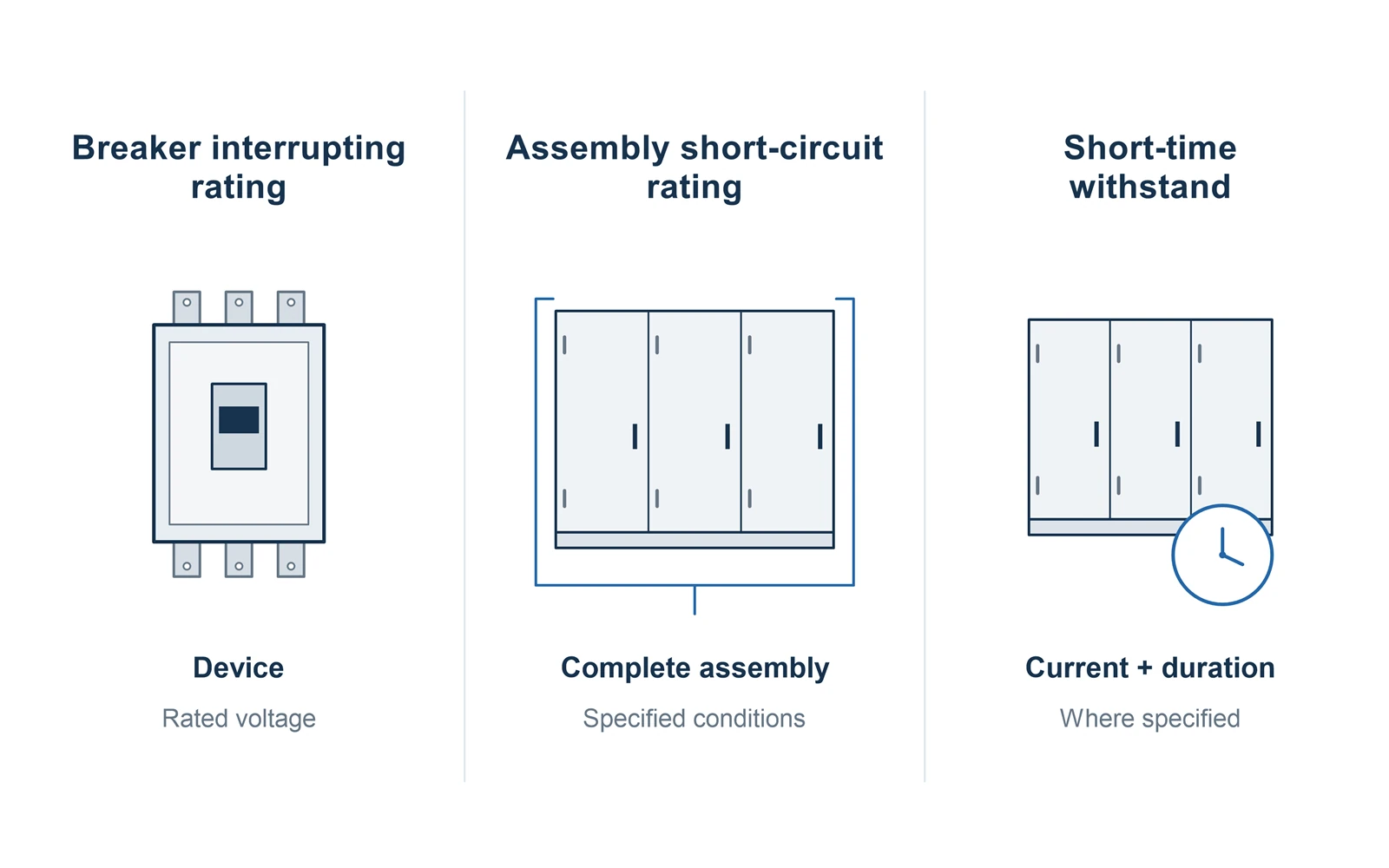
For example, two hypothetical offers could state the same rated voltage, bus current, and “65 kA.” That is still an incomplete comparison. One supplier may be quoting an assembly short-circuit rating while another is emphasizing a breaker rating. Ask both to fill in the same rating schedule before evaluating either offer.
Selective coordination aims to isolate a fault with the nearest protective device while leaving unaffected upstream sections energized. It depends on the devices, settings, and available fault currents.[3]
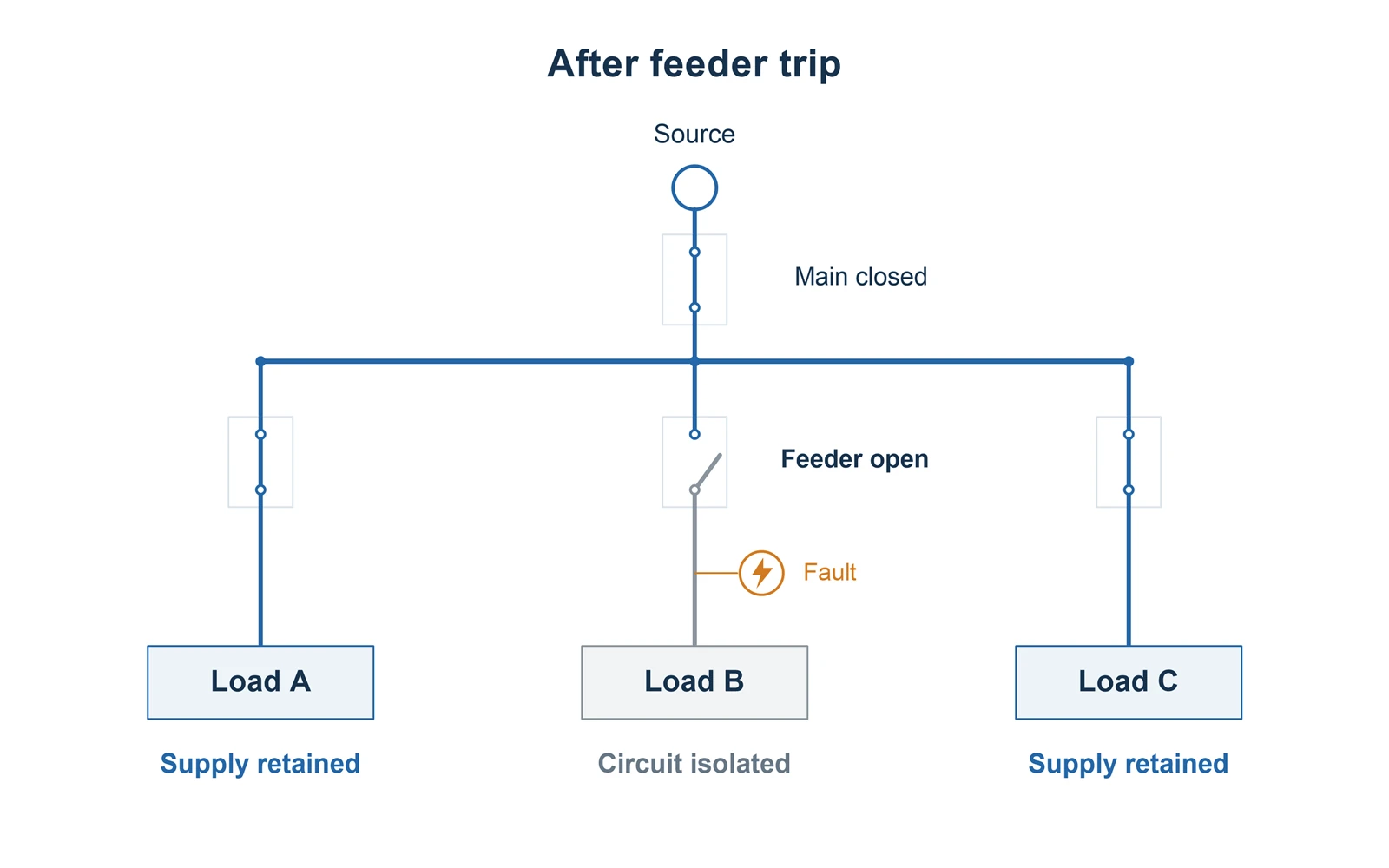
For UL-based proposals, switchboards can support selective coordination in some applications. For any proposal, have the engineer assess the actual devices across the relevant fault-current range before accepting a claim that the system is coordinated.[3]
The assessment should cover time-current characteristics, instantaneous settings, short-time delay, and withstand capability.[3]
A useful tender requirement is:
> Provide the proposed protective-device models and trip units, the coordination data required for the project study, and all limitations affecting the specified settings.
Also ask the engineer to identify the source configurations that the study must cover. Keep unresolved coordination requirements visible in the bid comparison. Do not accept a statement such as “fully coordinated” without the supporting study or the information needed to complete it.
Replace a vague requirement such as “easy to maintain” with a task the facilities team expects to perform.
For a feeder breaker replacement, ask the bidder:
For switchgear, request drawings that identify the breaker, bus, and cable compartments, together with the barriers and access points. For a switchboard, request the same level of clarity about internal access and the equipment that must be isolated. Do not infer the arrangement from a closed-door photograph.
Treat these answers as inputs to the outage plan. Do not treat a withdrawable-breaker description as authorization for energized work. Require the manufacturer’s procedure and the site’s approved electrical safe-work process before planning the task.
Check the room layout at the same time. Include cable routing, door swing, access to terminations, and the path for moving a replacement breaker. A cabinet that fits on the floor plan may still leave an impractical maintenance arrangement.
Use the following order when evaluating bids.

First, establish the mandatory requirements: equipment category, applicable certification, voltage and frequency, available fault current, and required protection performance. Reject or resolve documented exceptions before comparing prices.
Next, evaluate the operating constraints. If the owner can accommodate planned outages and the proposed switchboard meets the electrical and maintenance requirements, keep it in the comparison. Do not specify switchgear solely because the name sounds more capable.
Where the design requires an assembly short-time withstand rating, demanding coordination, or a defined breaker service arrangement, make those items explicit acceptance criteria. Require supporting evidence for the offered assembly. For a UL-based comparison, these requirements warrant close evaluation of UL 1558 switchgear.[1][3]
Finally, compare the installed scope. Include drawings, studies, testing, shipping sections, site assembly, spare breakers, and commissioning support where required. Ask for exclusions and delivery assumptions in writing. A price difference is meaningful only after the technical scope and supplied services are aligned.
The evidence should identify the assembly being offered, not just a component inside it. UL Solutions distinguishes recognized components from complete end products; component recognition alone does not certify the finished product.[6]
Ask for a document package that includes:
Cross-check the model and configuration across these documents. If a certificate, test report, and quotation refer to different equipment, request an explanation before accepting them as evidence for the offered assembly.
Factory acceptance testing should have an agreed scope. Ask which checks will be performed on the supplied equipment, which records will be retained, and which separate documents establish the required certification and ratings.
Send the current single-line diagram with the system voltage and frequency, load schedule, available fault-current information, required standards, installation conditions, and maintenance constraints. Flag anything still under engineering review.
Require each bidder to return the same rating schedule and a list of deviations. That makes it easier to identify a missing withstand duration, an unsuitable access arrangement, or an unsupported certification claim before the purchase order is issued.
Before requesting a final quotation, ask the supplier to confirm the available assembly, applicable documents, and any exceptions to the project requirements in writing. Attach the specification and drawings so that the response addresses the equipment you need.
No. If the offered switchboard meets the project’s electrical and maintenance requirements and the owner can accommodate the planned outages, keep it in the comparison. Where documented short-time withstand capability, demanding protection coordination, or a defined breaker service arrangement is required, ask for evidence for the offered assembly before selecting it.
Not necessarily. This comparison concerns low-voltage equipment. Under UL-based specifications, both UL 891 switchboards and UL 1558 power circuit breaker switchgear include low-voltage equipment. Confirm the assembly standard and duty rather than classifying the equipment by its name alone.
No. Check whether each quoted value applies to a breaker or to the complete assembly. Request the assembly rating schedule and its conditions. If short-time withstand is specified, the supporting information needs to identify both the current and its duration.
A drawout arrangement alone does not authorize energized work. Confirm which equipment must be de-energized and isolated, then use the manufacturer’s maintenance procedure and the site’s approved electrical safe-work process to plan the task.
Confirm the applicable standard, assembly ratings, protection requirements and maintenance access first. Then align the drawings, studies, testing, shipping sections, site assembly, spares and commissioning support included in each offer. Ask bidders to identify exclusions and delivery assumptions in writing.