Request a Quote
Share your product list, technical ratings, quantity and delivery destination.
Compare rectifier vs transformer functions, isolation limits and supply scope. Use the RFQ checklist to separate a transformer from a complete DC power package.
A transformer can change the AC voltage supplied to equipment. A rectifier converts AC to DC. An industrial DC supply may use both, with the transformer feeding the semiconductor rectifier stage.[1][2][4]
That distinction matters when buying a rectifier transformer. The name describes the transformer’s application; it does not, by itself, confirm that the quotation includes the rectifier, controls or cooling equipment. ABB describes a retrofit in which new rectifiers fit existing transformers, demonstrating that these can be separate supplied assets.[5]
Before comparing prices, identify the required function and the boundary of each offer.
The comparison below separates the two functions. Package labels need a separate check against the quotation and bill of materials.
| Question | Transformer | Rectifier |
|---|---|---|
| Main function | Can adjust AC voltage to suit the load.[1] | Convert AC into DC.[2] |
| Output in the comparison here | AC at the specified secondary voltage.[1] | DC; confirm the required output quality separately.[2] |
| Relevant construction | Windings; an autotransformer shares part of a winding between input and output.[3] | Semiconductor power stage, commonly using diodes or thyristors in industrial systems.[5] |
| Isolation | Depends on the winding arrangement. An autotransformer does not provide the isolation of separate windings.[3] | Do not assume the rectifier stage establishes the required isolation boundary; identify it in the system design.[3][4] |
| Quote-stage check | Confirm secondary requirements and whether only the transformer is included. | Confirm whether the offer includes power electronics alone or an integrated DC supply. |
Rectifier waveforms vary by converter design.
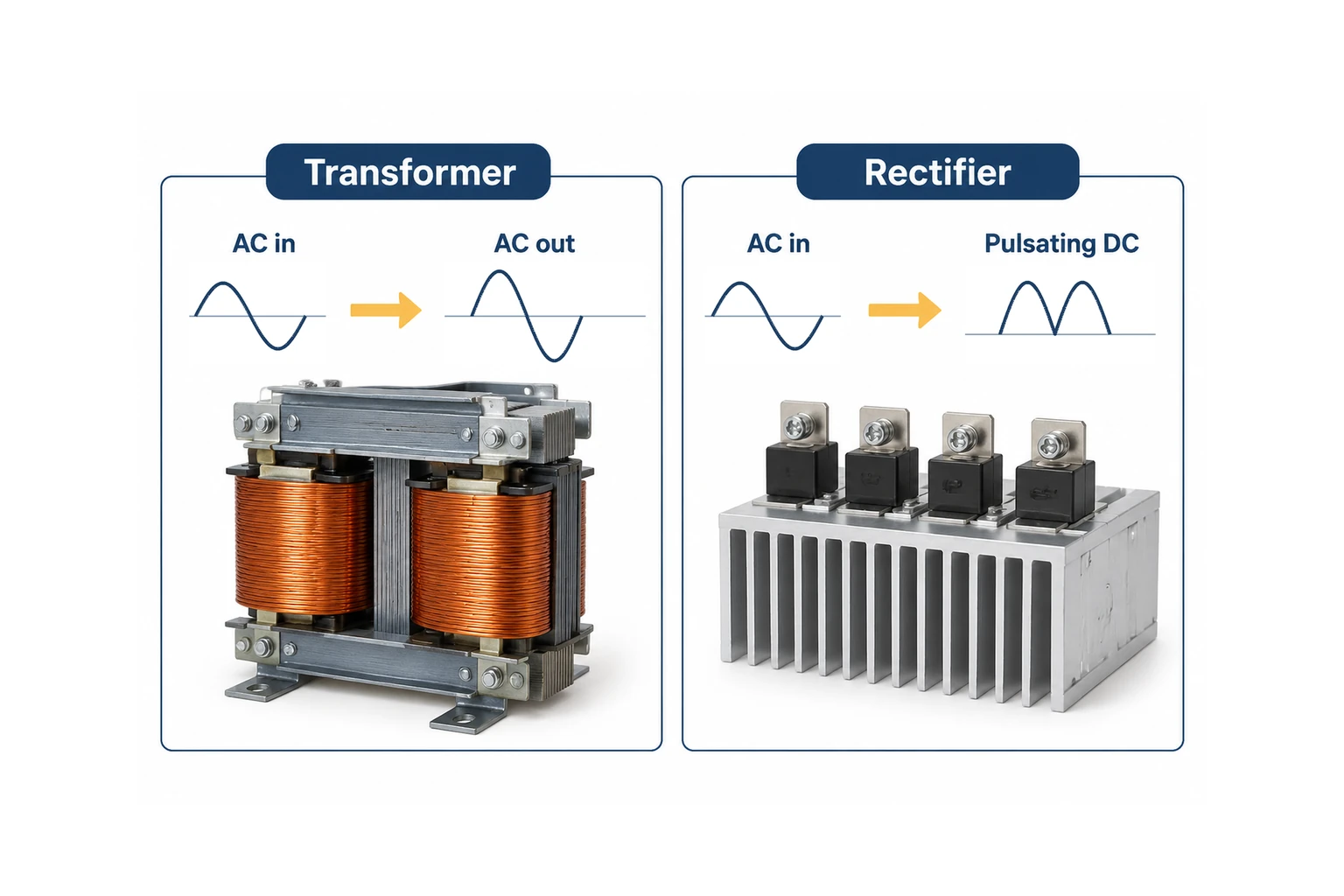
A transformer can step the supply voltage up or down. HPS describes autotransformers specifically as voltage-adjustment devices for applications that do not require isolation from the supply.[1]
Do not apply the word “isolating” to every transformer. In an autotransformer, part of the winding is common to the primary and secondary circuits.[3] If the process specification requires galvanic isolation, ask the electrical designer to identify the isolation arrangement and require the supplier to document it. Our autotransformer and isolation-transformer comparison explains that distinction in more detail.
For a rectifier-fed process, “secondary voltage” alone leaves important questions open. Ask the converter supplier to confirm the required winding arrangement, voltage range and interface before the transformer offer is finalized. This is especially important where the transformer and rectifier come from different suppliers.
The semiconductor stage performs AC-to-DC conversion. ROHM explains that a diode conducts principally in one direction and describes a basic bridge arrangement that reverses the negative half-waves.[2] Industrial high-power systems commonly use diodes or thyristors; ABB notes that thyristors require active control, allowing more dynamic adjustment of power output.[5]
Rectification alone should not be read as a promise of perfectly smooth, regulated DC. ROHM’s basic explanation distinguishes the bridge output from the capacitors or regulators that can follow it.[2] Specify the process requirement: acceptable output ripple, operating voltage and current range, regulation mode, and response to a changing load. Ask the package supplier how those requirements will be met and verified.
Do not use a diagram of a basic bridge as the design basis for a high-current process. It does not select semiconductors, protection settings or conductor sizes.
A useful functional description is:
AC supply → transformer → rectifier → DC process load
This describes one common arrangement, not every power-conversion topology. Hitachi Energy describes rectifier transformers combined with diode or thyristor rectifiers, with voltage regulation built in or provided separately.[4]
Some industrial arrangements also coordinate phase-shifted windings and multiple rectifier pulse groups. Hitachi Energy discusses these configurations in relation to harmonic mitigation and process stability.[4] Do not choose a pulse arrangement from the transformer name alone. Ask who specifies it, who checks compatibility, and which party supplies each component.
Actual inclusions must follow the agreed bill of materials.
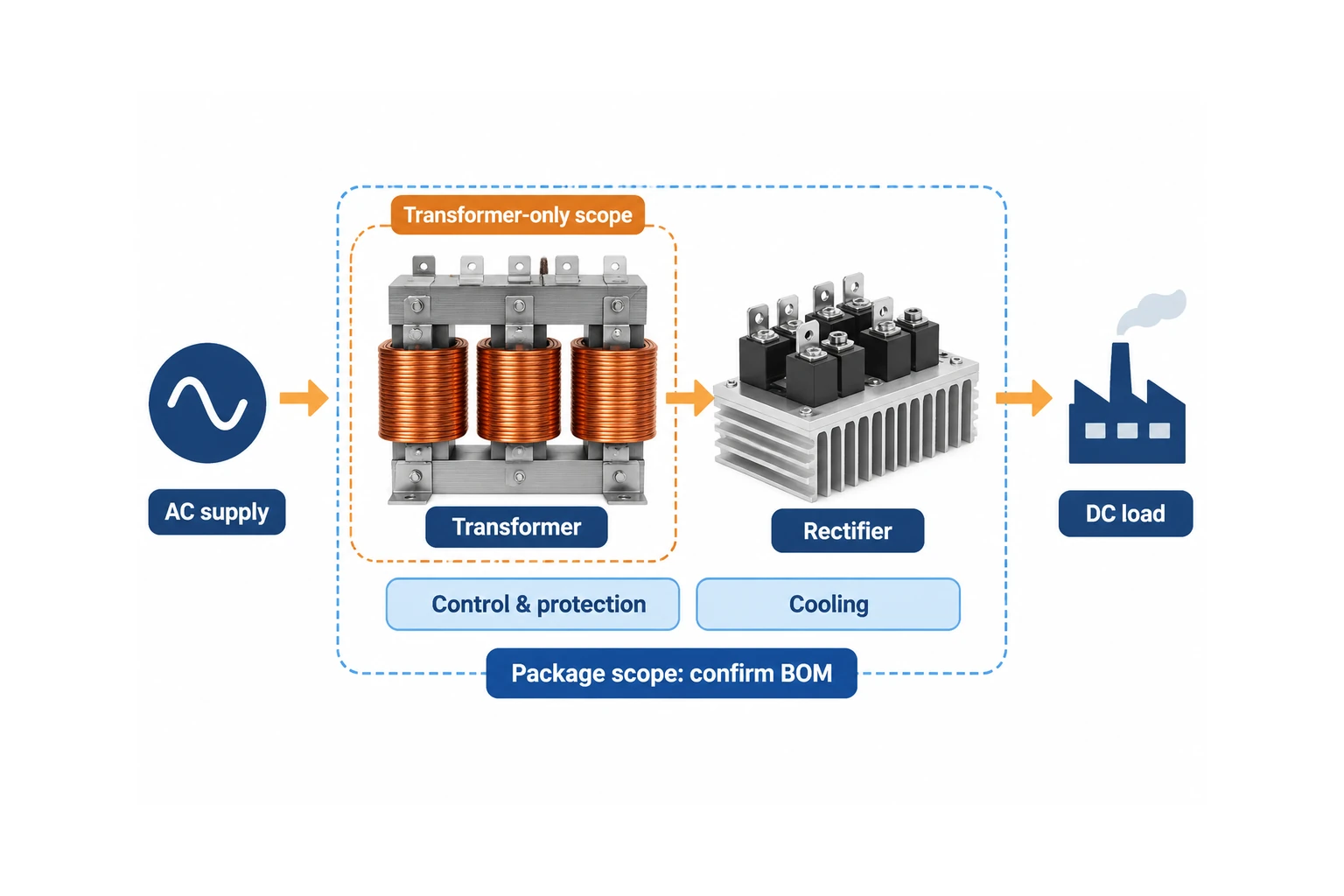
A package may extend well beyond the magnetic component and semiconductor stage. ABB describes integrated installations combining power electronics with control and cooling systems.[5] Its MCR1000 rectifier, for example, includes cooling provisions, semiconductor assemblies, protection and gate-firing electronics.[6] Those are examples of product architecture, not claims about equipment available from HJD.
Treat “rectifier transformer,” “transformer rectifier” and “transformer rectifier machine” as terms that need scope clarification. Ask the seller to mark the supply boundary on a functional drawing and list every included assembly.
Consider two offers for the same process. One names a transformer with an agreed secondary arrangement. The other lists a transformer, semiconductor rectifier, controls and cooling equipment. Comparing their headline prices would compare different deliverables.
Request clear responsibility for:
Also ask where any efficiency figure is measured. Is it a transformer figure, a rectifier-stage figure or a complete AC-input-to-DC-output package figure? Require the load point and treatment of auxiliaries to be stated. Do not copy a component figure into a whole-system comparison without that basis.
Use the following checklist to organize the enquiry. These are information requests, not recommended electrical ratings. The project designer and the relevant suppliers must establish the values.
| RFQ field | Information to provide or confirm | Why it belongs in the enquiry |
|---|---|---|
| AC supply | Voltage, frequency, phase arrangement and available site data | Gives both suppliers the same input basis |
| DC process demand | Operating voltage/current range, duty cycle and required overload conditions | Defines what the process needs rather than only naming equipment |
| Output quality | Ripple limit, regulation mode and measurement conditions | Prevents “DC output” from standing in for a complete performance specification |
| Transformer interface | Secondary arrangement, isolation requirement and converter compatibility | Identifies which party approves the transformer-to-rectifier match |
| Cooling and installation | Site conditions, available utilities, layout and connection limits | Makes infrastructure and installation exclusions visible |
| Supplied equipment | Itemized BOM, connecting parts, controls, protection and auxiliaries | Distinguishes a transformer-only offer from a package |
| Acceptance evidence | Agreed tests, operating points, documentation and responsibility | Defines how the delivered scope will be checked |
Attach the available process specification and single-line diagram. Mark unresolved fields as “to be confirmed” rather than choosing values merely to complete the form. The transformer specification checklist can help assemble the transformer-side information.
Send your requirements to HJD with the AC supply details, DC process demand and intended equipment boundary. State whether the enquiry concerns a transformer alone or a complete DC power package. Ask for written confirmation of the proposed scope, exclusions and interface responsibilities before treating the offer as technically comparable.
The equipment name alone does not establish the supplied BOM. Transformers and rectifiers can be separate assets, as illustrated by ABB’s replacement of rectifiers while retaining existing transformers.[5] Require the quotation to identify the semiconductor stage, controls, cooling and connecting equipment individually.
No such performance should be assumed from the word “rectifier.” ROHM describes the basic bridge output separately from subsequent capacitors or regulators.[2] Put the required ripple and regulation limits, operating conditions and acceptance method into the package specification.