Request a Quote
Share your product list, technical ratings, quantity and delivery destination.
Station service duty can use a conventional auxiliary transformer or an SSVT. Compare the equipment types, define the load and source, and prepare a clear enquiry package.
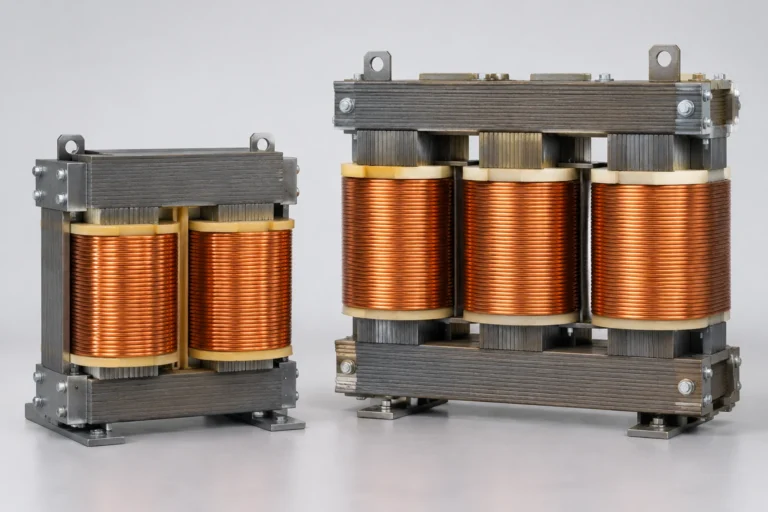
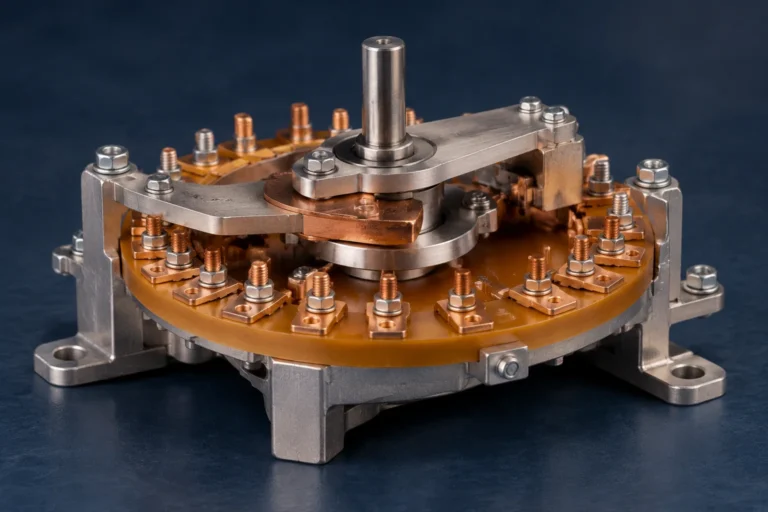
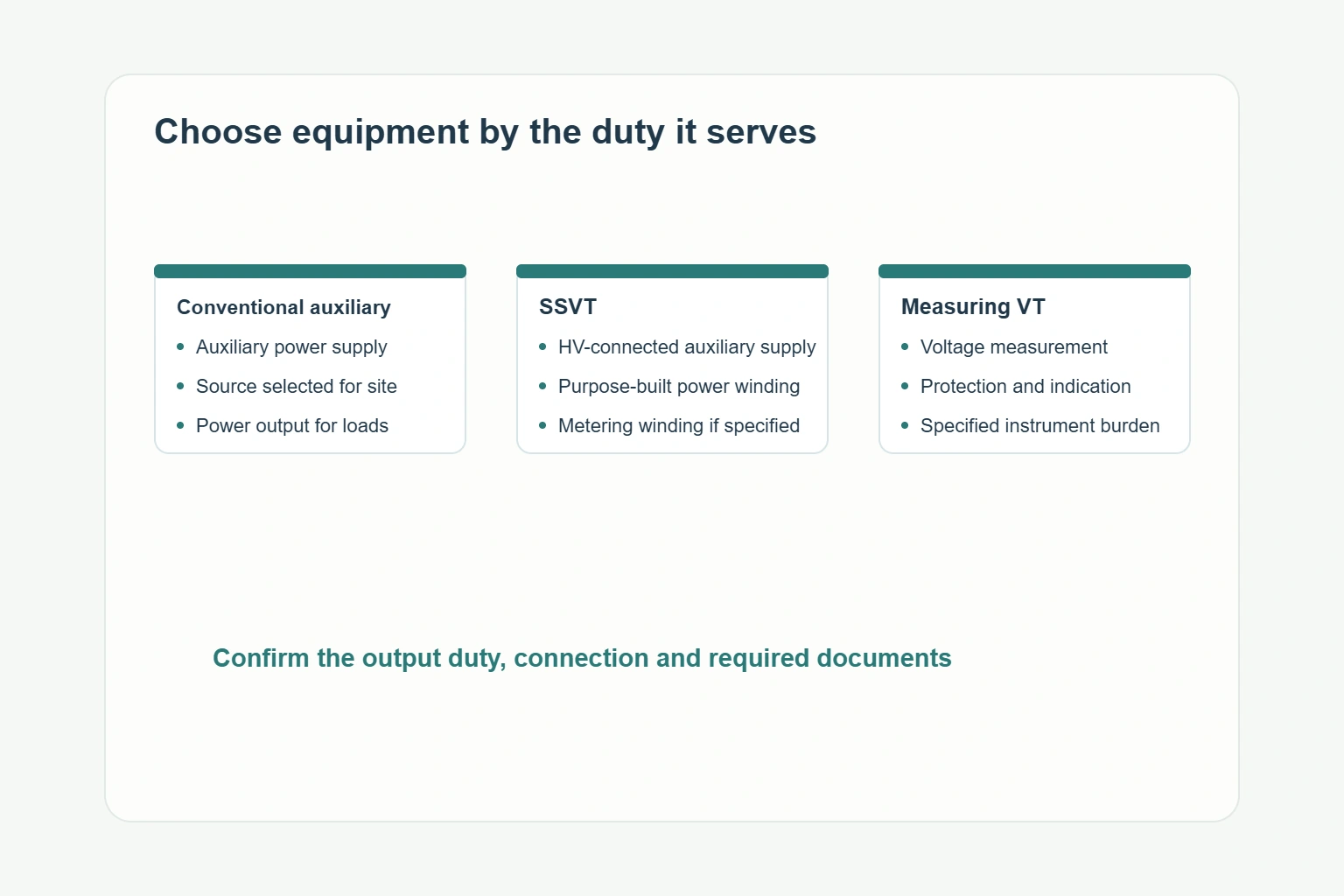
A station service transformer supplies the auxiliary power used to operate a substation. The equipment can be a conventional auxiliary transformer fed from a distribution supply or an SSVT drawing power directly from a high-voltage circuit. Choose between them by identifying the available source, the auxiliary load and the required supply arrangement. A measuring voltage transformer serves a different duty: providing voltage signals for metering and protection. [1] [2] [3]
Station service describes the transformer’s job within the installation. Start with the AC distribution board it will feed and list the connected equipment. Check lighting, heaters, ventilation, cooling equipment, motor-operated mechanisms, sockets and battery-charger inputs against the actual station drawings. Keep each item’s voltage, phase and operating duty in the load schedule.
For a battery-backed control system, list the charger’s AC input separately from its DC output loads. Ask the system designer which loads must remain available during loss of the normal source and how the station will supply them. This establishes the duty for the transformer and the surrounding distribution equipment before a supplier chooses a model.
Auxiliary transformers are available in different constructions. Hitachi Energy’s rail-infrastructure range, for example, includes liquid-filled and dry-type units for auxiliary networks and substation ancillary loads. MGM’s distribution substation transformers illustrate the conventional medium-voltage step-down approach. These are distinct equipment families to evaluate against the project’s source and installation conditions. [1] [5]
| Equipment | Duty to specify | Questions for the supplier |
|---|---|---|
| Conventional auxiliary or station service transformer | Step down an available supply to the station’s auxiliary distribution voltage. | What are the input supply, phase arrangement, continuous load, starting duty and installation conditions? |
| Station service voltage transformer, or SSVT | Take auxiliary power directly from a high-voltage circuit through a design intended for power output. | Which high-voltage connection and grounding conditions apply? What power output and secondary arrangement are available? |
| Measuring or protection voltage transformer, or VT | Provide a voltage signal to meters, relays and associated instruments. | What ratio, burden, accuracy class and protection duty does the connected equipment require? |
Hitachi Energy describes its SSVT as directly connected to the high-voltage network and supplying a substation panel or remote load. The same range can include optional metering windings. Its EMF voltage transformer instead lists revenue metering, protective relaying and system indication as applications. Read the winding duties on the offered datasheet rather than treating every item called a “voltage transformer” as interchangeable. [2] [3]
Trench describes an SSVT with a high-voltage coil and low-voltage winding specifically designed for power output. Its single-phase units can form a three-phase arrangement. Specify the complete assembly needed by the auxiliary board, including the number of units and the connection drawing. [4]
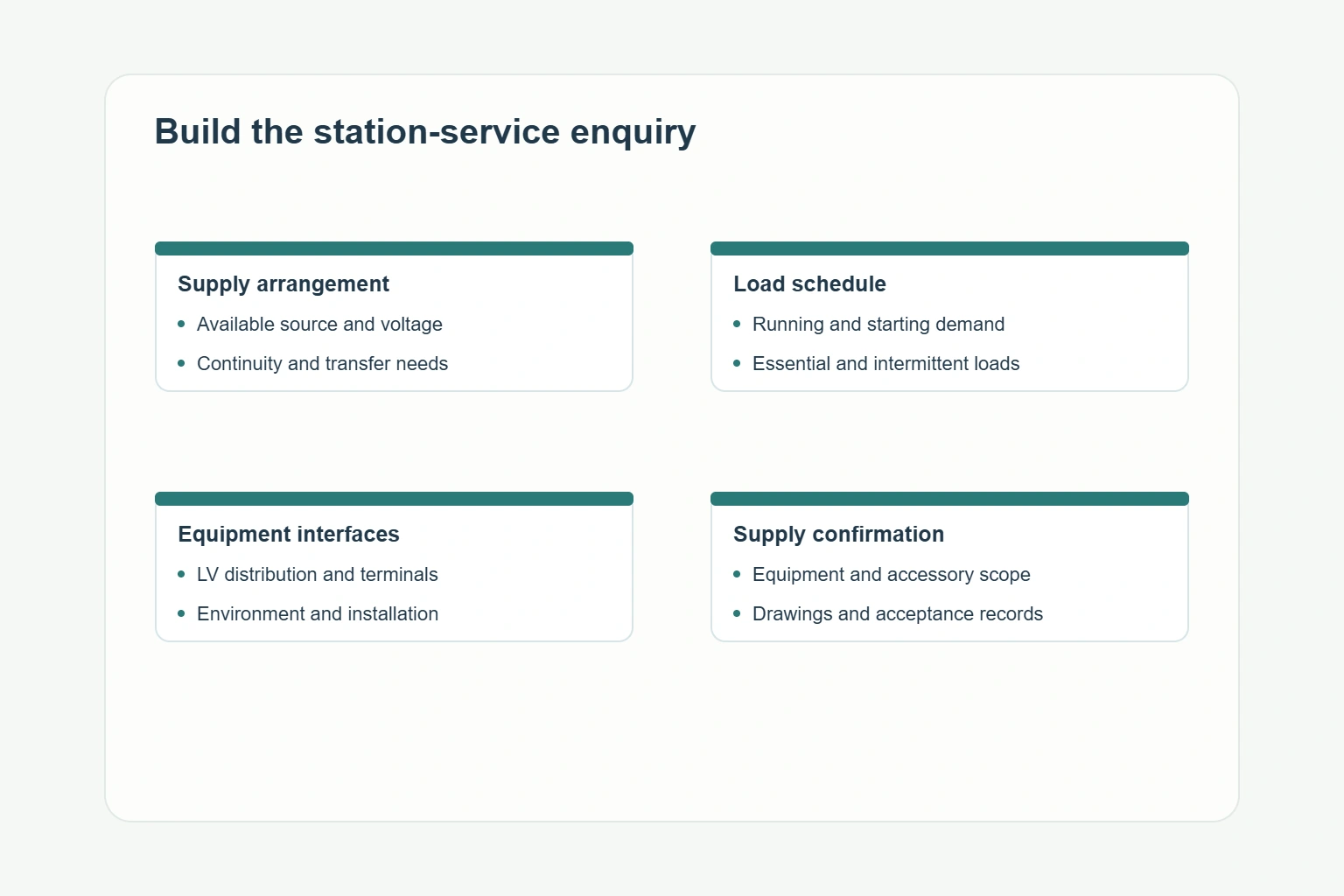
Give the supplier operating cases, not just a list of connected nameplates. Separate normal running, equipment starting, charger recovery and planned expansion. Record which loads operate together and which can be disconnected when the station uses its alternative supply.
Ask the supplier to identify the operating case used for its proposed rating and explain any allowance for starting or non-linear loads. MGM, for example, distinguishes standard designs from options intended for higher harmonic content. That makes the load description relevant to the offered design as well as its headline kVA. [5]
For a preliminary enquiry, use a row for each load and columns for normal operation, starting and alternative-source operation. Mark the equipment that operates in each case and attach the assumptions. A missing charger-input value or motor-starting requirement then becomes a specific question for the equipment vendor, instead of an unexplained allowance in the transformer rating.
A useful comparison schedule puts the same duty cases beside every quotation. If one proposal assumes that all heaters run together while another applies a different operating sequence, resolve that difference before comparing prices.
Mark the proposed transformer connection on the station single-line diagram. Identify the normal source and any alternative source, then show which auxiliary circuits each arrangement supplies. Ask the designer to review loss of the incoming circuit, a bus outage and transformer maintenance separately.
For an SSVT, the high-voltage network details are part of equipment selection. Hitachi Energy’s cited oil-filled range uses a phase-to-ground connection on grounded-neutral networks. Give the supplier the actual network grounding and voltage information so it can assess the proposed model against that system. [2]
Write whether each stated voltage is phase-to-phase or phase-to-earth. Include nominal voltage, highest system voltage, frequency and the project’s insulation requirements. Also identify the required secondary voltage, neutral arrangement, phase sequence and any metering windings.
Also ask which events can remove both proposed sources. Two transformer symbols on a drawing do not establish independent supplies when they share the same upstream circuit. Have the station designer identify the intended outage cases and show the supply path that remains available for each one.
Document who supplies the changeover equipment, protection, auxiliary board and interconnecting cables. Where continuity requires another source, include its capacity, intended operating sequence and transfer requirements in the enquiry. Avoid leaving these interfaces to be inferred from a transformer-only quotation.
| Project input | Information to attach |
|---|---|
| Application and supply | Station single-line diagram, connection point, normal and alternative sources, and intended operating cases. |
| Electrical duty | Primary and secondary voltages, frequency, phase arrangement, load schedule, starting data and future capacity. |
| System interfaces | Grounding arrangement, insulation requirements, protection interfaces, neutral requirements and terminal connections. |
| Installation | Indoor or outdoor location, ambient temperature, altitude, pollution conditions, available space and access. |
| Deliverables | Required drawings, applicable project standards, test schedule, inspection points and documentation language. |
| Supply scope | Transformer units, enclosure or tank, supports, accessories, protection, changeover equipment and delivery responsibilities. |
Keep the transformer and its enclosure as separate scope lines. An enclosure enquiry needs dimensions, access, ventilation and interface details; the transformer enquiry also needs the electrical duty. Mark whether the order covers the complete transformer, its housing, or an assembled package.
If the specification calls for an SSVT, name it explicitly and request confirmation of that equipment type. A supplier’s general transformer catalogue is a starting point for discussion; the quotation should identify the actual model and configuration proposed for the station.
Ask each supplier to return a completed technical schedule against your inputs. Check the rated output under the stated conditions, winding and terminal arrangement, number of units, overall dimensions, mounting details and included accessories. Record deviations beside the relevant requirement.
Agree which drawings and test documents require approval before manufacture or dispatch. For an SSVT with a metering winding, identify the power-output duty and measuring duty separately in that schedule. Hitachi Energy’s optional metering-winding arrangement shows why both functions need their own specification. [2]
Use the transformer product range to identify relevant equipment for discussion. To request supply confirmation, send HJD Electrical the single-line diagram and load schedule, and identify whether you need a conventional auxiliary transformer, an SSVT or enclosure fabrication. Ask for the proposed scope and any deviations in the reply.
Some designs include optional metering windings. Specify the required measuring duty and confirm that it is included in the offered configuration. [2]
Send the single-line diagram, source voltage and grounding information, auxiliary load schedule, installation conditions and scope of supply. Identify continuity requirements and the documents needed for approval.