Request a Quote
Share your product list, technical ratings, quantity and delivery destination.
Compare autotransformers and two-winding transformers by electrical isolation, system compatibility and RFQ requirements. Know what to confirm before ordering.
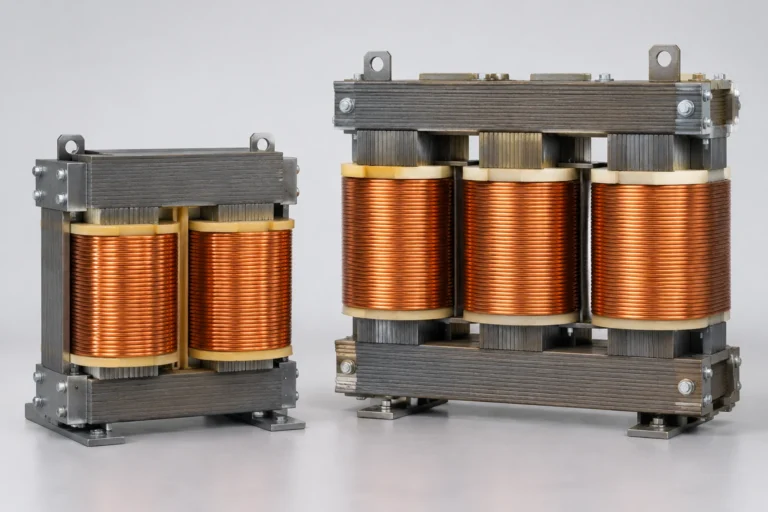
An autotransformer shares part of a winding between its input and output, so it does not provide galvanic isolation. A two-winding transformer uses separate primary and secondary windings and transfers power through magnetic coupling. When comparing the two designs, that connection difference is the first selection question, ahead of price or cabinet size. [1][2]
If the project requires electrical separation between supply and load, exclude an autotransformer from that requirement. If isolation is unnecessary, an autotransformer may be a candidate, subject to the supply arrangement, load, protection requirements and applicable installation rules. HPS describes voltage adjustment without line isolation as an intended use. [1]
An autotransformer is itself a transformer. Here, the comparison is with a conventional two-winding design, rather than with every transformer technology.
In an autotransformer, part of the winding belongs to both circuits. HPS describes one winding per phase with a common section. Rex Power Magnetics explains that this arrangement transfers power through both the electrical connection and magnetic coupling. Changing the voltage does not remove the conductive path between input and output. [1][3]
In a two-winding transformer, the primary and secondary are separate conductors. The magnetic field couples them without a direct winding connection. This is the basis of galvanic isolation between the windings; it does not specify how the completed installation is grounded or protected. [2]
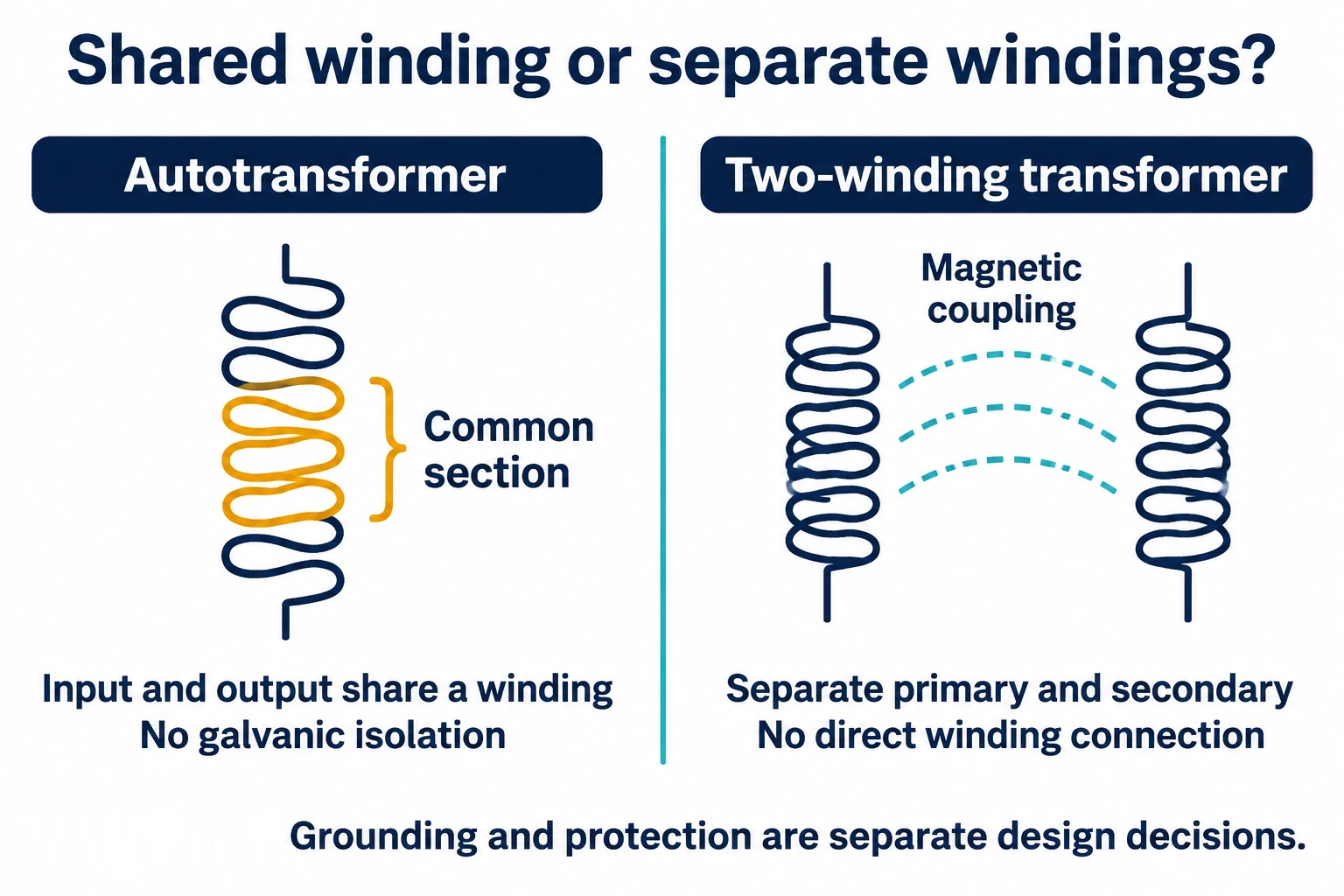
Ask for a winding connection diagram rather than judging the construction from the enclosure or a product name. A voltage ratio and a kVA figure do not show whether the supplier has offered separate windings or a common winding section.
| Selection point | Autotransformer | Two-winding transformer |
|---|---|---|
| Winding connection | Part of a winding is common to input and output. [1] | Primary and secondary windings are separate. [2] |
| Galvanic isolation | No isolation between input and output through the winding arrangement. [1] | No direct connection between the primary and secondary windings. [2] |
| Initial selection question | Can the project accept the conductive connection? | What separation and insulation requirements must the design satisfy? |
| Size and loss comparison | Shared construction can offer advantages for suitable voltage conversions; request actual offer data. [3] | Compare against the same load, voltage, environment and acceptance requirements. |
| Installation review | Confirm compatibility with the existing neutral, grounding and protection scheme. | Define the secondary arrangement and its protection; do not leave them implicit. |
“Isolation required” needs an engineering purpose. The project may require electrical separation between source and load, an approved secondary-system arrangement, or equipment meeting a particular insulation and test specification. Put the applicable requirement in the RFQ so suppliers can answer it directly.
For example, IEC 61558-2-4:2021 addresses safety requirements for isolating transformers for general applications and power supplies incorporating them. The IEC public description says it is used with IEC 61558-1:2017. This illustrates why a winding sketch alone is not proof that a product meets an application-specific safety requirement. It does not make that standard the right specification for every power-transformer project. [6]
Have the responsible engineer identify the applicable standard, edition, insulation requirements and evidence to request. Do not accept the word “isolated” as a substitute for a model-specific datasheet and agreed test documentation.
Keep power-quality claims separate as well. If a supplier proposes an isolation transformer to address interference, ask which disturbance it is intended to reduce, under what conditions, and what performance data supports the proposal. A general statement about separate windings is not a quantified noise-attenuation or surge-protection guarantee.
An autotransformer can be worth evaluating when voltage matching is needed and electrical isolation is not. Rex identifies modest voltage changes as a typical application and links the shared winding arrangement to reduced material requirements. These are reasons to request an alternative quotation, not grounds for assigning a universal size, cost or efficiency saving. [3]
Provide the actual supply and required load voltages, their operating ranges, phases, frequency and load demand. Ask each bidder to identify the proposed configuration and its rated operating conditions. Compare guaranteed losses, dimensions, mass and price only after those conditions match.
Do not confuse the word “auto” with a promise of automatic voltage regulation. If the load needs its voltage held within a specified band as the supply changes, state that separately. Ask the supplier whether the offered equipment provides the required adjustment or regulation function.
HPS explains that a small buck-boost transformer can be connected as an autotransformer for voltage correction. In that arrangement, primary and secondary are directly connected, so it does not function as an isolation transformer. The connection used in the proposal matters, not just the transformer hardware or catalogue heading. [5]
Ask for the manufacturer’s connection diagram and the permitted load rating for that exact arrangement. Do not compare a small transformer’s standalone rating with another offer’s autotransformer application rating without clarification. Nor should an existing unit be reconnected from a generic article: obtain the model-specific approved arrangement through the project engineer.
A matching line voltage does not settle the neutral requirement. Identify whether the load requires a neutral, how the source is configured and which conductors must be available at the load. Include that information in the single-line diagram sent with the enquiry.
HPS’s guidance for its three-phase autotransformers makes neutral terminals an ordering consideration and warns about inappropriate grounding arrangements. Those instructions concern specific HPS equipment. The transferable procurement lesson is to obtain the proposed model’s neutral and grounding requirements; do not copy another manufacturer’s terminal options or connection instructions into your installation. [4]
Ask the project engineer to review fault levels, transformer impedance, protective-device coordination and any grounding changes before accepting either design. Request the supplier data needed for that review. A cheaper transformer quotation is incomplete if the engineer cannot confirm compatibility with the upstream supply and downstream equipment.
Separate windings are not permission to omit protective earth, bonding or fault protection. Keep those decisions in the approved system design.
Record the isolation decision as required, not required, or unresolved. If unresolved, identify who must decide and keep alternative offers clearly labelled. Do not let a supplier’s lower price silently settle an engineering requirement.
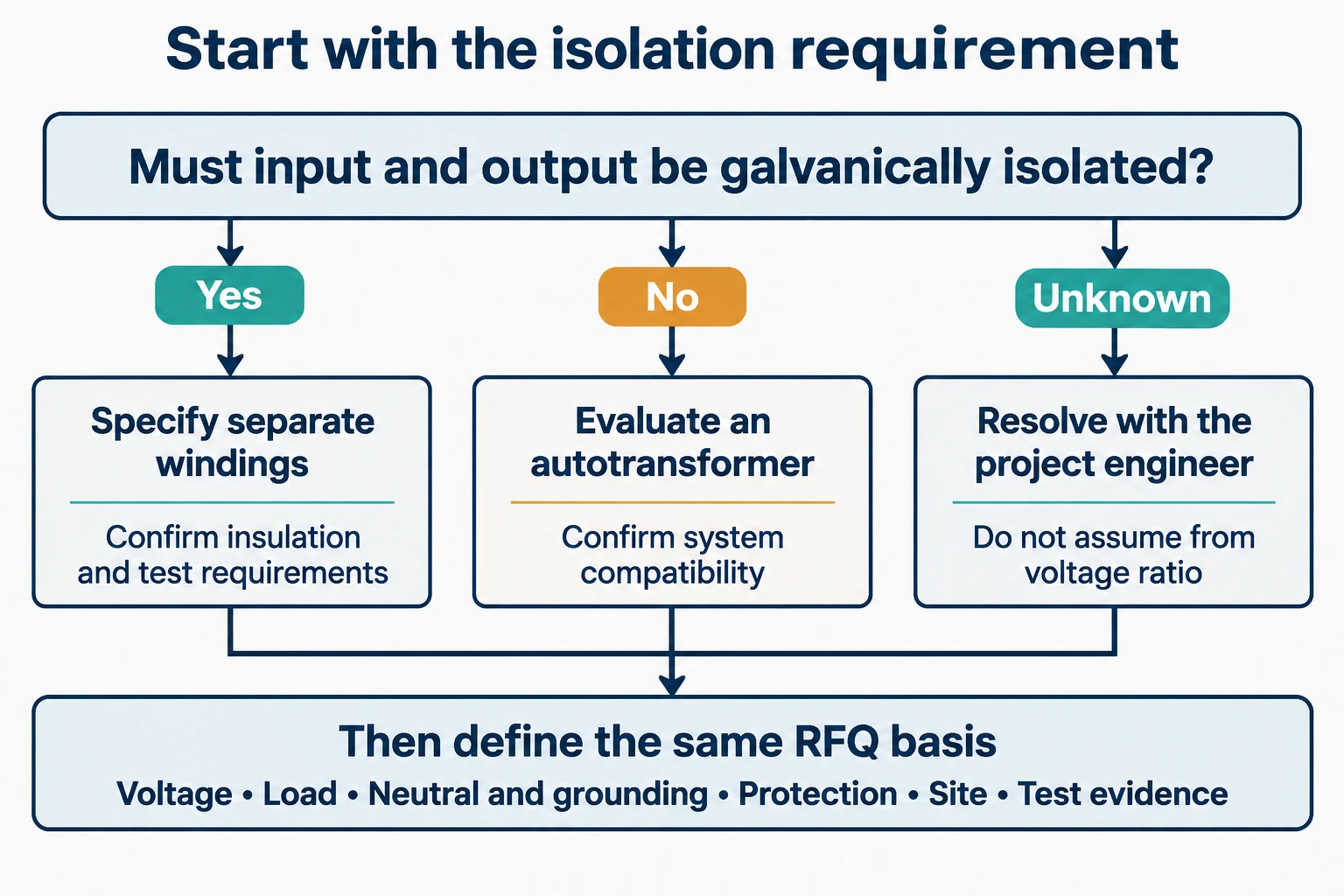
Once that decision is recorded, give every bidder the same input schedule. The following checklist covers the questions that commonly remain hidden behind a short request for a voltage ratio and rating. For low-voltage equipment supplies, the SG three-phase transformer page lists isolation and autotransformer options; specify which construction the project requires.
| RFQ item | Information to provide | What to require in the offer |
|---|---|---|
| Isolation requirement | Required separation, application and engineer-approved standard basis. | Explicit confirmation of common or separate windings, with a connection diagram. |
| Electrical duty | Supply and load voltages, operating ranges, phases, frequency and continuous demand. | Rated input and output conditions, available taps or adjustment function, and limitations. |
| Load behaviour | Starting demand, duty cycle, nonlinear loads and future load assumptions. | Confirmation that the proposed design covers the stated duty, with exceptions identified. |
| Neutral and grounding | Source configuration, required load conductors and the project grounding concept. | Model-specific neutral availability and information for engineering review. |
| Protection and interfaces | Available system data, upstream and downstream equipment, cable or busbar interfaces. | Impedance and connection data needed for coordination and interface checks. |
| Installation conditions | Indoor or outdoor location, ambient conditions, altitude, ventilation and space constraints. | Dimensions, mass, enclosure details, cooling assumptions and installation requirements. |
| Acceptance and commercial scope | Required standards, reports, drawings, accessories and delivery responsibilities. | Itemized evidence, supply boundaries, deviations and commercial terms. |
Use the transformer specification checklist to expand the electrical and site inputs. Pair it with the transformer testing guide when agreeing which reports and acceptance activities belong in the order.
A factory needs to match an incoming supply to replacement machinery. The initial request gives the two voltages and the load rating. One supplier offers an autotransformer; another offers separate windings. The lower price cannot establish which offer is acceptable.
If the machine specification requires galvanic isolation, the autotransformer does not meet that requirement. If isolation is unnecessary, the engineer can evaluate the autotransformer against the actual load, neutral arrangement and protection scheme. If nobody has checked the machine requirement, mark the decision unresolved before comparing the offers.
For an HJD enquiry, use the contact page to describe the required voltage conversion and isolation requirement. Include the specification schedule and relevant drawings through the contact channel provided. Ask HJD to confirm the proposed model, supply scope and available supporting documents.
No. Part of its winding is common to input and output, leaving a direct conductive connection. A voltage change does not create galvanic isolation. If separation is required, specify separate windings and have the responsible engineer define the applicable insulation and acceptance requirements. [1][2]
No. The ratio describes the input and output voltages, not the winding connection. Check the connection diagram and insulation specification. Separate windings provide the relevant separation; the ratio alone does not establish it or demonstrate compliance with a particular safety requirement. [2][6]
Check how it is connected in the offered application. HPS explains that a buck-boost transformer connected as an autotransformer has a direct primary-to-secondary connection and does not act as an isolation transformer. Request the exact manufacturer’s configuration rather than relying on the product label. [5]
Do not assume a fixed saving. Shared winding construction can reduce material requirements in suitable applications, but compare actual quotations on the same operating and supply basis. Where galvanic isolation is required, the autotransformer is not a compliant alternative regardless of its purchase price. [1][3]