Request a Quote
Share your product list, technical ratings, quantity and delivery destination.
Follow transformer manufacturing from core and coils to insulation treatment, factory testing, and the records buyers should request before shipment.
Transformers are made by preparing the magnetic core, winding the coils, assembling the insulation and internal structure, completing the relevant insulation-treatment process, and building and testing the finished unit. A cast-resin dry-type unit follows a different insulation route from an oil-immersed unit.[1][3][4]
Much of that work is hidden when the transformer leaves the factory. The painted tank or protective enclosure tells a buyer little about the core, windings, insulation, or production records inside. Understanding the manufacturing stages helps you request evidence while the relevant work is still accessible.
Before discussing machines or production capacity, identify the transformer being ordered. A buyer’s review package should connect the quotation, approved technical data, drawing revisions, and inspection requirements to one job reference. Use a transformer specification checklist to organize the electrical ratings, site conditions, interfaces, and documentation requests.
Ask which details must be approved before production starts and which can still change later. A cable-entry revision, accessory substitution, or different shipping arrangement should appear in the agreed documents rather than remain in an email thread.
Also agree on the inspection and test plan. For each proposed inspection, name the responsible party, notice period, required record, acceptance basis, and action if a nonconformity is found. If the contract uses terms such as hold point or witness point, define their meaning there. Do not assume that a visit permits shipment or that a missed witness date automatically waives an inspection.
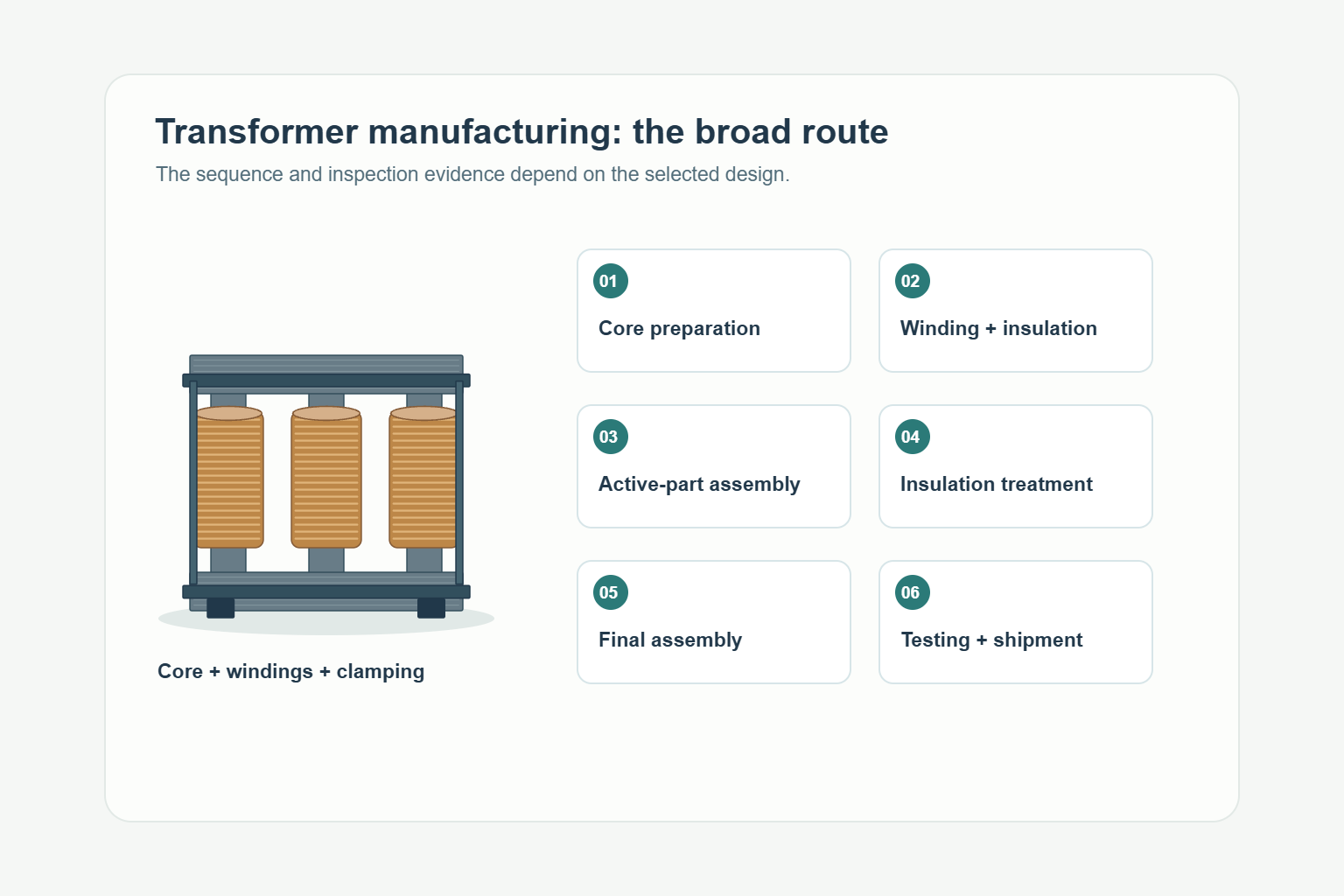
The following route is a planning summary. Ask the manufacturer to confirm the exact sequence for the offered construction.
| Stage | What happens | Useful buyer question |
|---|---|---|
| Core preparation | Magnetic material is prepared and assembled into the specified core | Which drawing and material record identify this core? |
| Winding and insulation | Conductors, insulation, and supports form the coil assemblies | What records confirm the winding design and checked dimensions? |
| Active-part assembly | Core, coils, connections, and supporting structures are brought together | Which inspections occur before the internal assembly becomes inaccessible? |
| Insulation treatment | The relevant drying, impregnation, or casting route is completed | What process record and acceptance basis apply to this design? |
| Final assembly | The tank or protective arrangement and specified accessories are completed | Does the assembly match the approved interface drawings? |
| Testing and shipment | Agreed tests, document review, and packing checks are completed | What must be closed before dispatch authorization? |
In a laminated steel-core design, thin insulated steel sheets form the magnetic structure. Virginia Transformer’s core description explains cutting and stacking, joint alignment, burr control, and mechanical tightness.[1] These are internal manufacturing concerns that an exterior photograph cannot resolve.
For procurement, ask for identification rather than a vague statement that the core is high quality. The proposed record might include the material specification, drawing revision, and inspection sign-off. If a buyer visit is planned, clarify whether the core can be viewed before coil assembly and what the visit is intended to verify.
Avoid making one core shape or stacking method a universal requirement. Have the technical reviewer confirm the specified construction for the offered transformer.
Windings are formed from conductors with insulation and mechanical support appropriate to the design. Copper and aluminum both appear in commercial transformer construction; the material and winding arrangement need to be identified in the offer. Hammond Power Solutions, for example, describes copper or aluminum conductors in its cast-resin range.[3]
Virginia Transformer’s winding description shows why turn count, alignment, tension, and spacers receive attention during coil production.[2] Its disc-winding example concerns a particular power-transformer construction, not every transformer family.
Useful questions concern the approved conductor, winding identification, dimensional checks, and any recorded deviations. Request a job-linked record or an agreed inspection opportunity.
Before the transformer is closed, arrange any required review of accessible connections, supports, identification, and conformity with the approved drawings. The inspector should use the agreed checklist and authority.
An effective visit has a defined outcome. Ask who records observations, how they are linked to the job, and which findings need closure before the next stage. If photographs are permitted, agree on the subject, date, model or serial reference, and authorization for later use. An unidentified workshop image has little value as order evidence.
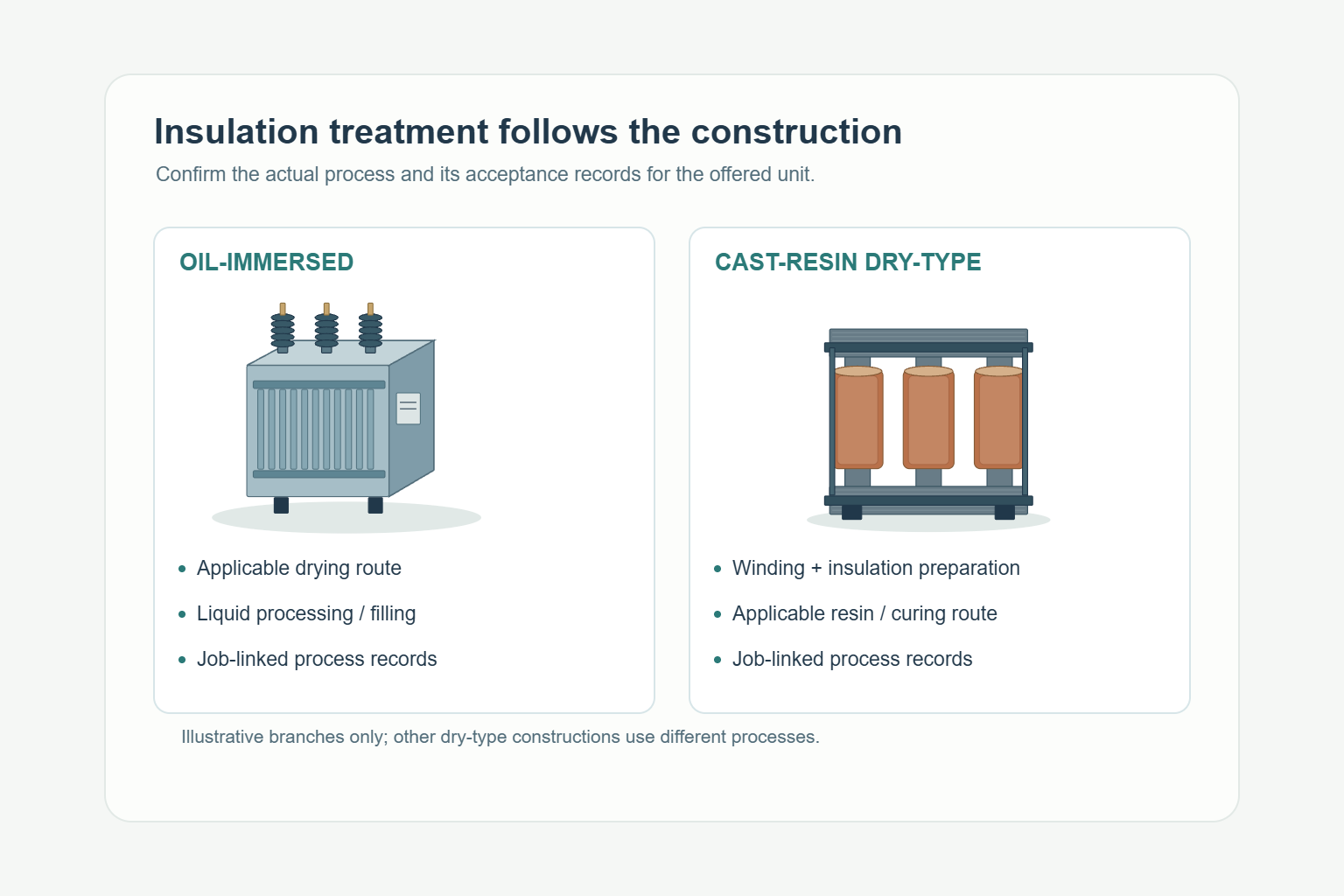
Oil-immersed and dry-type transformers require different treatment records. Keep those routes separate when comparing manufacturing proposals.
Drying equipment is part of established oil-paper insulation manufacturing. HEDRICH describes vapor-phase drying equipment specifically for power-transformer production.[4] That establishes an example of an industrial process; it does not mean every transformer uses that equipment or the same cycle.
Ask the manufacturer which drying route applies, how its completion is accepted, and what record can be supplied for the job. The qualified manufacturing process defines temperature, vacuum level, duration and acceptance criteria.
Oil treatment is a separate subject. HEDRICH’s oil-purification equipment description includes degassing and measurements for documenting residual moisture, gas, temperature, vacuum, and throughput.[5] For an order, distinguish the liquid specification, processing record, and agreed oil test results. A liquid supplier’s certificate should not be presented as proof of every subsequent factory operation.
If the product type is still being selected, review the dry-type and oil-filled transformer comparison before requesting a manufacturing route.
Cast-resin manufacture follows its own insulation process. Hammond Power Solutions describes wound conductors with mineral-filled epoxy and fiberglass reinforcement in its cast-resin product range.[3] This example supports the distinction between casting and oil-paper processing, not a claim that all dry-type transformers use identical materials.
Ask which insulation construction is offered, what manufacturing records apply, and which finished-unit tests are included. Keep cast-resin and other dry-type descriptions separate in the technical schedule. A generic phrase such as dry-type process is too broad for approving a specific production method.
For an oil-immersed transformer, the tank has a mechanical and sealing role beyond appearance. Virginia Transformer’s tank-fabrication description connects tank design with operating and shipping demands, leak mitigation, and coating requirements.[6] Its materials and coating details are manufacturer-specific and should not be copied into another supplier’s specification without review.
At this stage, compare the proposed unit with its approved general arrangement: dimensions, terminal positions, specified cooling equipment, accessories, identification, and transport interfaces. Ask how the required leak checks and visual inspections are documented. A buyer’s visual check complements the inspection plan; it does not establish pressure capability or electrical performance.
Factory test schedules need a defined basis. Virginia Transformer’s published testing information includes ratio and winding-resistance measurements, loss and impedance measurements, dielectric testing, and other tests that depend on the transformer and order.[7] It also distinguishes routine and additional testing and describes customer witness arrangements.[7]
Use that list as an illustration of test categories, not as a mandatory checklist for every purchase. Ask the technical reviewer to confirm the applicable standard editions, test selection, conditions, acceptance criteria, and any agreed exceptions for the offered unit.
For a report, check the equipment identity, date, revision, measured results, and applicable acceptance basis. A document titled test certificate without that connection may not answer the purchase requirement. See the transformer testing guide for a broader introduction to test purposes.
The checklist below is a procurement planning aid. Add it to the inspection plan only after the supplier and project team agree on scope and responsibility.
| Review point | Evidence to request | Question to close |
|---|---|---|
| Before production | Approved data, drawings, and inspection plan | Are revisions and open comments resolved? |
| Before internal closure | Agreed inspection records and authorized job-linked photographs | Have required internal observations been recorded and addressed? |
| After insulation treatment | Applicable process record and acceptance reference | Is the record tied to the correct unit or production batch? |
| At factory testing | Agreed test schedule, results, and witness record where required | Are deviations and any retest requirements closed? |
| Before shipment | Final documents, packing list, transport arrangement, and release record | Who authorizes dispatch, and what remains to be completed on site? |
Shipment deserves a separate review. Confirm which accessories travel installed and which are packed separately, then reconcile the packing list with the approved supply scope. Request identification for packages, the agreed transport drawing, receiving instructions, and the applicable storage documentation.
Keep unresolved items visible in a closeout list with an owner and due date. If the buyer accepts a documented exception, record its limits. Avoid replacing an unresolved technical decision with a general note that everything was inspected.
See HJD’s manufacturing page and quality-control page before discussing your order’s inspection requirements. For a specific purchase, request model-linked records and confirm what can be reviewed or witnessed.
Contact HJD with the transformer specification, applicable project requirements, and proposed inspection points. Ask HJD to confirm the offered model, available production evidence, test-document scope, and any visit arrangements before making them contractual requirements.
Common constructions combine a magnetic core, conductor windings, insulation, and supporting structures. Laminated steel cores and copper or aluminum conductors are examples. The insulation and external assembly differ between oil-immersed and dry-type designs, so check the offered construction rather than assuming one material list applies to all transformers.[1][3]
Witness arrangements exist in the industry, but availability and scope must be agreed for the order. Specify the stages, notice period, access conditions, records, and authority to accept or reject findings. Do not assume an open invitation or an unrestricted factory visit.[7]
Use the agreed contract and inspection plan: completed required tests, closed or formally accepted deviations, final identification and drawings, packing details, transport instructions, and dispatch authorization. Confirm which documents cover factory completion and which checks remain the responsibility of the receiving or commissioning team.