Request a Quote
Share your product list, technical ratings, quantity and delivery destination.
Compare step-up and step-down transformers for industrial loads. Check voltage, kVA, frequency, reverse feeding and 208V-to-240V requirements before ordering.
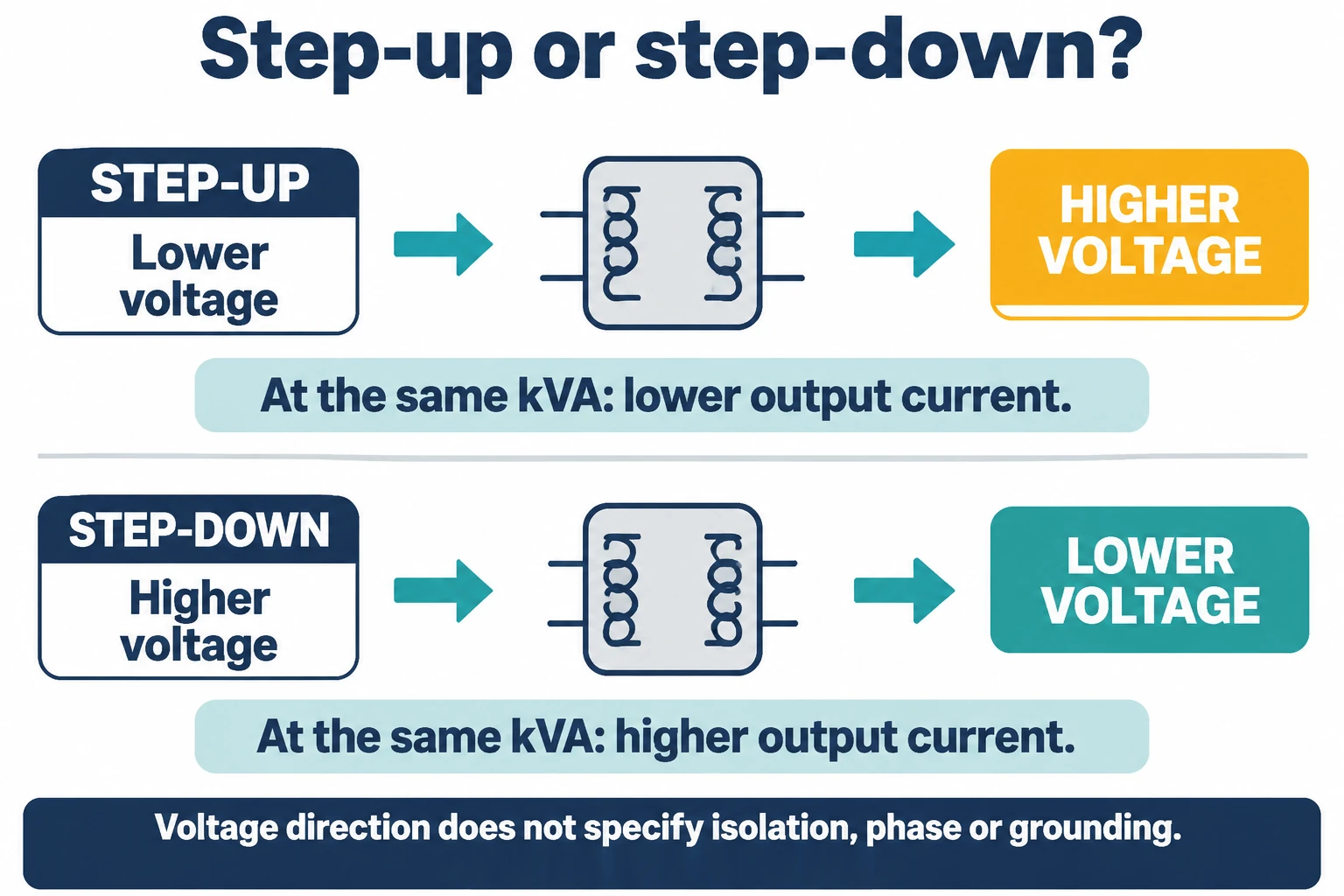
A step-up transformer supplies a higher voltage than it receives; a step-down transformer supplies a lower voltage. For an industrial buyer, that distinction identifies the direction of conversion. It does not settle the load capacity, winding connection, frequency rating or suitability for reverse feeding. [1][2]
Start with the available supply and the equipment nameplate. Then specify what must arrive at the load terminals, including phase and neutral requirements. A quotation that says only “step-up transformer” leaves the supplier to guess information that can change the proposed unit.
Here, input means the energized supply side and output means the side serving the load. On a purpose-built unit, these are normally described as primary and secondary. If an existing transformer might be reverse-fed, identify its marked terminals separately rather than relabeling them in the enquiry. [1][2]
| Selection point | Step-up transformer | Step-down transformer |
|---|---|---|
| Voltage direction | Output higher than input | Output lower than input |
| Typical industrial requirement | Raise the available supply to match equipment | Reduce the supply to the equipment voltage |
| Current at equal kVA and the same phase basis | Higher-voltage side carries less current | Lower-voltage side carries more current |
| Isolation | Must be specified separately | Must be specified separately |
| What to put in the RFQ | Actual input and required output, not just “step-up” | Actual input and required output, not just “step-down” |
Autotransformer construction shows why voltage conversion alone does not establish electrical isolation. [1][5][7]
Both descriptions concern voltage. Neither is a complete product specification.
For a single-phase load, apparent power is voltage multiplied by current. For a balanced three-phase load, use line-to-line voltage and line current: [7]
As a calculated illustration, 30 kVA at 208V three-phase corresponds to about 83.3A; 30 kVA at 240V corresponds to about 72.2A. The higher voltage does not turn a 30 kVA requirement into a larger power supply. These figures compare equal apparent power and exclude transformer losses; they are not a cable, breaker or transformer selection. [7]
Ask the supplier to state the applicable rated currents and loading conditions. Send the equipment current, operating duty and load type, including drives or other nonlinear loads. A running-load calculation is a starting point, not approval for a motor-starting event or an unspecified overload. Manufacturer sizing guidance identifies harmonics and duty as additional selection considerations. [7]
A factory with a higher-voltage supply and lower-voltage equipment needs step-down conversion. A machine requiring a voltage above the available supply needs step-up conversion. Generation projects can also require step-up transformers to connect generation voltage to a higher-voltage network. These describe functions, not interchangeable product families. [1]
Write the enquiry from source to load: “available supply → required load voltage.” Put the frequency and phase beside both values. This prevents a supplier from treating two voltage numbers as an unordered pair.
Also separate voltage direction from construction. A buck-boost transformer can be connected as an autotransformer for relatively small voltage corrections. In that arrangement, input and output have a direct electrical connection, so it does not provide galvanic isolation. If separation is a project requirement, request an isolated solution explicitly. [5]
A search for a 208V-to-240V step-up transformer often points to a voltage-matching problem. The nominal increase is 32V, or approximately 15.4% of 208V. That arithmetic does not identify the correct transformer configuration.
Schneider Electric publishes different selection procedures for single-phase, three-phase three-wire and three-phase four-wire buck-boost applications. Its four-wire example requires a four-wire source; the guidance warns against trying to create a neutral through those buck-boost connections. Those instructions apply to the specified Schneider products, not to every transformer offered with similar voltage labels. [6]
A useful hypothetical enquiry is: “We have a nominal 208V, 60Hz, three-phase supply and equipment requiring nominal 240V. Please review the attached nameplate and single-line diagram, and confirm the appropriate arrangement.” Add the measured supply range, load current, wire count, neutral loads and whether isolation is required.
For the quotation review, ask the supplier to show the expected output range and identify the exact selection table and connection drawing used. Do not accept “208 to 240” as evidence that line-to-neutral loads, starting duty or all operating conditions have been checked. The manufacturer’s selection method needs the actual load and supply arrangement. [6][7]

The output frequency remains the input frequency. A 50/60Hz marking describes permitted operation, not conversion from 50Hz to 60Hz. If imported equipment requires a different frequency, changing its voltage does not resolve that requirement. [4]
Check the rating at the actual supply frequency. HPS warns against operating a 60Hz-rated transformer on a 50Hz supply because of increased losses, core saturation and temperature rise. Do not apply an informal derating percentage to an unidentified unit; obtain the manufacturer’s approved operating conditions. [3]
State single-phase or three-phase, the source connection, the required load connection and any line-to-neutral loads. A voltage pair alone does not establish these interfaces. For example, reversing a delta-wye step-down transformer changes which winding serves the load; the resulting delta output does not provide the same neutral arrangement as the original wye output. [1]
Ask the project engineer and supplier to review grounding, protection and terminal identification against the proposed drawing and applicable installation requirements. Do not copy a neutral or bonding arrangement from a superficially similar transformer. HPS specifically flags neutral-terminal and approval issues for certain reverse-connected three-phase units. [2]
The theoretical ability to transfer power in either direction is not enough to approve reverse feeding. HPS identifies higher inrush, turns-ratio compensation on some small units, neutral complications and possible warranty or listing consequences. Its general recommendation is a transformer designed for step-up service. [2]
If reuse is important, provide the existing nameplate, connection diagram and proposed supply conditions. Request written manufacturer confirmation for that exact unit. The review should address output voltage, available tap adjustment, energization current, protection and the required load-side connection. Taps designed for the original input side may not offer the same adjustment when the transformer is reversed. [1][2]
Compare a purpose-built step-up quotation first. Reverse feeding should be an assessed alternative, not a purchasing shortcut based solely on matching two nominal voltages.
Use the following as an enquiry checklist. It is a document request, not a substitute for project design. The electrical inputs reflect the manufacturer selection issues discussed above. [1][2][3][6][7]
| RFQ item | Information to send | Confirmation to request |
|---|---|---|
| Supply and output | Nominal and measured input; required load voltage and tolerance | Proposed ratio, tap range and expected output conditions |
| Capacity and duty | Nameplate, load current, operating duty and starting requirements | Rated kVA, currents and load assumptions |
| Phase and connections | Single-line diagram, phase, wire count and neutral loads | Winding connection and terminal drawing |
| Frequency | Actual supply frequency and equipment requirement | Rating at that frequency; any approved restrictions |
| Isolation and grounding | Isolation requirement and project grounding arrangement | Proposed construction and grounding/protection review |
| Site conditions | Indoor/outdoor location, ambient conditions, altitude and space | Applicable enclosure, cooling and installation requirements |
| Documentation | Project specification and required approval/test documents | Model-specific drawings, compliance scope and test deliverables |
Mark unknowns as “to be confirmed” rather than filling them with assumed values. Ask the supplier to list deviations alongside the offer so that engineering can compare quotations on the same basis.
Use the transformer specification checklist to assemble the enquiry. For broader equipment categories, review power transformers and distribution transformers; a category listing does not confirm suitability for a particular voltage conversion. Then contact HJD with the requirement and submit supporting documents through the contact channel provided. Ask for model-level confirmation before placing an order.
Increasing voltage does not create additional capacity. At equal apparent power and on the same phase basis, higher voltage corresponds to lower current. Specify the load in kVA and the required voltage, then confirm the proposed transformer’s ratings and operating conditions. [7]
It can be a candidate where the manufacturer’s selection method supports the phase, wire count and load. Check isolation and neutral requirements separately. Schneider’s published procedures distinguish those configurations and warn against creating a neutral with the described buck-boost connections. [5][6]