Request a Quote
Share your product list, technical ratings, quantity and delivery destination.
Review transformer factory tests, FAT witness points, report fields and deviations. Use a practical checklist to confirm evidence before acceptance.
For transformer testing at the factory, start with an agreed test plan and finish with traceable evidence for the equipment you ordered. This factory acceptance testing (FAT) review should cover both the results and the documents needed for acceptance. Check which tests are required, which transformer each report covers, whether the results meet the agreed criteria, and how any missing items or deviations were resolved. A report marked “pass” still needs those checks before the buyer can make an acceptance decision.
Ask the supplier to return a proposed test schedule with the quotation. Use the approved specification revision as its starting point; the transformer specification checklist can help organize the inputs. Each scheduled activity should identify the test, applicable procedure or standard, acceptance criterion, equipment covered, required report and review responsibility.
Specify the applicable standard parts and editions. IEC 60076-1 covers general requirements for power transformers, with exclusions and qualifications in its scope.[1] IEC 60076-11 addresses dry-type power transformers within its stated voltage and equipment boundaries; it should not be applied automatically to every product described as a dry-type transformer.[2] Have the responsible engineer confirm which requirements fit the selected design.
Replace “tested to IEC” in the purchase documents with a defined list of tests and deliverables. Ask the supplier to mark additions, exclusions and proposed alternatives. Resolve those differences before agreeing the FAT date, particularly where testing requires a witness, additional equipment or evidence from a representative design.
A useful inspection and test plan, usually called an ITP, connects each requirement to the record that will demonstrate compliance. Assign a named person or role to review each record and identify any point that needs approval before work proceeds. IOGP’s published transformer quality requirements provide one example of formal inspection, review and hold-point arrangements; the purchase order must establish the arrangements for your project.[5]
The IEC terminology distinguishes three categories. Routine tests apply to each individual transformer. Type tests use a representative transformer to demonstrate requirements outside the routine-test scope. Special tests are additional tests agreed between the manufacturer and purchaser.[3]
These categories lead to different evidence requests:
Match each required test to the evidence that will support acceptance.
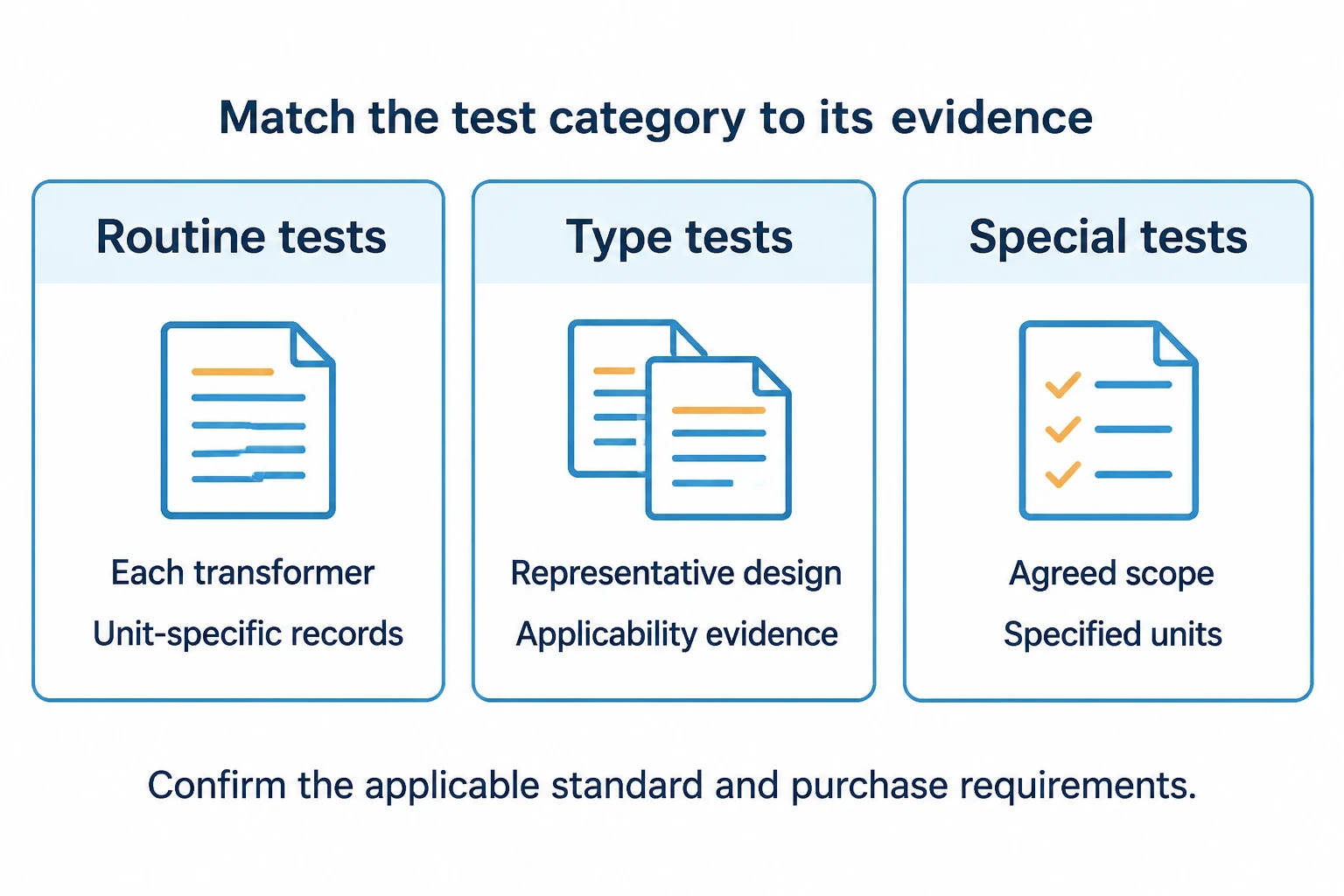
Do not accept “type tested” as a complete response to a request for unit-specific records. Equally, do not request a fresh type test on every unit without first reviewing whether acceptable representative evidence already exists. Have the responsible engineer decide whether a design change affects the relevance of that evidence.
Keep these categories separate from the witness arrangements. The test category describes its coverage; the ITP records whether the buyer will attend, review the results or approve a hold point.
Begin with identity. Check the purchase-order reference, manufacturer, model, serial number, ratings and drawing revision against the approved configuration. A report from a similar transformer may be relevant design evidence, but it cannot silently replace a routine-test report for the unit being supplied.
Then read the values and their conditions together. For winding resistance, temperature affects the measured value. Megger’s technical guidance explains the need for a common reference temperature when comparing results.[4] Ask for the measured temperature and any correction method used, together with the winding, terminal pair and tap position. A number without its unit or measurement context is not ready for comparison.
Use the following table to review the agreed records. It is a document checklist; the applicable standard, approved procedure and purchase requirements determine the test settings and limits.
| Record to review | What the report should identify | Question for the reviewer |
|---|---|---|
| Winding resistance | Unit, winding or terminal pair, tap position, measured values, units, temperature and any correction | Are the values being compared on the same basis? |
| Voltage ratio and phase displacement | Connections, tested tap positions, expected values, measured results and criteria | Do the recorded connections and ratios match the approved design? |
| No-load loss and current | Applied voltage, frequency, measured values and units | Are the results assessed against the corresponding guaranteed values and agreed tolerances? |
| Load loss and short-circuit impedance | Test configuration, tap position, reference basis and reported results | Does the report use the same conditions as the specified requirement? |
| Dielectric tests | Test identity, terminals or insulation involved, applied conditions, duration and result | Does the record cover the dielectric tests specified for this equipment? |
| Insulation resistance, where specified | Connections, test conditions, temperature, measured values and units | Is the reading assessed using the agreed procedure and criterion? |
| Equipment-specific checks | Applicable accessories, protection interfaces, cooling equipment or enclosure checks | Were the items included in the purchase scope actually covered? |
| Type or special test evidence | Tested design or unit, procedure, result, report reference and applicability | Does the evidence apply to this order and its stated configuration? |
Keep the measured result, specified requirement and review conclusion distinguishable in the report. Ask for clarification if “acceptable” appears without the criterion used to reach that conclusion. Where corrections or calculations are necessary, retain enough information for the engineer to follow them.
Request the instrument identification and calibration evidence required by the approved procedure or quality plan. The reviewer should be able to link that evidence to the test date and equipment used. A calibration certificate attached to the report bundle is useful only when its relevance can be established.
Before attending the FAT, agree the notice period, agenda, documents available for review and authority to sign. Identify whether each activity is a witness point, a hold point or a document review. Do not leave the difference to be decided on the test day.
In IOGP S-720Q’s terminology, a hold point prevents further progress without the required approval. A witness point requires notice but may allow the activity to proceed without attendance once the agreed notice conditions are met.[5] Confirm the definitions adopted by your contract, including how a waiver or rescheduled attendance will be recorded.
For remote witnessing, agree how the reviewer will see the equipment identity, test indication and resulting record. Also decide what happens if the connection fails or the record cannot be read. Attendance should produce an identifiable witness record, with any exclusions or unresolved observations documented.
Separate the witness signature from the final acceptance authority. Record what the signature confirms: attendance, review of a particular result, closure of an item or authorization for a defined next stage. This avoids a signed attendance sheet being treated as approval of the entire delivery package.
Separate a missing record from a result that does not meet the agreed requirement. A missing tap-position entry may need a corrected report supported by the underlying test record. An unacceptable result requires a technical disposition. Do not treat either issue as closed simply because a later cover sheet says “passed.”
For each open item, record the affected unit, requirement, issue, responsible person and evidence needed for closure. Ask the responsible engineer to define whether the response requires corrected documentation, further investigation, corrective work or repeat testing. If a deviation is proposed for acceptance, identify who can authorize it and under which purchase-order conditions. IOGP’s quality requirements distinguish correction of nonconformance from customer acceptance under the order conditions.[5]
Return revised evidence to review before recording the acceptance decision.
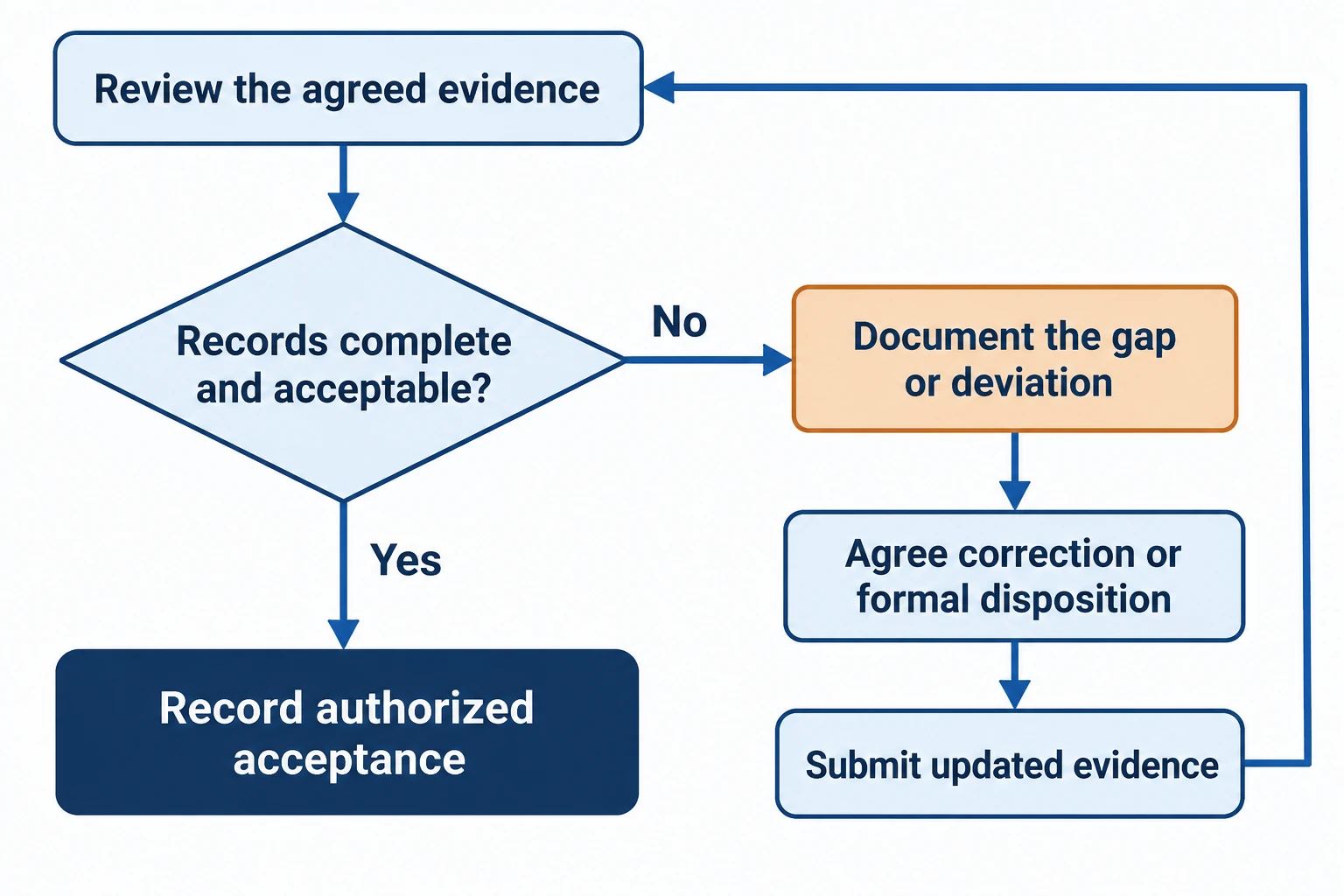
For example, in a hypothetical report review, the serial number matches the order but the resistance table omits the tap positions. The next action is to request the missing information and its underlying record. The omission alone does not establish that the transformer failed, and it does not establish that the required test coverage was completed.
Retain the original issue, revised report and closure reference together. If work changes the configuration after testing, ask engineering to identify which earlier evidence remains applicable and what needs to be repeated. The release record should refer to the final document set and the authorized disposition of every relevant open item.
Ask bidders for the proposed ITP, a blank or redacted report template, the routine-test deliverables for each unit, and the proposed type or special test evidence. Include witness arrangements, notice periods, document language and responsibility for resolving deviations. Comparing these items alongside price makes the testing scope visible; the transformer quote comparison guide explains how to align included and excluded work.
For the offered transformer, request the test schedule and supporting evidence for its configuration. A product description alone does not establish the serial-number records or representative test evidence that will accompany the order.
Before release, assemble the approved specification, completed test schedule, signed reports, applicable design evidence, deviation closures and acceptance record. Keep document names and revisions consistent so the receiving team can identify the package for each transformer. Agree site receipt and commissioning requirements separately, including the records that the site team will need.
No. Factory records describe the equipment and conditions covered by those tests. They do not document its condition after transport, installation or site connections. Define the site acceptance and commissioning scope separately with the responsible engineer and pass the relevant factory records to that team.
An insulation-resistance result covers one part of the agreed assessment. It does not provide the ratio, loss, winding-resistance or other records required by the test plan. Also distinguish insulation resistance from winding resistance when requesting reports; both need their own measurement context. Temperature matters when evaluating resistance readings.[4]
Review representative evidence first. Type testing concerns a representative design, while routine testing covers individual transformers.[3] Ask the supplier to establish the relevance of the type-test report to the offered design, and have engineering assess any differences that could affect the result.
Check the agreed ITP. A witness point may permit progress after the specified notification arrangements, while a hold point requires approval before proceeding.[5] Record any waiver or revised arrangement through the people authorized by the contract.
Treat them as separate evidence questions. An impedance measurement does not by itself demonstrate the transformer’s ability to withstand the thermal and dynamic effects of external short circuits. IEC 60076-5 addresses that withstand capability.[6] Ask engineering which calculations, design evidence or test records are required for the order.