Request a Quote
Share your product list, technical ratings, quantity and delivery destination.
Learn how a vacuum circuit breaker interrupts AC current, how its components and protection interfaces work, and which ratings to check before requesting a quote.
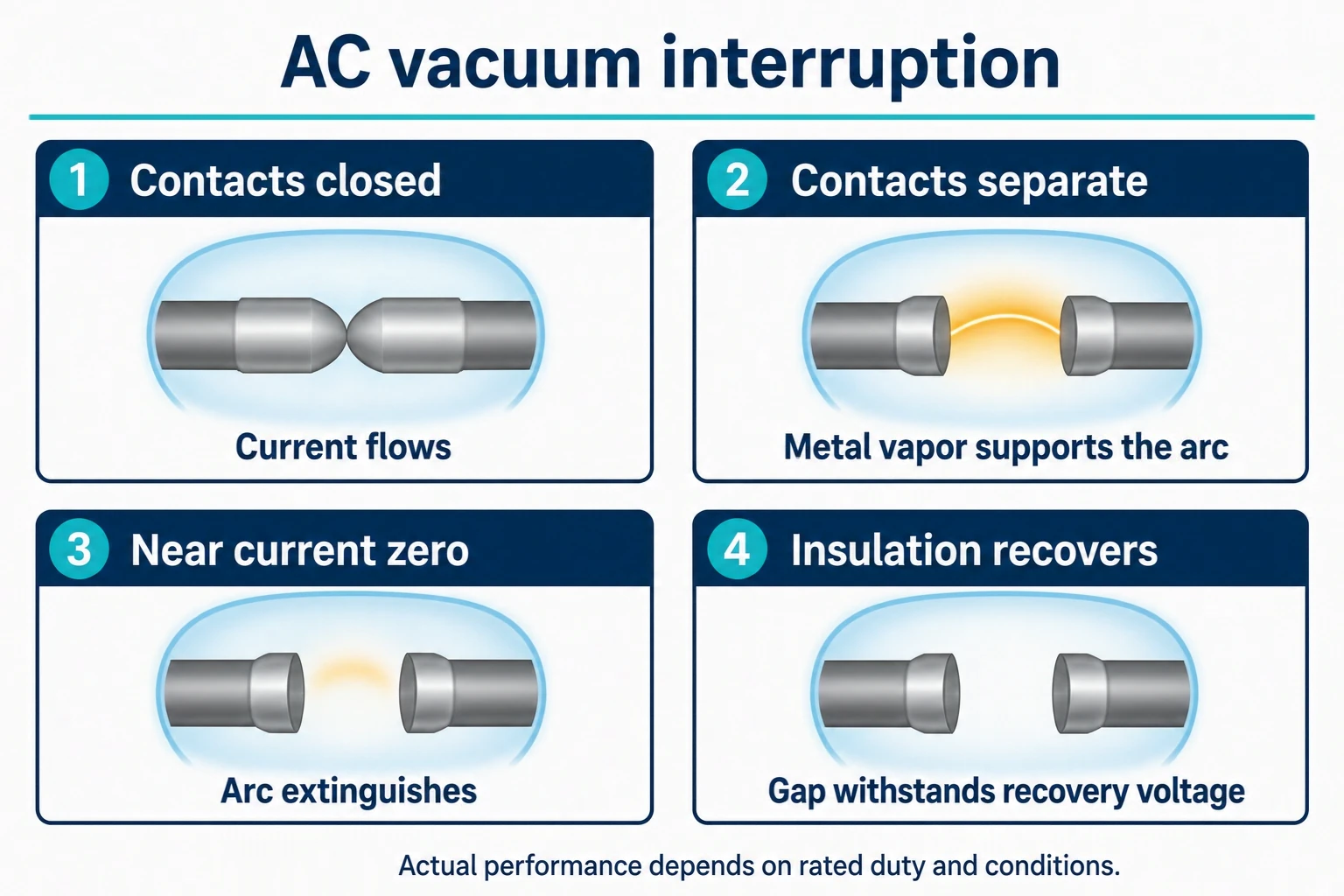
A vacuum circuit breaker opens its contacts inside a sealed vacuum interrupter. An arc still forms as the contacts separate under load. In normal AC interruption, that arc extinguishes near current zero, and the gap rapidly regains the insulating strength needed to withstand the recovery voltage. The vacuum does not prevent every arc from forming. [1][2]
For procurement, separate three questions: can the breaker interrupt the specified duty, can the protection and operating system command it correctly, and does the complete installation meet the project requirements? A vacuum interrupter alone answers none of those questions for the assembled equipment.
Each interrupter contains a fixed contact and a moving contact. A sealed envelope maintains the vacuum; a metal bellows allows the moving contact to travel while preserving the seal. With the contacts closed, current passes through their conducting surfaces. [1][2]
An opening command operates the release and mechanism. As the contacts pull apart while current is flowing, contact material melts and vaporizes locally. This metal vapor provides the conducting medium for an arc across the opening gap. Saying “there is no air, so there is no arc” misses this part of the process. [2]
AC current passes through zero periodically. As the current falls toward zero, the arc loses its sustaining energy. Metal vapor then condenses and the conducting path disappears. The contact design controls the arc during interruption; the relevant current and switching duty must remain within the breaker’s verified capability. [2]
Interrupting current is followed by voltage appearing across the separated contacts. Successful interruption requires the recovering gap to withstand that voltage without renewed conduction. ABB’s description connects rapid vapor condensation with recovery of dielectric strength and the ability to withstand transient recovery voltage. [2]
This sequence explains why visible contact separation is only part of the event. ABB lists opening time, arcing duration and total breaking time separately. When reviewing an offer, ask which timing quantity is stated rather than comparing unlike figures. [2]
The interrupter performs the electrical interruption, while other parts produce motion, provide insulation and connect the breaker to its surroundings. The component descriptions below follow Eaton’s interrupter overview and ABB’s breaker catalogue. [1][2]
| Component | Function | What to confirm |
|---|---|---|
| Fixed and moving contacts | Carry current when closed; support the arc during opening | Applicable current and interruption ratings |
| Sealed envelope and bellows | Maintain the vacuum while permitting contact movement | Exact interrupter identification and approved inspection method |
| Internal shields | Protect parts of the interrupter during service | Manufacturer’s construction and service documentation |
| Operating mechanism and linkage | Move the contacts through the required operating sequence | Mechanism type, endurance and maintenance requirements |
| Insulating supports and main terminals | Support the poles and connect the primary circuit | Insulation level, terminal geometry and installation arrangement |
| Releases and auxiliary contacts | Receive commands and provide operating/status interfaces | Coil supply, contact availability and wiring diagram |
Mechanism design varies. Stored-energy spring mechanisms and electromagnetic or magnetic-latch arrangements are different solutions, not interchangeable names. Specify the supplied mechanism and its control requirements instead of assuming all VCBs use the same operating system. [2][6]
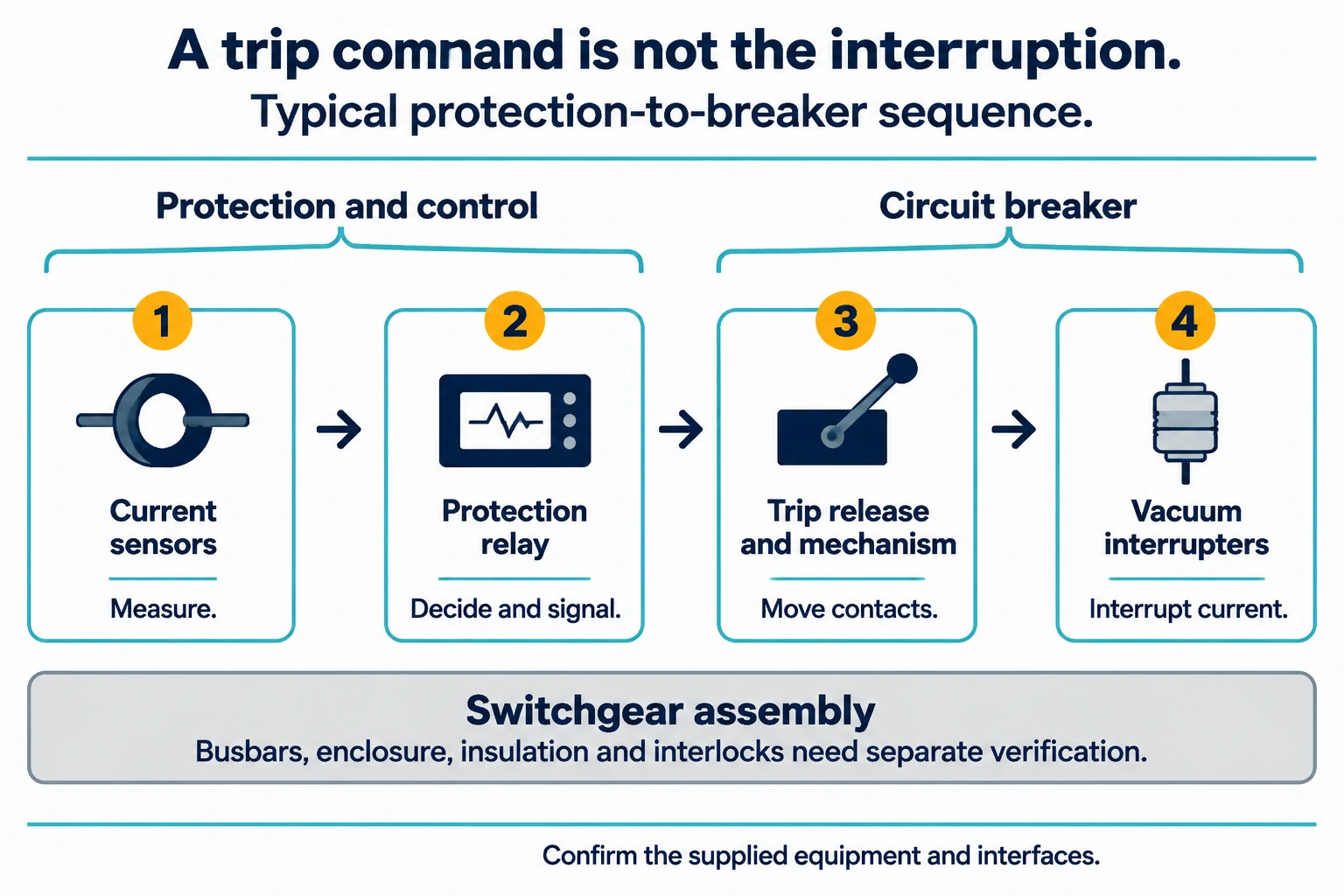
In a typical protection scheme, current sensors or CTs supply measurements to a protection relay. The relay evaluates its configured functions and issues a trip command. The trip release and operating mechanism then move the breaker contacts. Actual interruption takes place inside the vacuum interrupters. ABB lists protection relays and current sensors as available equipment alongside its secondary-distribution breakers. [2][3]
Confirm who supplies and integrates each interface. An RFQ should identify the relay or controller scope, CT or sensor requirements, auxiliary supply, trip and closing releases, and required status contacts. ABB’s catalogue notes that the delivered accessories are those included in the order acknowledgement; a product-family brochure is not an accessory list for a particular order. [2]
The full switchgear assembly adds another boundary. Busbars, enclosure, insulation, earthing arrangements and interlocks need their own design and verification. The public scopes of IEC 62271-100 and IEC 62271-200 distinguish circuit breakers from metal-enclosed switchgear assemblies. A breaker test report is not, by itself, proof that the complete cabinet meets the assembly requirements. [4][5]
Also, “vacuum” identifies the interrupting technology. It does not describe every insulating material or compartment in the surrounding equipment. Confirm the complete assembly when the project has an insulation-medium or environmental requirement. [5][6]
VCBs serve industrial distribution, transformer substations and other medium-voltage switching and protection applications. ABB describes secondary-distribution use in factories and industrial workshops. Indoor fixed or withdrawable breakers must match the intended switchgear interface; a matching voltage and current rating does not prove that a replacement will fit an existing cubicle. [2][3]
For an indoor replacement, request the approved outline, pole spacing, main-contact arrangement, auxiliary connector details and interlock interface. Use the existing equipment drawings rather than relying on a front-view photograph.
Outdoor distribution equipment requires a different installation review: mounting, external insulation, environmental conditions, controller supply and communications may all affect the specified package. HJD’s outdoor vacuum circuit breaker range is a starting point for that enquiry, not confirmation of a complete feeder-automation package.
Do not infer automatic reclosing from the presence of vacuum interrupters. Eaton identifies circuit breakers, reclosers, contactors and load-break switches as distinct applications of the technology. Define the required device function, operating sequence and controller separately. [1]
A rated-current value states a different duty from a short-circuit breaking rating. Likewise, short-time withstand, making capability and insulation withstand describe different stresses. ABB’s published rating schedule lists these separately, along with frequency and operating sequence. [2]
| Rating or condition | What it describes | Buyer check |
|---|---|---|
| Rated voltage and frequency | The system basis for the equipment rating | Match the project system and applicable standard |
| Rated normal current | Continuous current-carrying duty under stated conditions | Confirm installation and ambient assumptions |
| Short-circuit breaking current | Fault-current interruption capability under specified conditions | Compare with the project fault study and recovery-voltage duty |
| Short-time withstand current | Current the closed equipment withstands for a specified duration | Read the current and duration together |
| Making and peak-current ratings | Closing duty and peak electrodynamic stresses | Do not substitute an RMS breaking-current figure |
| Insulation withstand levels | Power-frequency and impulse voltage withstand duties | Obtain the relevant test configuration and values |
| Operating sequence and endurance | Permitted switching sequence and mechanical/electrical duty | Confirm the actual load and required operations |
For an IEC-based project, the public scope of IEC 62271-100:2021+AMD1:2024 covers three-phase AC circuit breakers above 1,000V operating at 50Hz and/or 60Hz. IEC 62271-200:2021+AMD1:2024 addresses specified metal-enclosed assemblies above 1kV through 52kV. These scope statements help identify the relevant documents; they do not establish a product’s compliance. Ask for the applicable edition and model-specific evidence. [4][5]
Send the single-line diagram, system voltage and frequency, load duty, fault-study requirements and indoor or outdoor location. For a replacement, include the existing nameplate and interface drawings. Ask the supplier to return a rating schedule, dimensional drawing, control schematic, accessory list and an explicit list of exclusions.
Request the relevant type-test evidence and routine-test records for the offered configuration. ABB’s catalogue distinguishes tests of insulation, current withstand, making/breaking capability and mechanical life from individual checks such as circuit resistance and operation. Use that distinction to ask what each supplied report actually covers. [2]
Obtain the maintenance instructions and inspection criteria too. A sealed-for-life interrupter does not make every mechanism or assembled breaker maintenance-free: ABB describes sealed interrupters alongside regular maintenance for its Vmax breaker. Do not invent a common inspection interval or field vacuum-test voltage for unrelated models. [2]
Review HJD’s indoor vacuum circuit breakers or the outdoor range, then contact HJD with the project requirement. Submit supporting documents through the contact channel provided and request confirmation of the complete supply scope before ordering.
No. Contact material supplies metal vapor that can sustain an arc when loaded contacts separate. Interruption depends on extinguishing that arc and recovering sufficient insulation across the gap, not simply removing air. [2]
No. Rated normal current concerns continuous carrying duty. Short-circuit breaking current concerns interrupting a fault under specified conditions. Compare both, together with voltage, frequency, operating sequence and other required ratings. [2]
Do not assume so. A sealed interrupter and the complete breaker have different service requirements. Follow the model-specific instructions for the mechanism, interfaces and inspections, and obtain the manufacturer’s permitted checks and acceptance criteria. [2]