Request a Quote
Share your product list, technical ratings, quantity and delivery destination.
Understand transformer cooling codes, ONAN, ONAF, OFAF and ODAF, dry-type AN/AF, cooling-stage ratings and the details to confirm in an RFQ.
Transformer cooling describes how heat travels from the active parts to the surroundings. A code such as ONAN or ONAF identifies the cooling media and their circulation methods. To specify a transformer, pair that code with the offered power rating, site conditions and required cooling equipment.[2][5]
Start by asking the supplier to show the cooling circuit and identify the equipment required for each rating. A quotation should make clear which fans, pumps, controls and auxiliary supplies are included, and what operating conditions apply if cooling equipment becomes unavailable.
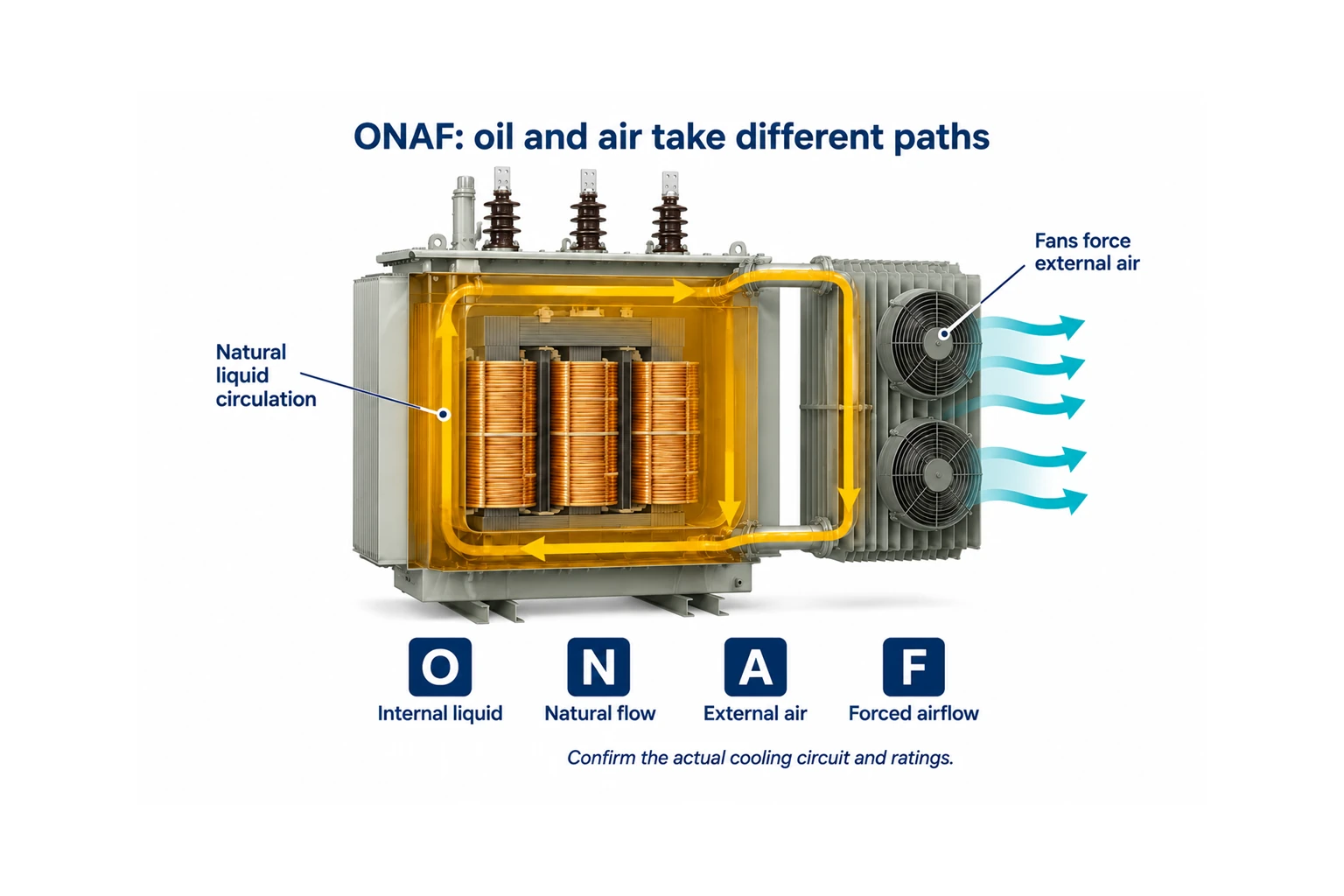
In a liquid-immersed transformer, insulating liquid carries heat from the active assembly toward the tank’s cooling surfaces or connected radiators. Radiators increase the surface available to release that heat. In a natural-circulation arrangement, warmed liquid rises and cooler liquid returns toward the lower part of the tank.[3]
This creates two questions: how does the internal liquid circulate, and how does the external cooling medium move? A fan acting on the outside of a radiator does not, by itself, mean that a pump drives the liquid inside it.[2]
The oil-immersed transformer guide explains the tank, active assembly and liquid system behind this heat path.
IEC 60076-2:2011 covers temperature rise for liquid-immersed transformers and identifies their cooling methods. Its public preview defines the four positions below; Eaton’s substation guide also presents this classification.[1][2][5]
| Position | Question answered | Common symbols |
|---|---|---|
| First | What is the internal cooling liquid? | O, K or L, according to the specified liquid classification |
| Second | How does that liquid circulate? | N: natural; F: forced, non-directed; D: forced and directed into the main windings |
| Third | What receives the heat externally? | A: air; W: water |
| Fourth | How does the external medium move? | N: natural convection; F: mechanically forced circulation |
For the first letter, O covers mineral oil or synthetic insulating liquid with a fire point at or below 300°C. K identifies insulating liquid with a fire point above 300°C; L identifies liquid with no measurable fire point. These are liquid-classification definitions, not permissible transformer operating temperatures.[2][5]
Ask for the actual fluid specification as well as the letter. “KNAN” alone does not identify the fluid brand, establish a complete installation fire assessment or confirm the offered model’s other characteristics.
The four common examples below use air as the external cooling medium. The internal-liquid circulation changes independently of the external-air circulation.[2][5]
| Code | Internal-liquid circulation | External-air circulation |
|---|---|---|
| ONAN | Natural circulation | Natural convection |
| ONAF | Natural circulation | Fan-driven airflow |
| OFAF | Pumped through cooling equipment; winding flow remains non-directed | Fan-driven airflow |
| ODAF | Pumped through cooling equipment and directed into at least the main windings | Fan-driven airflow |
ONAF therefore retains natural liquid circulation. The F at the end describes forced external airflow.
The distinction between OFAF and ODAF needs more than a photograph of a pump. Under the IEC definition, F uses forced circulation through the cooling equipment while winding circulation remains thermosiphon-driven. D directs the pumped flow into at least the main windings.[2][5]
When a proposal changes from one method to another, request the supplier’s circuit description and revised technical schedule. Keep the cooling designation tied to the actual internal arrangement instead of inferring it from the visible accessories.
Dry-type transformer documentation commonly uses AN for natural-air cooling and AF for forced-air cooling. Schneider Electric’s Trihal installation manual treats these air-ventilation arrangements separately from liquid cooling.[4]
For a dry-type enquiry, identify whether the offered rating requires transformer-mounted fans and what clear airflow paths the installation must provide. Room ventilation and the transformer’s own fan equipment should appear as separate items in the discussion. A room exhaust fan does not document the transformer’s AF rating.
Arrows indicate overall airflow around the assembly; the actual ventilation openings, cooling ducts and clearances must come from the offered model’s documentation.
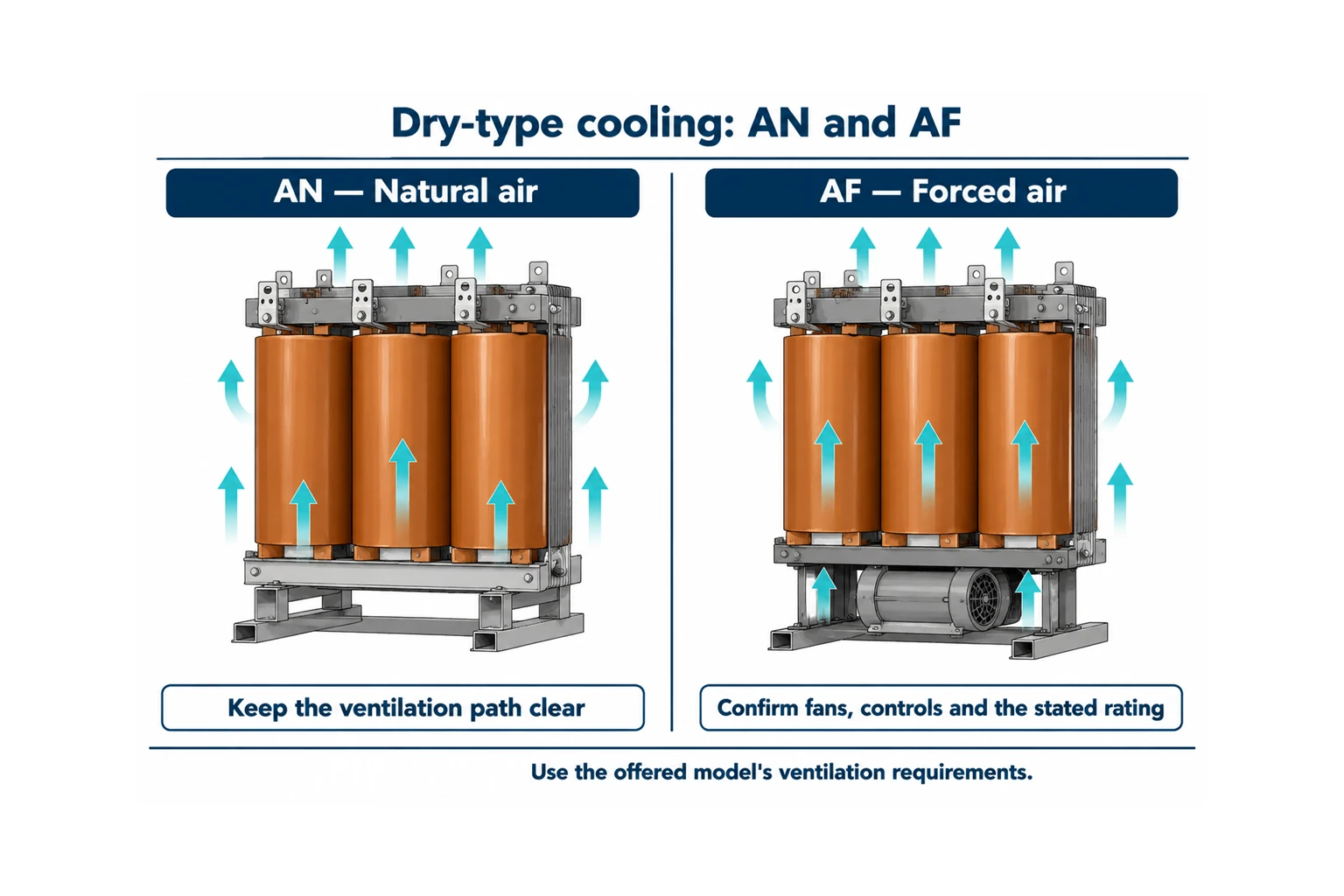
Request a drawing of the complete supplied assembly, including any enclosure and blower equipment. Use the dry-type versus oil-filled comparison when the insulation construction itself is still undecided.
A transformer may have alternative cooling methods. IEC 60076-2 explains that the specification and rating plate should identify the corresponding power values. Its ONAN/ONAF example retains natural liquid circulation in both operating modes.[2]
Copy the proposed cooling designations and their associated ratings into separate RFQ fields. Ask which accessories must operate at each stage, the environmental conditions assumed, and whether all required equipment is included in the price.
Do not apply a general percentage increase because fans are present. A manufacturer’s documented rating applies to its specified design and conditions. If a quotation gives only one kVA value beside “ONAN/ONAF,” ask the supplier to explain the relationship before treating the offer as complete.
The load calculation remains a separate input. Use the transformer sizing guide to assemble demand and operating assumptions, then have the supplier confirm the relevant cooling stage for that duty.
Cooling equipment creates interfaces that belong in the supply scope. Request the required auxiliary voltage, frequency and phase arrangement, together with the equipment power demand and the party responsible for providing the supply.
For the control package, ask for a description covering automatic operation, any manual mode, temperature inputs, status indications and the signals available to the site control system. Schneider’s Trihal documentation provides a manufacturer-specific example of cooling and temperature-protection arrangements; its configuration does not establish settings for another transformer.[4]
Resolve these questions in the technical review:
A lost cooling stage needs a model-specific answer. Do not assume that any forced-cooled transformer can continue indefinitely at an invented percentage of its normal rating. If a natural-cooling fallback is offered, obtain its documented conditions and applicable power value before including it in the operating plan.
Keep alarm and protection settings in the approved control documents. A general cooling guide cannot establish those values for the project.
Describe the actual installation: ambient conditions, altitude, room or outdoor location, ventilation constraints, access and expected contamination. Ask the supplier to identify departures from the conditions used for the offered rating. Obtain the required space around cooling surfaces and the access needed to inspect or replace accessories.
In a four-letter liquid-immersed designation, W in the third position means water is the external cooling medium.[2][5] For such an offer, request the heat-exchanger arrangement and the specified water conditions, connection details and monitoring requirements. Agree who supplies the water circuit and which cooling equipment belongs inside the transformer package.
Do not infer water quality, flow rate or permitted temperature from the letter W. Put the supplier’s requirements into the interface schedule so the site-services team can review them.
The enquiry package should connect the requested duty to an identifiable design. Include the load requirement, cooling preference if already decided, site conditions and available auxiliary services. Request the cooling circuit description, rating-plate information, accessory list, control description and operating limitations together.
When comparing quotations, mark missing items explicitly. An offer that includes fans without their supply or controls has a different delivery scope from one that includes the complete agreed package. Resolve those boundaries before comparing the total project provision.
Use the transformer specification checklist to organize the wider enquiry. Send HJD the project requirements and request confirmation of the available configuration, cooling-stage ratings and supporting documents before selecting a model.
Use the manufacturer’s stated rating for the exact transformer, fan equipment and operating conditions. For a multi-stage offer, request the rating associated with each cooling method and the approved response if a required stage becomes unavailable.