Request a Quote
Share your product list, technical ratings, quantity and delivery destination.
Learn what is inside an oil-immersed transformer, how its liquid and preservation system work, and which project inputs to prepare for a comparable quotation.
An oil-immersed transformer contains its core and windings in a tank of insulating liquid. The liquid provides electrical insulation and carries heat away from the active parts. These two jobs explain much of the equipment around the tank: cooling surfaces, liquid-level arrangements and devices that monitor operating conditions.[1]
For a buyer, “oil-immersed” identifies a construction family. A usable specification must also describe the electrical duty, insulating liquid, preservation system, cooling conditions and installation interfaces. Start with those choices before comparing dimensions, accessories or price.
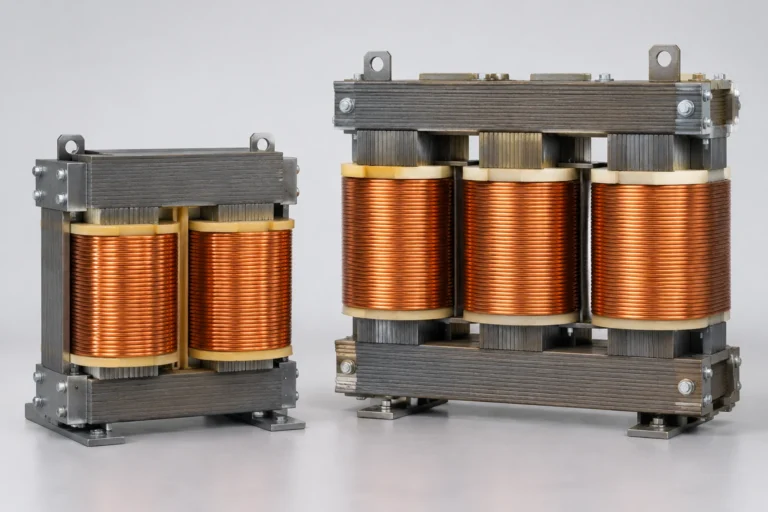
The core provides the magnetic path, while the windings connect the transformer to its electrical circuits. The liquid surrounds this active assembly; solid insulation is also part of the design. Eaton’s construction brochure illustrates a laminated electrical-steel core and copper or aluminum winding options, showing why material details belong in the supplier’s technical schedule.[2]
The outside appearance can vary considerably. A small distribution unit and a larger power transformer may both be liquid-filled while using different terminals, tanks and accessories. Use the following component map to read a general arrangement drawing.[2][6]
| Component | Function | What to confirm in the offer |
|---|---|---|
| Core and windings | Form the active electromagnetic assembly | Winding arrangement, conductor material and declared losses |
| Insulating liquid and solid insulation | Provide the insulation system around and within the active assembly | Named liquid, insulation system and applicable requirements |
| Tank and seals | Contain the active parts and liquid | Preservation arrangement, leakage requirements and access points |
| Bushings or cable interfaces | Provide insulated electrical connections through the enclosure | Terminal arrangement, cable entry and connection dimensions |
| Cooling surfaces or radiators | Transfer heat from the liquid to the surroundings | Cooling arrangement, clearances and any auxiliary equipment |
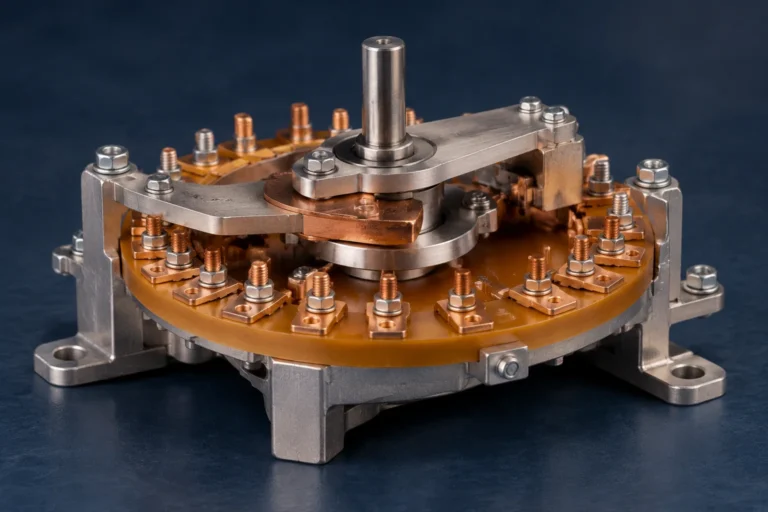
| Monitoring and tap-changing equipment | Support condition monitoring or voltage-ratio adjustment | Included devices, signal contacts and adjustment method |
Treat this as a drawing checklist. Ask the supplier to identify what is included, optional or supplied by another party. A picture of an accessory on a brochure does not settle the scope of a particular quotation.
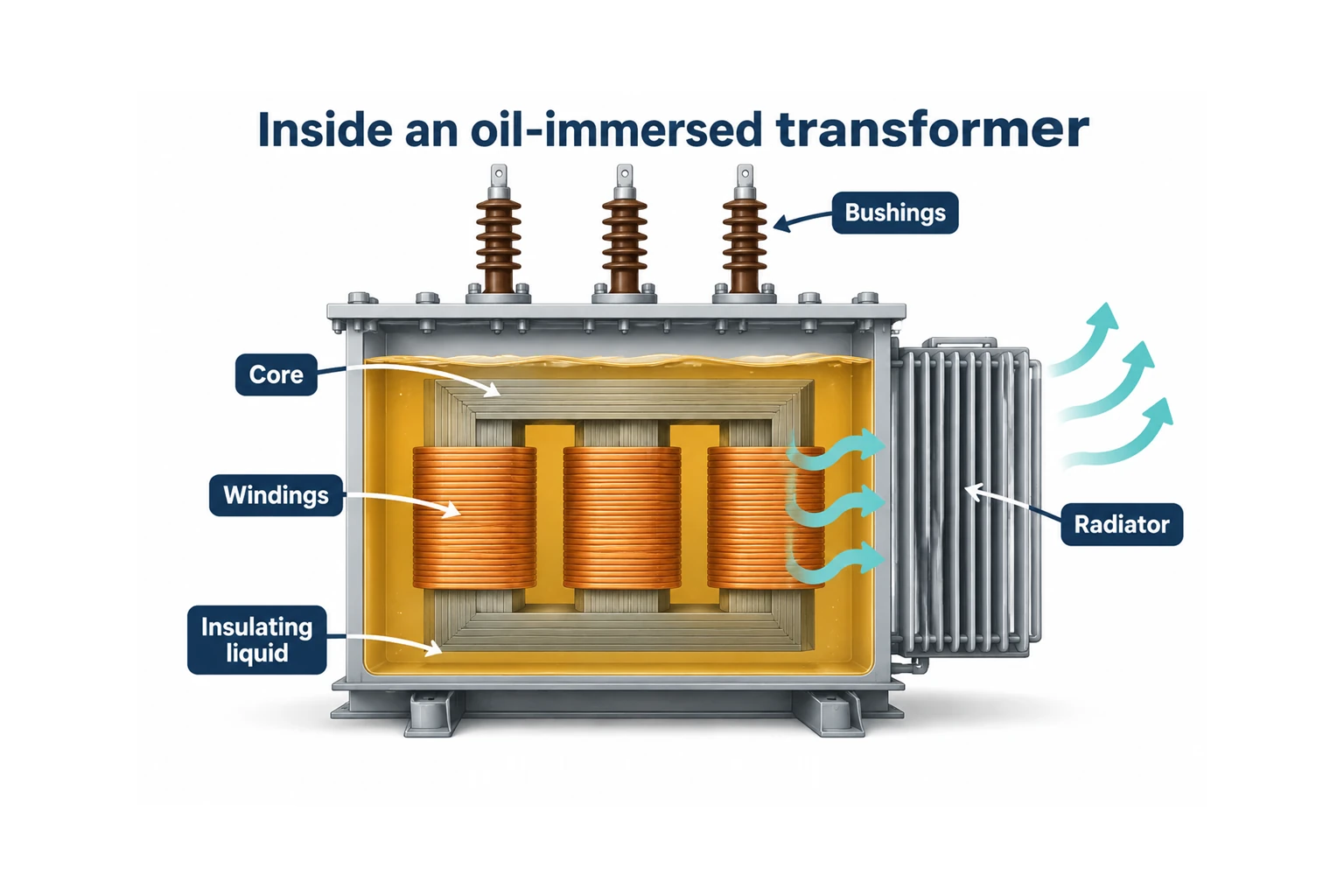
Electrical insulation depends on the complete insulation system. The liquid helps withstand electrical stress between internal energized parts, while also transferring heat away from them. The Bureau of Reclamation describes both functions and explains that oil condition changes with operating heat and contamination.[1]
That has a procurement consequence: the liquid specification and the transformer’s thermal design need to be reviewed together. A request for “good transformer oil” gives suppliers no common acceptance basis. Ask for the liquid designation, the proposed acceptance requirements and the documents that will identify the fluid delivered with the unit.
The liquid also needs protection from contamination during handling and service. Eaton’s user manual describes the importance of keeping moisture out and preserving the separation between ambient air and the insulating liquid in sealed designs.[3] Request the manufacturer’s handling and maintenance instructions with the offer so the site team can assess the work and facilities it will need.
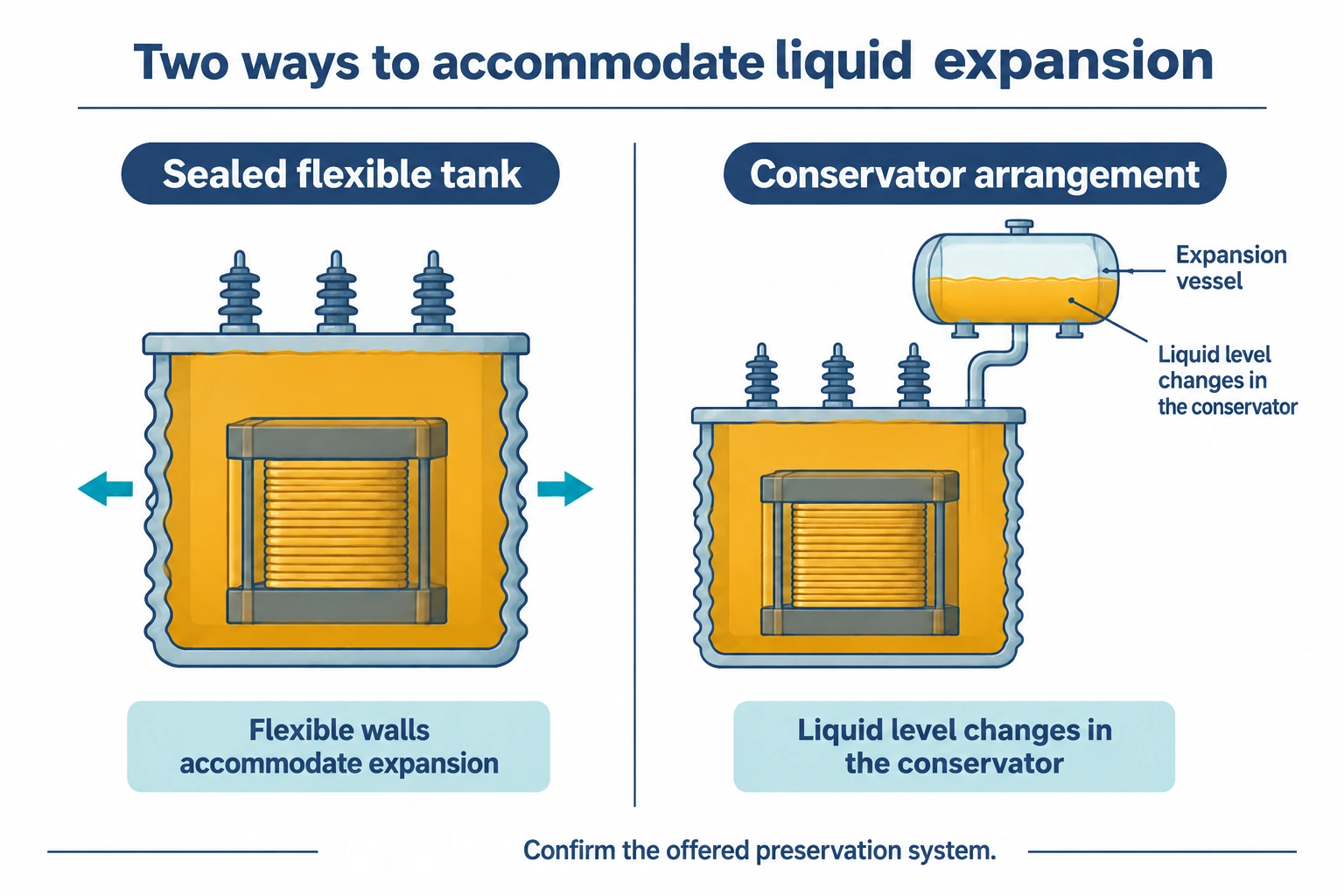
Liquid volume changes with temperature. The preservation arrangement must accommodate that change while controlling the liquid’s exposure to the atmosphere.[3][6] Two common arrangements help explain what to look for on a drawing.
A sealed transformer has a defined way to accommodate volume changes without routine breathing through an open liquid surface. Designs differ: some use a gas cushion, while fully filled designs may use flexible tank corrugations or specially designed cooling surfaces.[3][6]
The illustration below shows a fully filled, sealed flexible-tank example. Ask for the actual preservation arrangement rather than treating every sealed unit as the same construction. “Sealed” also does not remove the need to inspect the complete unit under its manufacturer’s maintenance plan.[3]
A conservator is a separate vessel connected to the main tank. Its liquid level accommodates expansion and contraction. The associated air-management arrangement may include a breather or a separator; the exact equipment depends on the design.[6]
For a replacement project, request the overall height and the service access required by this equipment. A transformer that fits the foundation can still conflict with overhead structures or leave an accessory difficult to reach. Check the complete assembled drawing, including parts installed after transport.
“Liquid-filled” is the broader description. Mineral oil is one insulating liquid; ester fluids are also used in transformers. Cargill’s FR3 technical documentation, for example, describes a vegetable-oil-based natural ester and gives fluid-specific properties and acceptance information.[4]
Keep those properties tied to the named fluid. A supplier’s description of a liquid as biodegradable or having a higher fire point does not establish that the complete installation satisfies the project’s fire, environmental or insurance requirements. Ask the project engineer to identify the required installation conditions, then request evidence for the offered equipment and fluid combination.
Put the fluid choice in the RFQ when it is already fixed. If it remains open, request separately identified alternatives with their technical and commercial differences. Compare the complete proposals, including any changes to cooling, handling documentation, required accessories and site provisions. Do not treat a fluid substitution as an administrative change to an otherwise identical order.
An oil-immersed unit may serve a distribution load or another power-system duty. “Oil-immersed,” “distribution” and “step-down” describe different aspects of a transformer; they are not interchangeable specification fields.[2][6]
Describe the unit’s position in the system, the circuits it connects and the expected operating duty. For the application distinction, use the separate guide to power transformers and distribution transformers. If the project has not yet settled on liquid-filled construction, the dry-type versus oil-filled comparison covers the installation decision in more detail.
Cooling surfaces need access to the intended cooling medium. Depending on the design, heat rejection can use the tank surface, radiators and auxiliary cooling equipment.[2][6] A quotation should identify the cooling arrangement associated with each offered rating.
Give the supplier the installation location, ambient conditions and expected load pattern. Where the unit is inside a room or enclosure, provide the ventilation concept and space constraints for review. If an offer includes more than one cooling stage, ask which capacity is available in each stage and what auxiliary power and controls are required.
Keep the declared losses and cooling assumptions together when comparing offers. Two quotations with the same headline kVA can carry different operating assumptions. Resolve those differences before deciding that one unit is smaller, more efficient or less expensive for the project.
A useful enquiry lets suppliers work from the same electrical and physical information. Use the table below as an input list, recording unknowns explicitly rather than allowing each bidder to assume a different answer.
| Input group | Information to provide | Response to request |
|---|---|---|
| Electrical duty | Required capacity, voltages, phase, frequency and load pattern | Rated schedule, connections and declared deviations |
| System interfaces | Grounding arrangement, impedance requirement and available system data | Connection diagram and items needing engineering confirmation |
| Liquid and preservation | Required fluid, or permitted alternatives; any preservation preference | Named fluid and the proposed tank/preservation arrangement |
| Site and cooling | Ambient conditions, altitude, indoor or outdoor location and ventilation constraints | Applicable rating conditions and cooling requirements |
| Physical interfaces | Foundation, access route, cable entry and terminal requirements | General arrangement, masses and connection details |
| Accessories and evidence | Monitoring signals, tap-adjustment requirement, specified standards and acceptance documents | Itemized scope, test plan and document list |
For example, a replacement enquiry might initially specify only the existing unit’s capacity and voltage. Adding the cable termination positions, delivery-route limits and required alarm contacts gives bidders concrete interfaces to address. Label the old drawing as reference information and identify dimensions that have been confirmed on site.
Use the transformer specification checklist to develop the electrical schedule. Keep unresolved engineering inputs in a separate list so the quotation can state its assumptions clearly.
The public scope of IEC 60076-1 includes general power-transformer requirements and provisions concerning liquid preservation systems and tank testing.[5] Referencing a standard in an enquiry still leaves practical decisions to be made about the applicable edition, tests, documents and project-specific requirements.
Request a drawing set and technical schedule that describe the actual offered construction. For liquid-filled equipment, include the fluid documentation, preservation-system description, accessory schedule and the manufacturer’s handling and maintenance instructions. The transformer testing guide explains how to organize the requested test records.
Review any voltage-adjustment requirement separately. A tap range in a quotation does not tell the buyer whether adjustment requires an outage or whether the transformer includes an on-load tap changer.[3][6] Have the supplier name the device and its intended operating conditions; the site engineer can then check whether that arrangement meets the project’s voltage-control needs.
To discuss an enquiry, use HJD’s contact page and provide the electrical schedule, installation location and available drawings. Request the proposed configuration, inclusions and deviations together so the technical review has a clear starting point.
The fluid choice is one input to that decision. Request the complete equipment configuration and the applicable installation requirements. Fluid-property statements alone do not establish acceptance of the room, protection arrangements or complete transformer installation.[4]
Those are starting inputs. An RFQ also needs the connections, operating conditions, physical interfaces, fluid and preservation requirements, accessories and acceptance documents. Record missing inputs as engineering questions before treating quotations as directly comparable.