Request a Quote
Share your product list, technical ratings, quantity and delivery destination.
Compare power and distribution transformers by system role, loading and project requirements. Use an RFQ checklist to request comparable supplier quotations.
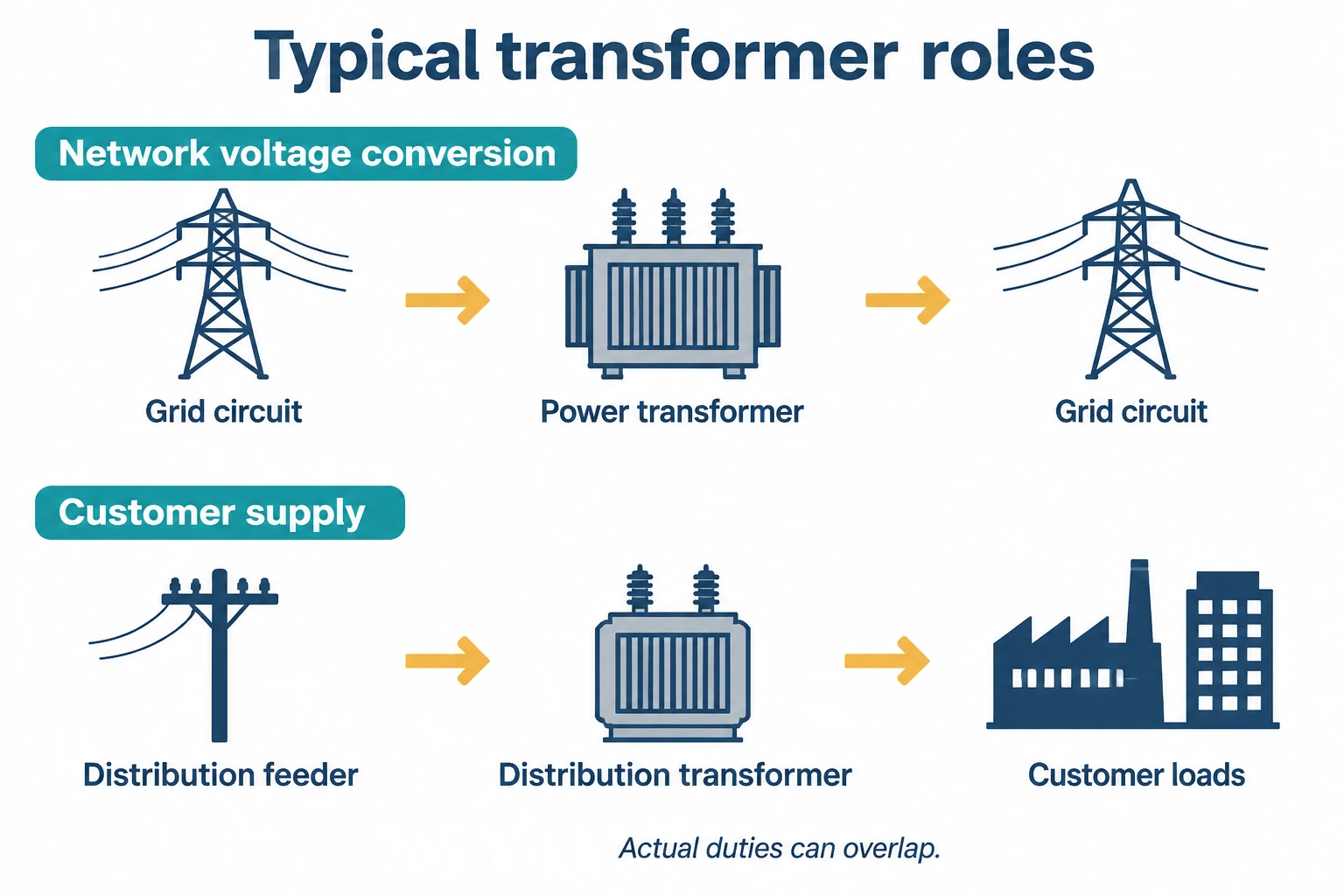
A power transformer typically changes voltage between network circuits; a distribution transformer typically brings a distribution circuit down to the voltage needed by customers. OSHA’s power-system glossary describes the roles in these terms, without setting a universal capacity boundary between them. [1]
For procurement, identify where the transformer connects, what load it serves and which operating conditions the quotation must cover. The equipment name alone leaves too many decisions open. A useful RFQ gives each supplier the same electrical, thermal and installation basis, then asks them to identify deviations.
Locate the transformer on a single-line diagram before choosing a catalogue category. Is it connecting network voltage levels, or supplying the voltage required by a building, production line or local group of customers? Record the circuits on both sides and the intended direction of power flow. [1]
Terminology also depends on context. IEC 60076-1:2011 is titled Power transformers, yet its public scope covers single-phase and three-phase power transformers, including autotransformers, subject to stated exclusions and other applicable standards. Its title should not be read as a procurement category restricted to large transmission equipment. [2]
| Project question | Network-circuit project | Customer-supply project |
|---|---|---|
| System role | Which network voltage levels must be connected? | Which incoming circuit and customer voltage must be matched? |
| Loading | What transfer duty and contingency loading must be covered? | What operating shifts, load peaks and future demand must be covered? |
| Voltage control | What operating range and control scheme does the network require? | What voltage variation is acceptable at the supply terminals? |
| Site interfaces | Which substation connections and control signals are in scope? | Which incoming and outgoing cables or busbars must the installation accept? |
| Acceptance | Which network-owner specifications and witness points apply? | Which project-owner or utility requirements and acceptance documents apply? |
Use these as project questions. A factory supply may also have contingency duty, and a network transformer may have cable interfaces. Complete both columns from the project documents where relevant.
A supplier may use a capacity range to organize its catalogue. A regulation may define a narrower product class for a particular programme. Neither should become a global rule for naming transformers.
For example, the US Department of Energy’s distribution-transformer programme uses a definition involving input voltage, output voltage, frequency, capacity and exclusions. Check that programme’s applicability when buying for the US; do not apply its definition as a worldwide classification. [3]
Construction is a separate question. Hitachi Energy lists both liquid-immersed and dry-type equipment within its distribution-transformer portfolio. Its listed applications also include renewable-energy step-up duties. These examples show why neither insulation type nor a step-down-only assumption is enough to classify every enquiry. [4]
Avoid descriptions such as “power transformers operate at full load” or “distribution transformers operate at light load.” Supply the expected load over time, the duration of peaks, planned growth and any duty during an outage of other equipment.
Keep normal service and contingency service separate. If the project requires temporary loading beyond a normal rating, ask the supplier to state the permitted duration, cooling assumptions, ambient conditions and limitations for the proposed design. Do not treat an unspecified overload allowance as spare capacity.
IEC 60076-7:2018 addresses mineral-oil-immersed transformers and relates loading and ambient temperature to operating temperature and thermal ageing. Its public scope supports specifying those conditions together. It is not a loading guide for every dry-type or alternative-liquid design. [5]
State the required input and output voltages, frequency, phases and operating ranges. Ask the project engineer to define the winding connection, neutral requirements, impedance basis and system fault conditions needed for supplier evaluation.
Specify the tap range and required method of adjustment. If adjustment during energized operation is required, include that requirement explicitly. If it is not required, ask the supplier to identify the proposed arrangement. Do not select a tap-changing method from the words power or distribution alone.
The same discipline applies to physical connections. Identify cable or busbar interfaces, termination positions, monitoring signals and the boundary between supplier equipment and site work. A quotation with an unresolved terminal arrangement still needs clarification before purchase.
Request guaranteed no-load and load losses separately, with the applicable test and reference conditions. Then evaluate the offers using the project’s expected service profile and a common financial method.
The ENERGY STAR purchasing guide published in 2017 and hosted by DOE separates purchase price, no-load losses and load losses in a total-owning-cost approach for liquid-immersed distribution transformers. That method is useful here; its historical prices, savings estimates and regulatory references are not current project inputs. [6]
Avoid ranking two offers from headline efficiency alone when the quoted load point, reference temperature or included auxiliary consumption differs. Ask suppliers to reconcile the basis before comparing the figures. The evaluation method should be agreed before bids arrive, so a lower purchase price cannot obscure a different loss guarantee or supply scope.
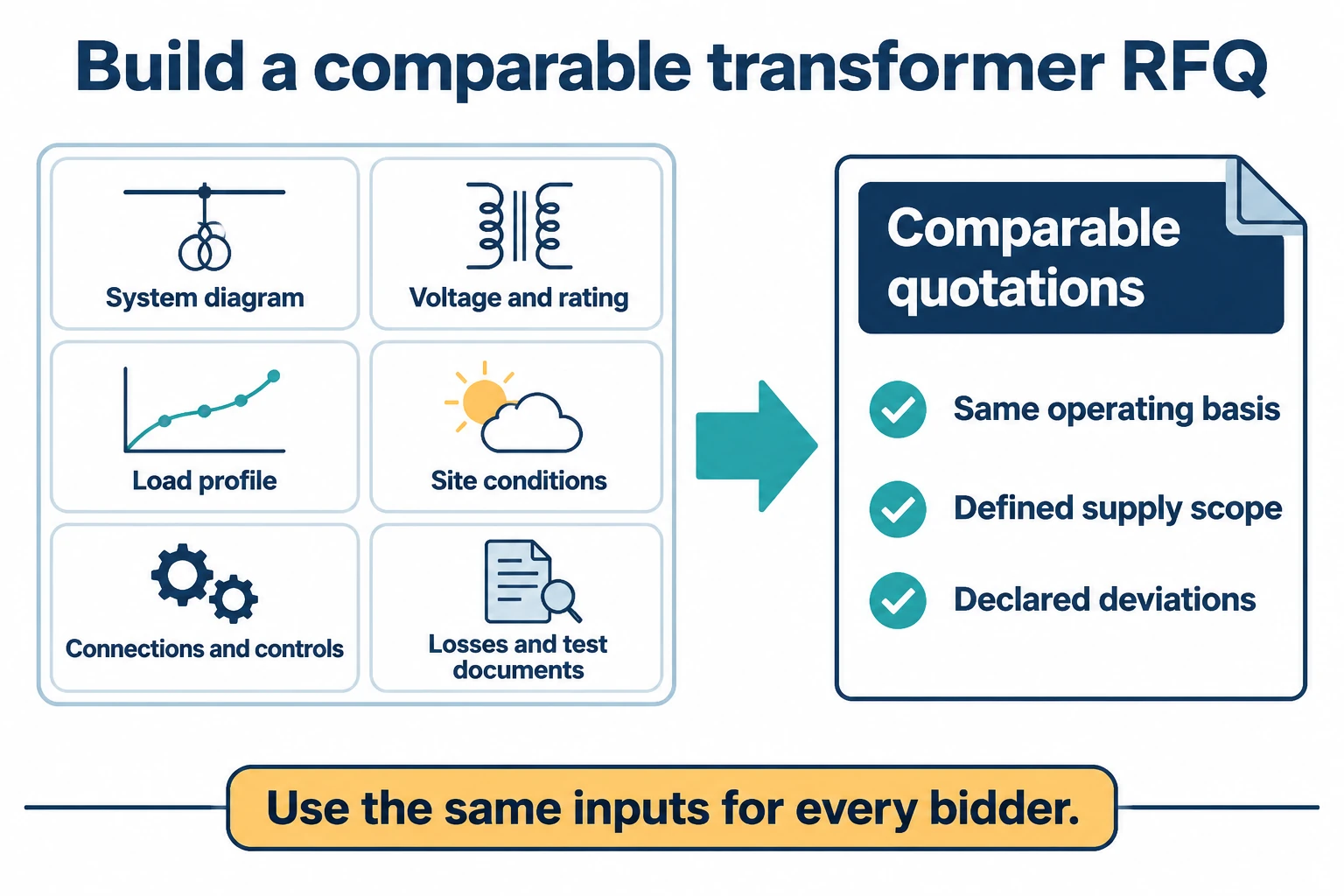
Send a common schedule and require each supplier to mark an item as compliant, proposed with a deviation, or awaiting clarification. Use the following as a procurement checklist, with electrical requirements completed by the responsible project engineer.
| RFQ item | Information to provide | What to check in the quotation |
|---|---|---|
| System role | Single-line diagram, connection points and intended power flow. | The offered arrangement serves the stated circuits and duty. |
| Electrical rating | Required kVA or MVA, voltages, frequency, phases and cooling basis. | The quoted rating uses the requested operating conditions. |
| Loading and environment | Load profile, peak duration, contingency duty, ambient conditions and altitude. | Assumptions, cooling provisions and operating limitations are declared. |
| Winding and voltage control | Engineer-defined connection, neutral, impedance and tap requirements. | Proposed values and control arrangements are explicitly stated. |
| Installation and interfaces | Location, space envelope, transport access, terminations and control interfaces. | Drawings identify dimensions, connections and site responsibilities. |
| Losses and evaluation | Required loss guarantees, reference conditions and bid-evaluation method. | Figures are comparable and exceptions are visible. |
| Acceptance and supply scope | Applicable standards and editions, test schedule, documents, accessories and delivery scope. | Included tests, reports, witness points and exclusions are itemized. |
For a fuller data schedule, use the transformer specification checklist. Keep acceptance requirements alongside it: the transformer testing guide helps organize the documents and test questions to discuss with suppliers.
Consider two enquiries with the same requested capacity. One concerns a transformer connecting two network circuits, with a defined contingency load during another unit’s outage. The other supplies a factory whose load changes by shift and whose incoming cables enter through a fixed site interface.
The first enquiry needs the contingency duration and operating conditions resolved. The second needs the shift profile and cable interface resolved. Both still need voltage, cooling, loss and acceptance requirements. Asking only for “a power transformer” or “a distribution transformer” would leave the most consequential differences out of both quotations.
Before requesting prices, assemble the single-line diagram, the completed schedule and the relevant site or interface drawings. Identify unknown items explicitly and name who will resolve them. Ask for a completed technical offer and a deviation list with the commercial quotation.
Use the HJD contact page to prepare an email enquiry, then attach drawings in your email application. Confirm the proposed model, supply scope and supporting documents during quotation review.
The usual distinction is their role in the system: voltage conversion between network circuits versus supply at the voltage required by customers. Treat that as a starting point, then confirm the actual connection points and duty. Terminology can overlap across standards and product catalogues. [1][2]
Do not use one worldwide cutoff for an RFQ. Product catalogues and regulatory programmes can define their own ranges. For example, DOE’s distribution-transformer definition combines several electrical characteristics and exclusions, rather than relying on capacity alone. Confirm the classification applicable to the project. [3]
No. Distribution-transformer portfolios can include dry-type and liquid-immersed designs, and some manufacturers include renewable-energy step-up applications. Specify the insulation system and direction of voltage conversion in the enquiry instead of assuming them from the category name. [4]
Yes, as a common information schedule. Both need defined system connections, ratings, loading conditions, interfaces, losses and acceptance requirements. Complete the values for the actual project and identify any additional duties. A shared template makes omissions visible; it does not make the equipment interchangeable.