Request a Quote
Share your product list, technical ratings, quantity and delivery destination.
See how ring main units fit within switchgear, then compare circuit functions, fault protection and project requirements before requesting quotations.
A ring main unit (RMU) is a type of medium-voltage switchgear. Comparing “RMU vs. switchgear” without naming the other arrangement compares a specific application with a broader equipment category. ABB, for example, lists its SafeRing RMU within its secondary-distribution switchgear portfolio. [2]
For procurement, the useful question is whether a proposed RMU arrangement provides the circuits, protection and access your project needs, or whether another switchgear lineup fits better. Start with the single-line diagram, then compare equivalent functions. Do not reject or accept an offer because one quotation says “RMU” and another says “switchgear.”
Within medium-voltage switchgear, an RMU is one arrangement for distribution duties, not a competing category outside switchgear. [1][2]
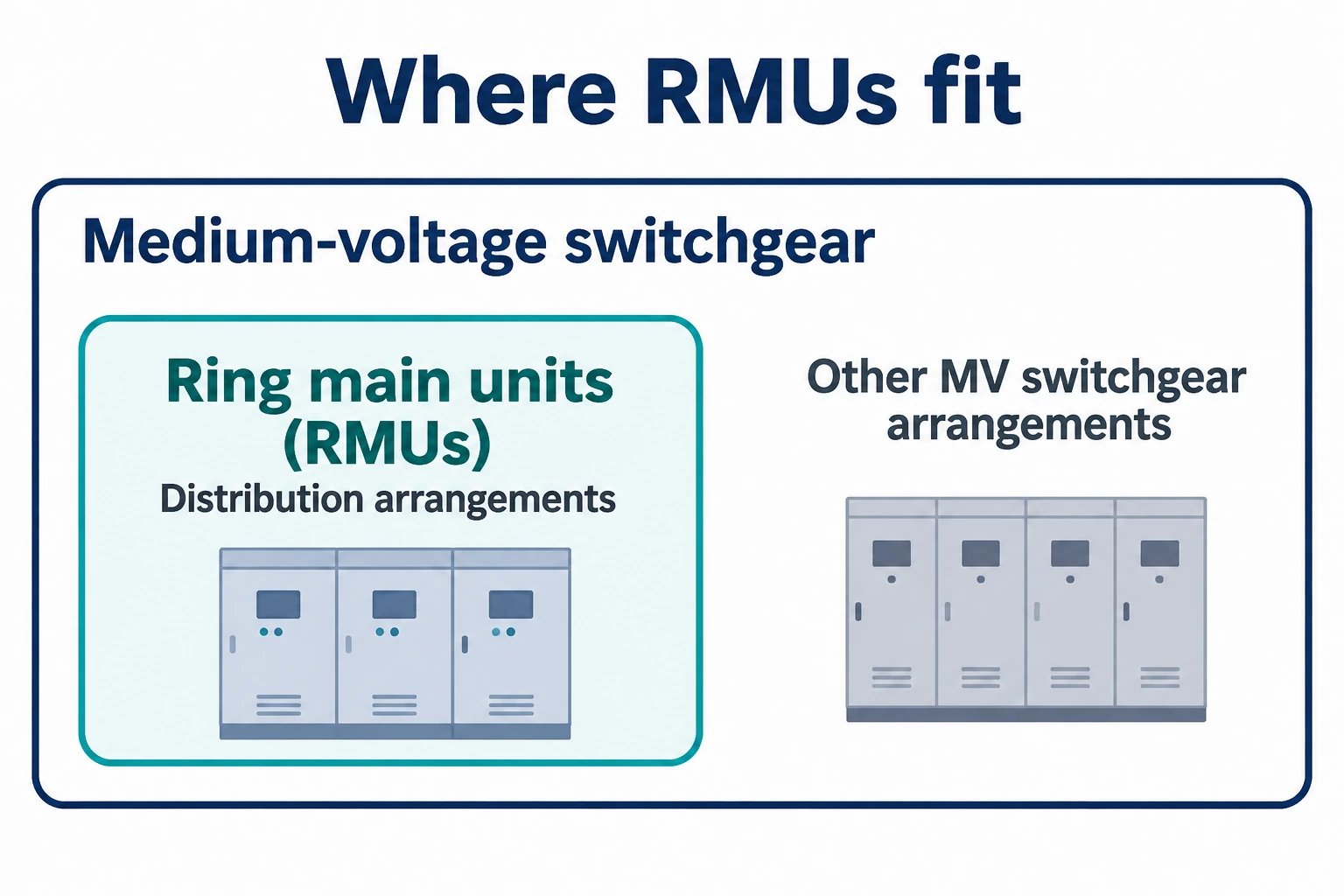
A familiar ring-connected arrangement has two load-break switches connecting the substation to the ring and a protected transformer feeder. That describes a common functional layout, not a rule that every RMU must have exactly three ways. The offered circuit combination still needs to be identified. [1]
The other quotation may be for a modular metal-enclosed lineup, a primary-distribution assembly or a different compact arrangement. Ask the bidder to name it. “Conventional switchgear” is too vague to establish its construction, ratings or maintenance access.
Insulation is a separate choice. ABB’s SafeRing portfolio includes SF₆ and dry-air variants; the RMU label therefore does not identify one mandatory gas. Likewise, a compact enclosure does not tell you whether a particular feeder uses a fuse or a circuit breaker. [2][5]
Consider a secondary substation that needs two ring connections and one transformer feeder. A matching RMU configuration is a reasonable starting point. If the project adds several independently protected feeders, utility metering, bus sectionalizing or future extensions, check whether that specific RMU provides those functions before assuming a larger lineup is necessary.
ABB distinguishes its standardized SafeRing configurations from the more configurable SafePlus platform. This is a manufacturer-specific example of why configuration matters; it is not a universal boundary between all RMUs and all other switchgear. [2]
Use the same comparison sheet for both bids:
| Project question | Ask about the RMU offer | Ask about the alternative lineup |
|---|---|---|
| Network connection | Which ways connect to the ring or supply? | Which incomers and feeders perform those duties? |
| Protected circuits | What protects each transformer or feeder? | What protects the corresponding circuits? |
| Fault duties | Which ratings apply to each functional unit? | Do the corresponding units meet the same duties? |
| Metering and control | What sensors, relays and controls are included? | Are equivalent functions included or optional? |
| Maintenance access | What must be isolated for each service task? | What access and outage boundaries are specified? |
| Expansion | Which extensions are supported, and how? | What future panels and interfaces are reserved? |
| Installation | Are cable access and equipment-removal routes workable? | Does the complete arrangement fit the same site? |
Request a marked-up single-line diagram with every included function and exclusion. A lower price means little if one bid omits the metering unit, relay, cable accessories or extension interface required by the project.
A ring way and a protected transformer feeder do different jobs. Identify the device and its duty on each circuit rather than assigning one protection capability to the whole RMU.
The ring ways provide the specified switching and isolation functions; the transformer feeder needs its own defined protection arrangement. [1][5]
The referenced ABB catalogue offers both a switch-fuse combination and a circuit breaker with relay for transformer protection. It also lists load-breaking, short-time withstand and short-circuit breaking ratings separately. A withstand rating states a different duty from a fault-breaking rating; do not treat one as proof of the other. [5]
For a switch-fuse proposal, request the fuse selection and coordination basis for the transformer and associated switching device. For a breaker proposal, request the relay functions, sensing arrangement, trip supply and settings responsibility. Protection coordination must consider upstream and downstream devices and transformer energization behavior. [4]
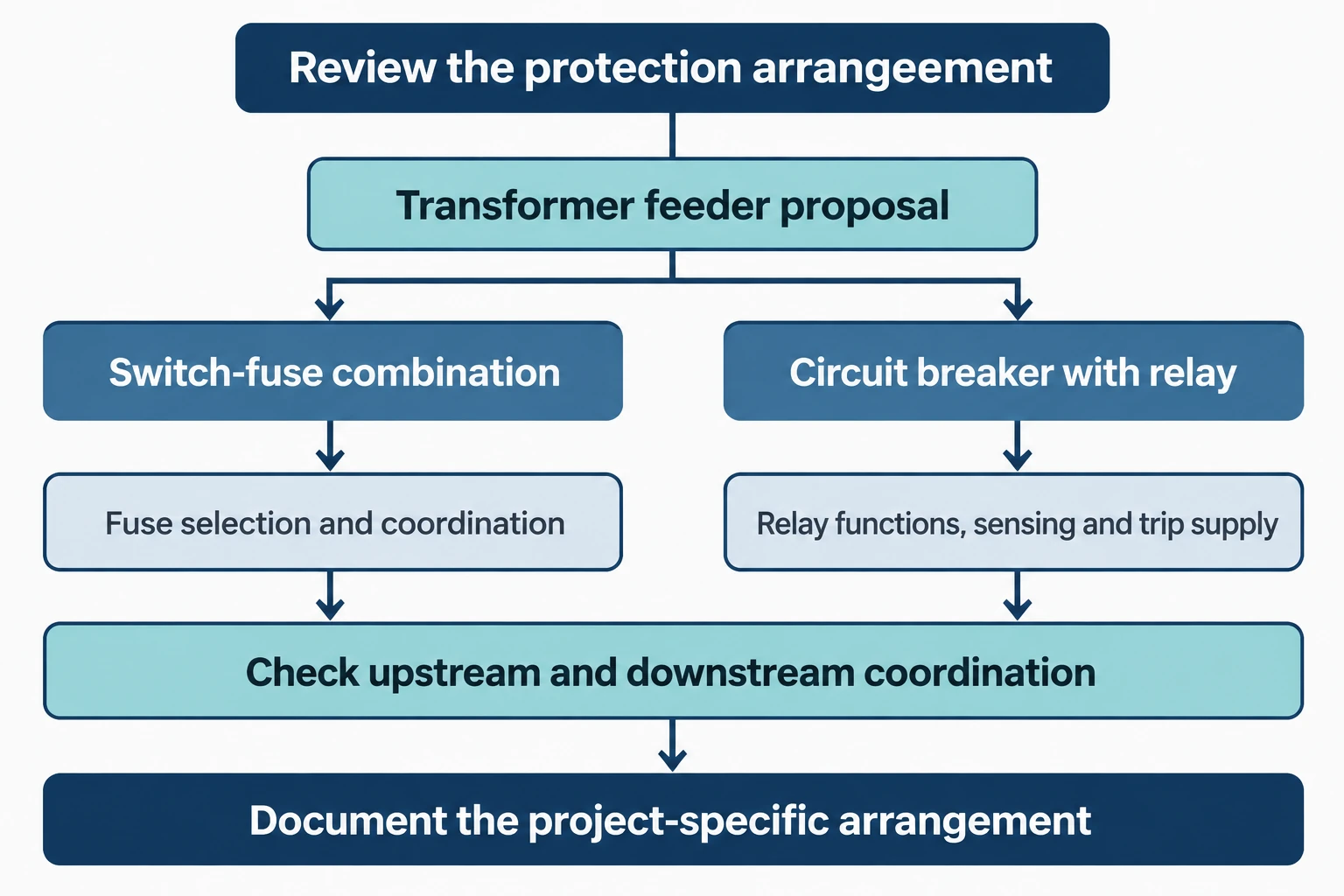
Choose between these proposals using the protection study and the utility’s requirements. An RMU can include a circuit breaker, and a larger enclosure does not, by itself, establish better protection. Reject a comparison that claims “RMU means switches only” before examining the actual circuit schedule. [5]
“Ring main” describes the network application; it does not establish that every switch is closed or that restoration is automatic. Schneider Electric’s distribution guide describes an open-loop network with one normally open point. Restoring healthy sections after a fault requires the appropriate fault isolation and network reconfiguration. [3]
Ask who performs restoration and what the proposed equipment includes. Remote operation needs the relevant actuators, control power, monitoring and communication arrangements, together with an approved control scheme. These functions should appear explicitly in the quotation. The guide treats manual and automated restoration as different arrangements. [3]
Do not infer automatic transfer, a restoration time or uninterrupted service from the RMU name. Confirm the network operating philosophy with the utility and protection engineer.
Send both bidders one project input package:
These inputs align with the network, layout and protection information identified in Schneider Electric’s substation-planning guide. For transformer-fed loads, the transformer specification checklist helps organize the transformer-side inputs. [7]
IEC 62271-200 covers AC metal-enclosed assemblies above 1 kV through 52 kV within its stated scope. Specify the applicable edition and required evidence; an RMU designation alone does not demonstrate conformity, internal-arc performance or a service-continuity classification. [6]
Keep an RMU on the shortlist when its documented configuration covers the required duties and interfaces. Prefer another arrangement when it resolves a specific unmet requirement, such as the approved protection scheme, access conditions or expansion plan. Record that reason instead of assigning a winner to an entire category.
For an HJD quotation discussion, send the single-line diagram and project conditions, and request a proposed circuit schedule, supply boundary and written deviations. Those documents provide a basis for comparison before price negotiations.
Yes. An RMU is a medium-voltage switchgear arrangement commonly used in secondary distribution. For example, ABB includes SafeRing RMUs within its switchgear portfolio. A meaningful comparison identifies the particular alternative lineup rather than treating all switchgear as a separate product. [2]
Yes. The cited ABB SafeRing/SafePlus catalogue documents transformer protection using a circuit breaker with relay as an alternative to a switch-fuse combination. Confirm the actual feeder device, protective functions and ratings in the quotation. [5]
No. Continuity depends on the network arrangement, protection, fault isolation and restoration provisions. A ring-connected RMU does not establish automatic operation or uninterrupted supply. Ask what the proposed control scheme and equipment actually provide. [3]