Request a Quote
Share your product list, technical ratings, quantity and delivery destination.
Prepare a transformer oil leakage report with equipment details, dated photos and operating records. Clarify technical support and site responsibilities.
A useful transformer oil leakage report identifies the equipment, shows where liquid is visible, and records what changed before and after discovery. Send those observations with existing operating records to the equipment owner and the responsible technical contact. A photograph alone cannot establish a repair method or authorize continued operation.
Follow the site’s emergency and environmental procedures first. If there is an alarm, smoke, an active discharge or another immediate concern, contact the designated site response team. Do not delay that notification while assembling a complete report. Keep outside restricted areas. Do not approach energized equipment, open covers, operate valves or attempt a repair to prepare this report.
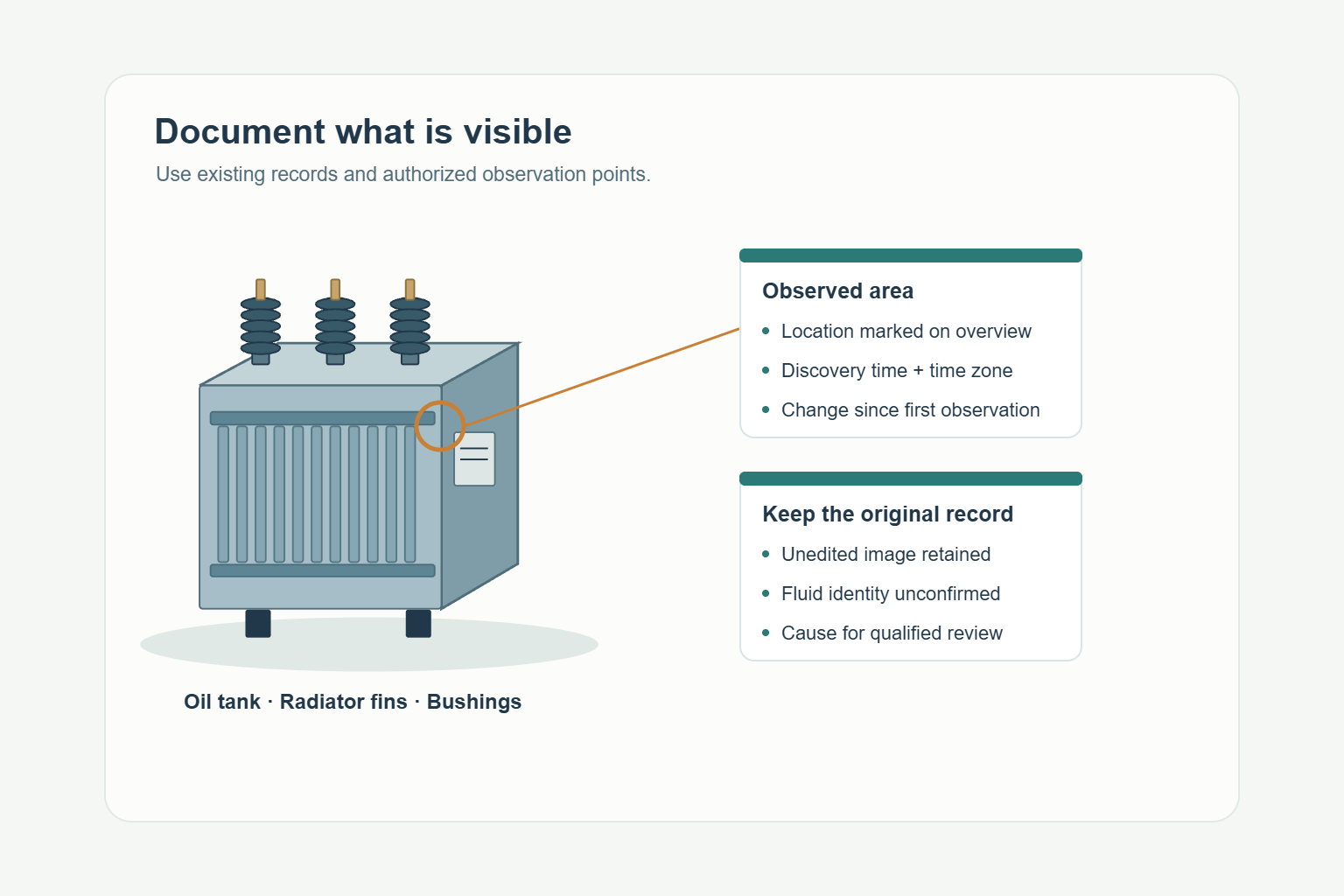
Describe what you can establish from an authorized observation point. “A fresh wet streak is visible below the upper radiator connection” gives the reviewer more to work with than “the transformer seal has failed.” Label a suspected location as suspected until a qualified inspection confirms it.
Record the first observation time, the most recent observation time and the time zone. Include earlier photographs if available. Distinguish a damp surface, separate drops and liquid collected on the ground without inventing a leakage rate. If no measurement exists, write “quantity not measured.”
Do not identify the fluid by color alone. Attach the equipment’s documented insulating-liquid designation or safety data sheet if available, and mark the visible liquid as unconfirmed until the responsible party establishes what it is. Include rain, washdown or nearby work in the chronology where relevant.
| Observation field | Useful information to send | Avoid assuming |
|---|---|---|
| Visible location | Equipment side, nearby labeled component, marked overview photograph | The visible drip point is the confirmed origin |
| Appearance | Wet area, streak, separate drops or collected liquid | A photograph proves fluid type or quantity |
| Change over time | Dated images from comparable viewpoints | One image establishes a stable condition |
| Operating context | Recorded state, load and temperatures with timestamps | An unchanged reading approves continued operation |
| Site impact | Observed affected area, nearby drainage, notifications already made | The supplier owns the site’s spill response |
Use the asset register, purchase documents or an existing readable nameplate photograph. Collect the manufacturer, model, serial number, rated power and voltage information. Add the purchase order or project reference and identify which unit is affected when several similar transformers share a site.
Include the general arrangement drawing and the applicable operating manual, with revision numbers. State whether the reported liquid is associated with the main tank or a separately identified compartment; leave the field unresolved if the equipment documents do not establish it.
Construction matters. GE Vernova describes conventional arrangements with a conservator and a hermetically sealed design without one; the latter uses specially designed radiators to accommodate liquid-volume changes.[1] This is a reason to send the actual configuration and drawings rather than apply advice intended for a different transformer. It is not a claim that every sealed design uses the same arrangement.
For orientation, our oil-immersed transformer guide explains the main equipment components. The installed unit’s documents remain the basis for technical review.
Send available records covering the period around discovery, including normal operation beforehand. State whether each value came from a local indicator, remote monitoring or an operator log. Preserve the original units and timestamps, and label missing information instead of filling gaps from memory.
Useful attachments include:
Do not turn this list into an instruction to take new readings near the equipment. The responsible site team decides which information can be obtained safely and which additional inspections are needed. Describe a recent event as part of the history, without asserting that it caused the leak.
Use existing photographs or images obtained within the site’s access and photography rules. A useful set includes an overview, a closer view of the observed wet area and an image showing its position relative to an identifiable component. Never move closer solely to improve a photograph if doing so crosses an access boundary.
Keep the original files. Make a separate annotated copy with a small arrow or outline, an equipment identifier and the observation time. Avoid cropping away the surrounding component or editing the stain itself. If a photograph predates discovery, label it accordingly.
Where repeat images are available, use a consistent viewpoint and describe changes in writing. State any uncertainty about scale, lighting or whether the surface was already wet. Do not imply that these images establish an approved inspection result.
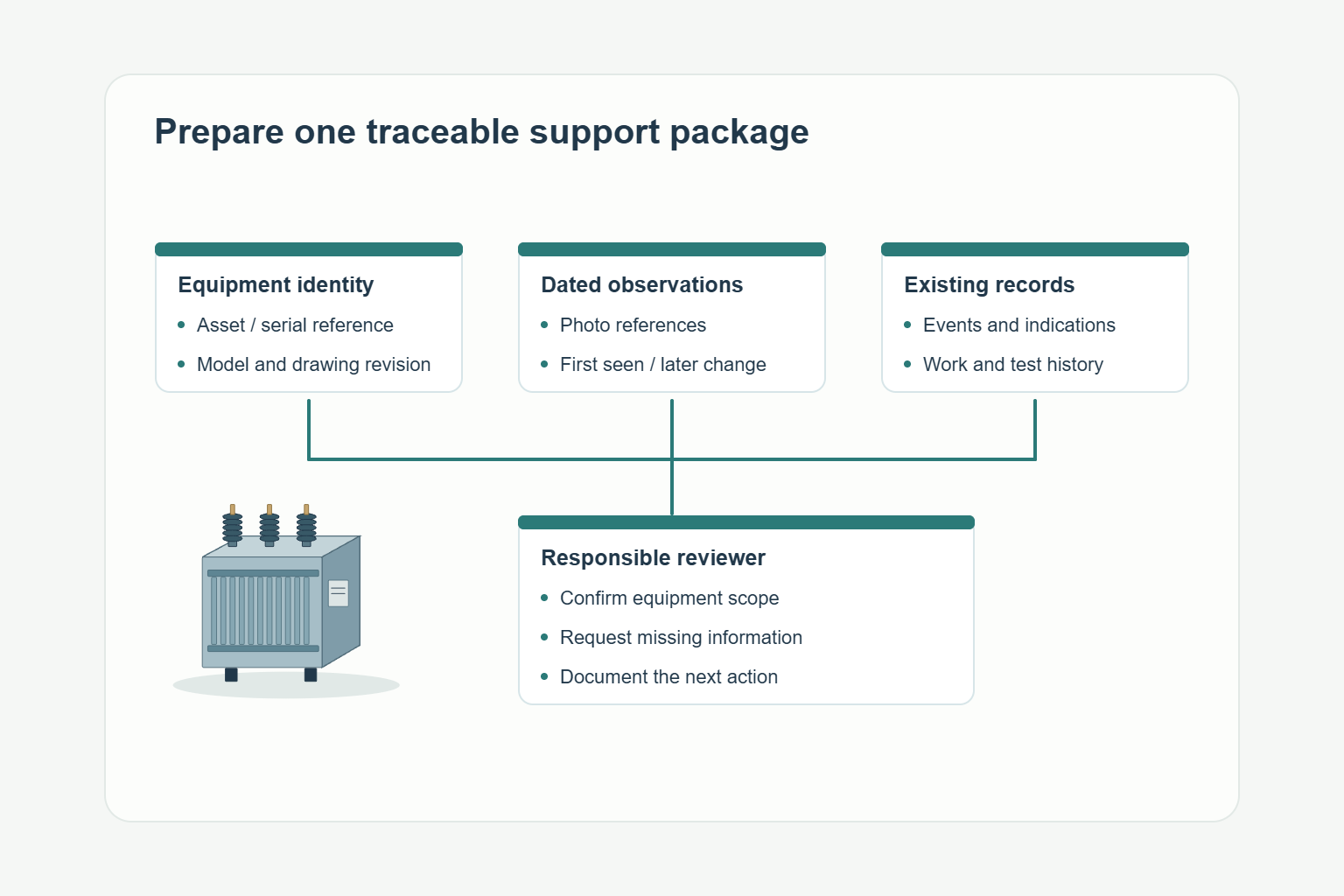
Assign one contact who can collect follow-up questions and obtain answers from the relevant site personnel. Separate equipment support, site operations, environmental response and any contracted inspection scope. Confirm the recipient and sharing authorization before sending site drawings, serial-number records or identifiable personnel photographs.
| Handover section | Suggested information | Question for the responsible party |
|---|---|---|
| Equipment identity | Asset ID, serial number, model and document revisions | Is this the correct unit and configuration? |
| Observation timeline | First discovery, changes, photo references and unconfirmed details | What further evidence is needed? |
| Operating records | Available indications, events and recent work history | Who reviews operational implications? |
| Site coordination | Site contact, access restrictions and response lead | Who arranges any authorized inspection? |
| Requested outcome | Written review, document clarification or inspection-scope discussion | Who confirms the next action and its scope? |
Where factory records are relevant, ask for the applicable report and its equipment identification. IEC 60076-1’s public scope includes tank vacuum, pressure and leak tests.[3] That scope does not prove that a particular unit passed a particular test, or establish a field repair procedure.
Attach existing oil-analysis reports where relevant, including the sample date, sample point and laboratory identification. ASTM D923 explains the importance of representative samples and includes distinct sampling provisions for dissolved gases, water and particles.[2] Do not collect liquid from the ground and present its analysis as representative of the transformer oil.
Our transformer oil testing guide and DGA guide explain how those records support a broader assessment.
For an enquiry about HJD-supplied equipment, contact HJD with the equipment reference and available documents, and ask for the appropriate technical contact. Confirm any inspection or service scope separately.
Send the asset ID or serial number, discovery time, observed location and available photographs. Add any alarms already reported to the site team. Mark missing information clearly; urgent notification should not wait for the full document package.
Use it to document the visible condition and location. Ask the responsible reviewer what additional records or authorized inspection are needed. Do not label a gasket, weld or component as failed solely from the photograph.
The responsible technical team should decide based on the equipment, event and existing evidence. If sampling is requested, agree the purpose, method and responsible personnel. ASTM D923 addresses representative sampling.[2]
The equipment owner and responsible qualified personnel must apply the unit’s instructions, actual condition and site procedures. Do not treat the absence of an alarm as permission from the supplier.