Request a Quote
Share your product list, technical ratings, quantity and delivery destination.
Coordinate transformer oil containment with confirmed liquid data, equipment drawings, foundation interfaces and clear site-design responsibilities.
Transformer oil containment planning needs a defined equipment package and a named site-design owner. Before a civil drawing is released, bring together the confirmed liquid inventory, the transformer general arrangement, foundation interfaces, drainage information and the project’s environmental requirements. The equipment supplier can provide equipment-side inputs; the responsible project team decides how those inputs become an approved site arrangement.
Buyers, EPC teams and project engineers can use the tables below to organize a handover package. Adapt them to the agreed project scope.
Record who owns the containment design before asking suppliers for a “containment pad.” That phrase may refer to the transformer support foundation, an oil-retaining area around it, or a broader package including drainage and collection equipment. Define the intended scope in the enquiry.
In a United States SPCC example, EPA’s December 2013 inspector guidance distinguishes general secondary containment from specific, sized containment provisions. It discusses oil-filled operational equipment separately from bulk storage containers and describes conditional alternatives for qualifying operational equipment. A storage-tank rule or an online capacity percentage therefore should not be copied into a transformer enquiry without checking its applicability.[1]
That guidance is a dated US reference, not a worldwide design standard. Ask the project’s qualified environmental and civil specialists to confirm the current jurisdiction, applicable rules, site permits, insurer requirements and approval route. Record the source and revision of the adopted design basis.
Use a short responsibility table to keep equipment information separate from design acceptance. Assign actual organizations and named reviewers before release.
| Coordination item | Information provider | Decision or acceptance owner |
|---|---|---|
| Transformer liquid inventory and arrangement | Equipment supplier for the selected configuration | Purchaser’s equipment reviewer |
| Site survey, levels and existing drainage | Site owner or survey team | Civil and drainage designer |
| Containment method and usable capacity | Responsible design team using verified inputs | Design authority identified by the project |
| Environmental and fire-related requirements | Project specialists and relevant authorities | Owner’s appointed approval team |
| Inspection, water management and response arrangements | Operator with the design team | Site owner or designated operator |
Use the selected transformer configuration, not a similar catalogue illustration. A nameplate rating alone does not describe the oil inventory or the footprint that the site designer needs. Ask for the status of every input: preliminary, confirmed for order, approved for manufacture or as built.
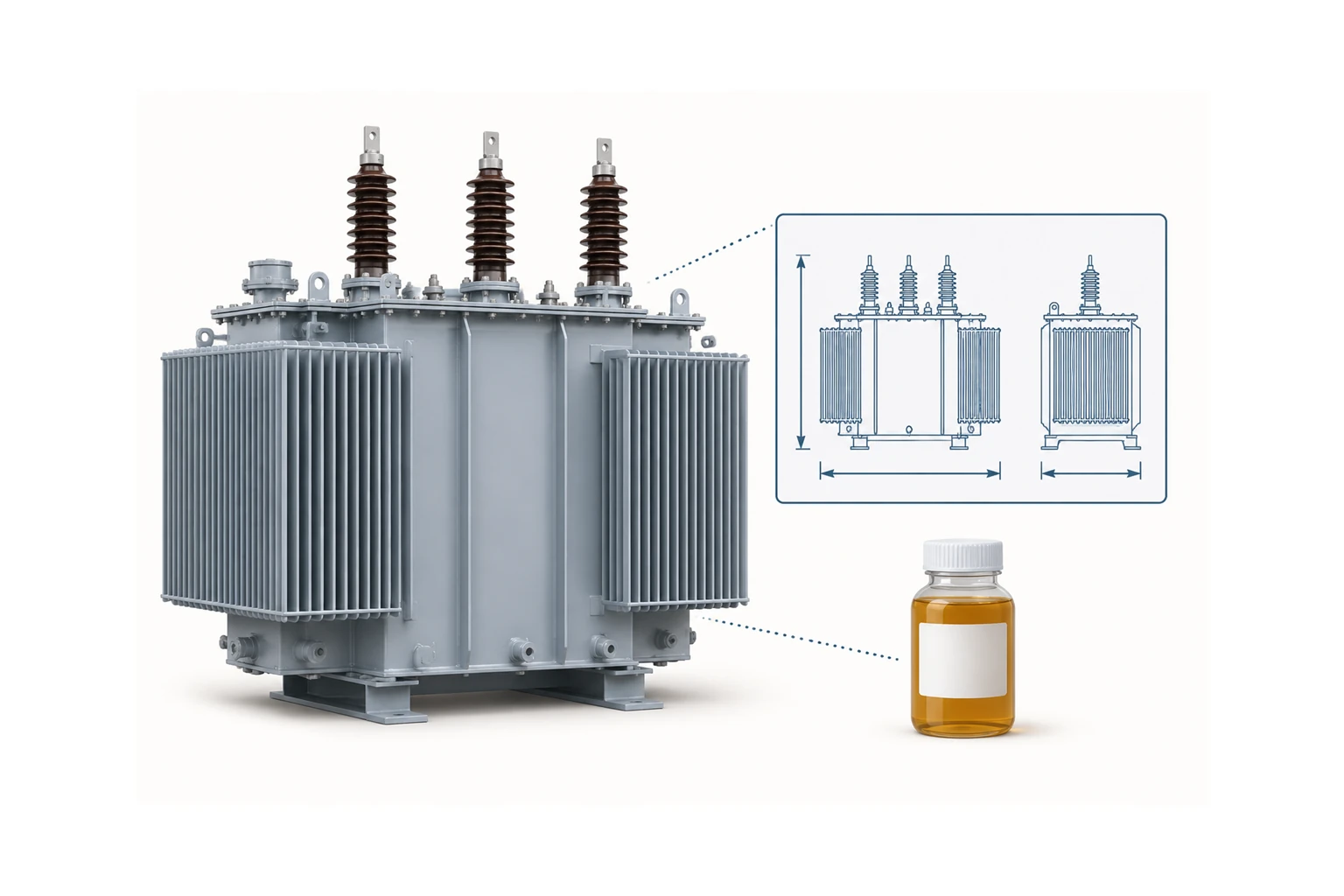
The oil-immersed transformer guide provides related equipment background. For this handover, keep the following items together under one equipment tag and document register.
| Equipment-side input | Detail to request | Coordination question |
|---|---|---|
| Insulating liquid | Product identification, type, stated quantity and units | Does the quantity describe the selected filled configuration? |
| Inventory boundary | Main tank and any separately identified oil-containing assemblies | What is included, excluded or still provisional? |
| General arrangement | Drawing number, revision, overall dimensions and accessory positions | Is the site team using the same revision as procurement? |
| Foundation interface | Support locations, fixing information and supplier-issued loads | Which data have been accepted by the structural designer? |
| Equipment access | Supplier-defined installation, inspection and maintenance access information | Can the proposed perimeter arrangement preserve the required access? |
| Shipment and assembly | Shipping arrangement and items assembled at site | Which drawing represents the final installed condition? |
| Fluid documentation | Available safety and technical data for the specified liquid | Which project reviewer checks material compatibility and handling requirements? |
Do not substitute liquid mass for liquid volume without a documented basis. If the supplier gives kilograms and the civil schedule requests litres, flag the mismatch and ask for a confirmed conversion basis or the required volume. Preserve the original units in the handover record.
Keep a separate list of unresolved items. For example, an accessory location marked “to be confirmed” should remain visible to the site designer. Removing the note to make a schedule look complete hides a decision that still has to be made.
Overlay the current equipment arrangement on the site drawing. Review support locations, perimeter walls or barriers, cable interfaces and the access information supplied for the transformer. Ask the design team to identify conflicts rather than assuming a basin sketch resolves them.
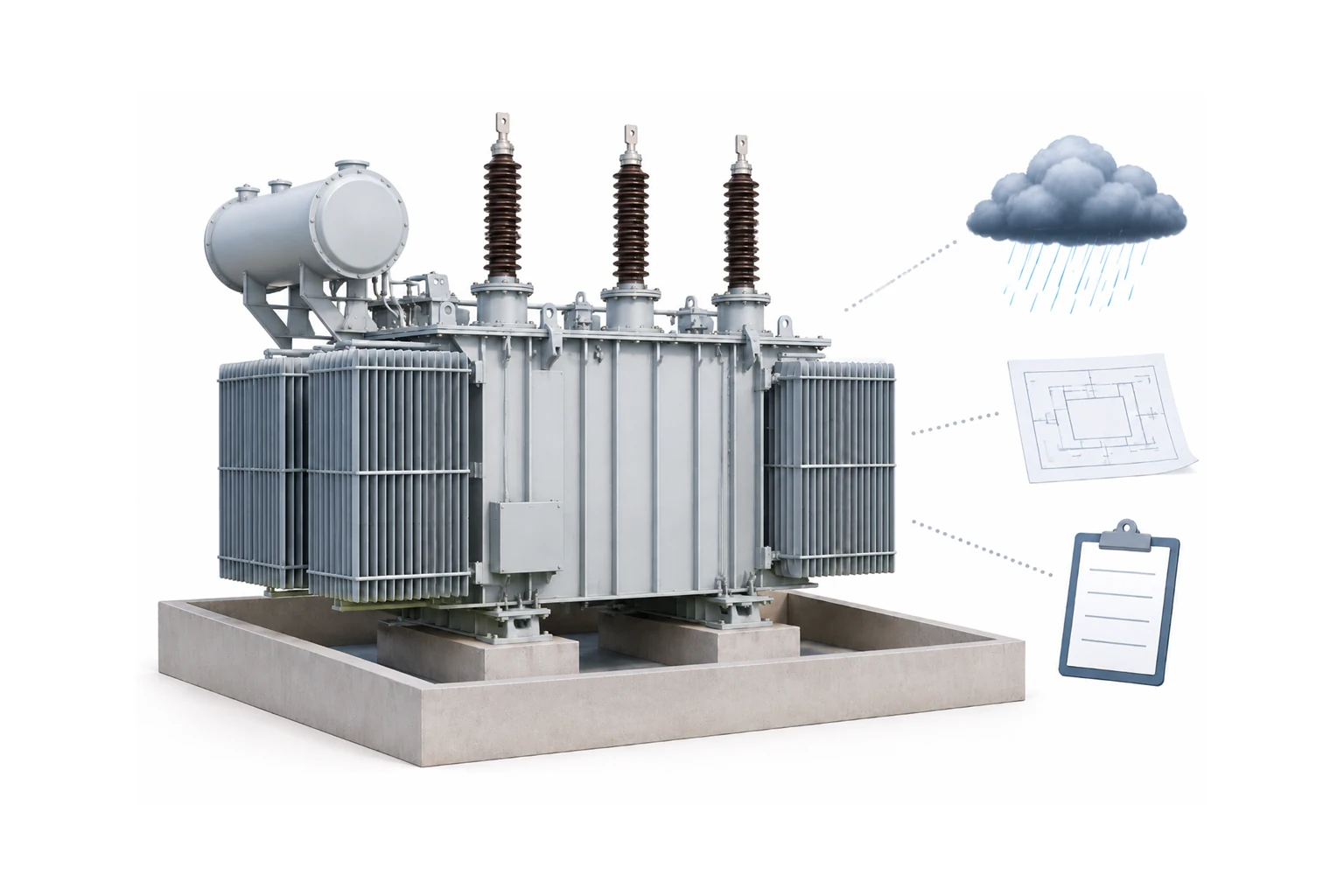
The supporting foundation and the containment arrangement may occupy the same area, but their acceptance questions differ. The equipment reviewer needs an agreed support interface. The containment designer needs a documented basis for retaining or directing the relevant release. Keep both reviews visible in the drawing register.
EPA’s secondary-containment worksheets illustrate why gross dimensions need care. Their simplified examples assume a flat floor, equal wall heights and right-angle corners; they do not include displacement from foundations or support structures. EPA says site-specific conditions may require modifications by the professional engineer for PE-certified plans.[2]
Treat a supplier’s external dimensions as an input. They do not establish the usable containment volume. Ask the responsible designer how occupied space, levels and the selected arrangement have been addressed.
A perimeter drawing can leave important questions unanswered: where does collected water go, who assesses it, and what happens when an outlet or collection system needs attention? EPA’s guidance discusses facility drainage, sufficiently impervious containment and the effect of accumulated precipitation on available capacity.[1]
For an outdoor installation, give the design team the site rainfall basis and drainage survey available to the project. Ask it to document how rainfall and other applicable site inputs are treated. Do not assume a generic drawing has included them.
Use these questions at the coordination review:
The answers belong in the project’s approved design and operating documents. Leave drain or valve operation and access to energized equipment to authorized personnel under the approved site procedures.
Send a coordinated package rather than a loose set of email attachments. Include the equipment tag, liquid-data schedule, current general arrangement, foundation-interface information, site drawing and a responsibility register. List missing information on the cover sheet.
For each revision, identify the changed field and the affected document. If a revised transformer arrangement changes the footprint or the confirmed liquid inventory, route that change back to the relevant designers. An earlier acceptance should not be treated as acceptance of a later configuration.
Before procurement or construction release, ask the designated reviewers to close their own comments. Keep equipment-data confirmation, civil approval and environmental acceptance as separate records. A manufacturer’s confirmed oil quantity is not approval of the site containment design.
For a transformer supply enquiry, use the transformer specification checklist and contact HJD with the equipment requirements, destination and requested document list. Ask which model-specific drawings and liquid data can be supplied, and when they can be confirmed.
Start with the selected transformer’s liquid inventory, current general arrangement, foundation interfaces and access information. Add the site survey, drainage information and the project’s agreed design basis. Name the party responsible for deciding containment requirements.
Do not assume so from its name or appearance. Ask the responsible designer to identify the intended retention or collection arrangement and its design basis. EPA’s US guidance treats secondary containment as a system providing temporary containment of released oil; a support-foundation drawing alone does not establish that function.[1]
Equipment classification, applicable jurisdiction and the adopted design basis need review. EPA’s dated US guidance distinguishes general containment from specific sized provisions, so a bulk-storage calculation should not automatically be transferred to an oil-filled transformer.[1]
The project must identify its design and approval authorities. Equipment suppliers confirm the inputs within their agreed scope; the appointed civil, environmental and other responsible reviewers assess the site arrangement. Keep those responsibilities in the contract and handover register rather than treating a supplier drawing as site approval.