Request a Quote
Share your product list, technical ratings, quantity and delivery destination.
Compare transformer types by duty, insulation, mounting and winding arrangement. Build a clear specification and identify the documents needed for an RFQ.
Transformer names describe different attributes: the job in the electrical system, the insulation, the winding arrangement or the installation. A single unit can be a three-phase, liquid-filled, pad-mounted distribution transformer. Those labels describe the same equipment from different angles.[2][5]
For an industrial project, start with the two circuits the transformer will connect and the load it must supply. Then define electrical requirements, site conditions and the delivery scope. This produces a more useful shortlist than choosing a product because its name resembles an item on an old quotation.
The map below separates the main classification questions. It also shows which decisions need a drawing, a data schedule or confirmation from the supplier before an order.
| Classification | Common descriptions | What the buyer still needs to define |
|---|---|---|
| System role | Power, distribution, generator step-up | Connected circuits, operating duty and project boundary.[4][5] |
| Insulation and cooling | Liquid-filled or dry-type | Insulation system, cooling arrangement and installation conditions.[1][5] |
| Installation | Pole-mounted, pad-mounted, ground-mounted, substation | Site layout, support, access and electrical interfaces.[2] |
| Voltage direction | Step-up or step-down | Required input and output voltages for the intended operation.[1] |
| Phase arrangement | Single-phase or three-phase | Available supply, connected loads and specified connections.[5] |
| Winding arrangement | Separate windings or an autotransformer | Whether a conductive connection between input and output is acceptable.[3][7] |
| Internal construction | Core form or shell form | Offered construction and evidence against the project requirements.[4] |
Consider a hypothetical outdoor installation supplying a factory from a medium-voltage feeder. The proposed unit might combine distribution duty, liquid insulation, three-phase operation, separate windings and a pad-mounted arrangement. The project team must still define its ratings and interfaces. None of the labels alone supplies that information.

Use the same classification fields for every quotation. If one supplier describes only the installation and another describes only the insulation, ask both to complete the missing fields before comparing their offers.
Distribution transformers commonly reduce a distribution-system voltage to a level used by connected loads. The wider distribution-transformer family also includes equipment for applications such as renewable generation, where the required voltage direction can be step-up.[5]
Power-transformer descriptions cover other system duties, including generator step-up service. The generator, the connected network and the required transformer construction then become part of the specification.[4]
For a quotation, show the transformer on the single-line diagram and identify the circuits on both sides. State whether the project supplies loads, connects generation or replaces equipment at an existing interface. Resolve any difference between the purchaser’s terminology and the supplier’s product family in the technical schedule.
A practical first review can be short: mark the source, load or generator, transformer terminals and equipment included in the order. If an adjacent switching device belongs to another package, identify who supplies it and who checks the interface. This avoids leaving a necessary connection outside both quotations.
The power transformer versus distribution transformer guide develops the operating-duty questions behind that comparison.
Measuring and protection current transformers and voltage transformers belong to the instrument-transformer group.[8] The IEC 61869-1 public scope describes secondary signals used for measurement, protection and control.[6]
Keep these items separate from the transformer supplying the project’s load. An RFQ that simply says “transformer” can leave the requested equipment unclear. Identify the function explicitly, then use the appropriate technical schedule for that equipment.
The instrument-transformer standard cited here has a defined voltage scope and works with the relevant product-specific requirements. Its family name does not establish compliance for an offered device.[6]
Liquid-filled and dry-type are two broad distribution-transformer categories.[5] In an oil-filled transformer, the insulating liquid contributes to electrical insulation and carries heat from the active parts. A dry-type installation instead needs the specified cooling-air conditions around the transformer and its enclosure.[1]
For the initial selection, collect the room or outdoor location, ambient conditions, ventilation arrangement and service access. Where a liquid-filled design is proposed, identify the liquid and ask the project team to state the applicable fire and liquid-control requirements. These inputs belong in the comparison before the purchaser selects a construction.
Ask each supplier to state the offered insulation and cooling arrangements in plain terms. “Dry-type” or “oil-filled” leaves further questions: which enclosure is included, which accessories are supplied, and which installation conditions the quoted rating assumes. Request a layout showing the complete offered assembly so the site team can review it.
A supplier offering an alternative should identify the changes it needs in the room or installation. Put those changes alongside the equipment price in the review. A quotation comparison is incomplete while one option assumes ventilation, access or site work that the other has included.
For a more detailed comparison, use the dry-type versus oil-filled transformer guide. The category name is a starting point for that review; the offered configuration is what must fit the project.
An autotransformer has a winding section shared by its primary and secondary circuits. A transformer with separate primary and secondary windings transfers energy through magnetic coupling without that direct winding connection.[3][7]
That distinction addresses electrical separation. “Step-up” and “step-down” describe the intended voltage change: the secondary voltage is higher or lower than the primary voltage, respectively.[1] Record both questions in the RFQ so that a voltage-ratio match does not leave the winding requirement unanswered.
Where the project requires separate windings, say so explicitly. Also describe what the separation is intended to achieve and have the responsible engineer define any additional requirements. A request for “isolation” should not leave the supplier to guess whether the buyer also expects a particular shield, grounding arrangement or application-specific qualification.
For a proposed autotransformer, request confirmation of the actual connection and its suitability for the specified system. Keep the review at the configuration level; a product-family label is insufficient information for field connection work.
The autotransformer versus separate-winding guide explains that decision. Use the step-up versus step-down guide when the main question is voltage direction.
Manufacturer portfolios distinguish pole-mounted, pad-mounted, ground-mounted and substation arrangements within the liquid-immersed distribution-transformer family.[2] This is a useful example of classification overlap: the installation description adds information to the insulation description.
Select the arrangement against the actual site. Give the supplier the support location, equipment access route, available footprint and connection constraints. For a replacement, include the existing layout and the interfaces that the new unit must retain.
Ask for a drawing that identifies cable or bus connections, service access and the equipment included in the quoted assembly. If the offer includes switches, protective devices or a surrounding enclosure, list those items separately. The project team can then compare the supply boundary with the drawings and purchase specification.
Treat a familiar mounting label as a prompt to check the layout. It does not answer whether a particular delivery will pass through the access route or meet the existing connections. Resolve those points while changes can still be reflected in the quotation.
Core form and shell form describe the relationship between a transformer’s magnetic core and windings. Hitachi Energy identifies them as two basic configurations; its core-type description places cylindrical windings around core legs.[4]
For procurement, ask the supplier to identify the construction being offered and provide the drawings or technical explanation needed for the project review. Keep the acceptance questions tied to the required performance and delivery conditions.
If a quotation highlights a core material, conductor material or manufacturing process, request the corresponding specification and the evidence relevant to the claimed result. Compare losses, sound and other guaranteed characteristics on the stated basis. A material name alone does not complete that comparison.
There is no need to turn every construction term into a separate purchasing category. Record the requirement, the offered design and any deviation in the same schedule so reviewers can see what has actually changed.
After choosing the likely family, send suppliers a common set of inputs. A marked-up single-line diagram, a data schedule and a layout are easier to compare than several unrelated product brochures.
Use the review below to connect each description to a document. Record who must resolve any missing information and whether it affects the quotation, design approval or delivery release.
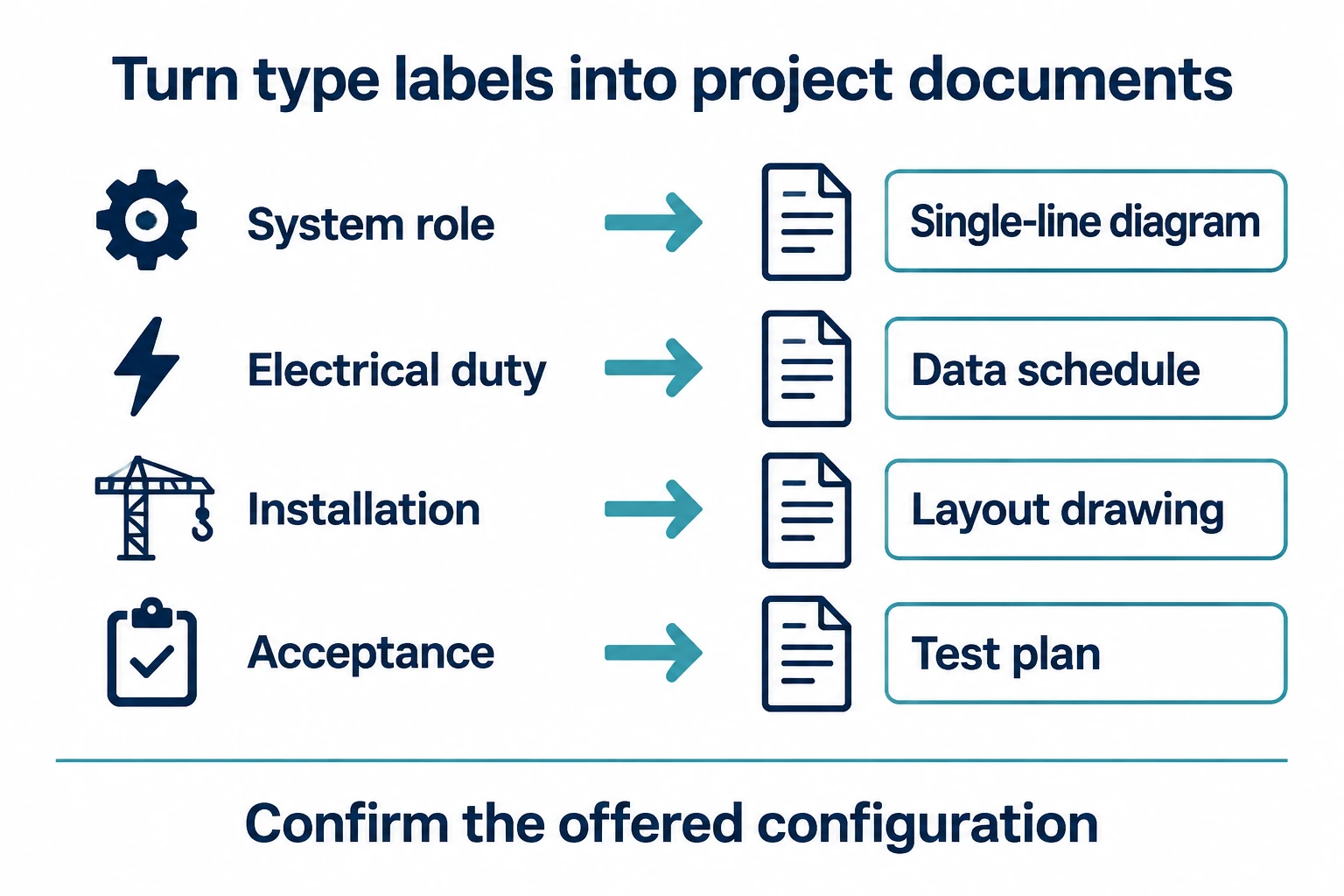
| Review item | Information to provide | Evidence to request |
|---|---|---|
| Duty and electrical basis | Connected circuits, load or generation duty, required capacity, voltages, frequency and phases | Completed data schedule with assumptions and deviations |
| Winding and system interface | Required separation, connection and neutral requirements defined by the project engineer | Offered connection description and terminal identification |
| Site and installation | Location, environment, footprint, access route and retained interfaces | General arrangement, dimensions, access requirements and connection details |
| Insulation and cooling | Project restrictions and the conditions for the required rating | Offered insulation, cooling arrangement and accessory schedule |
| Supply boundary | Transformer, enclosure, switching, protection and other included equipment | Itemized scope, interface responsibilities and exclusions |
| Acceptance | Required standards, guaranteed characteristics and document milestones | Agreed test plan, applicable reports and delivery documentation |
Review a proposed alternative against these same inputs. Ask the supplier to mark each departure and describe the project consequence, such as a different connection interface or additional site provision. This keeps an alternative offer traceable through technical approval and purchase review.
For the full input list, use the transformer specification checklist. The transformer testing guide explains how to organize acceptance documents without treating a general brochure as a test report for the ordered unit.
Use the relevant guides to define the proposed transformer configuration, then contact HJD with the project requirements. Confirm the available product scope and supporting documents before selecting a model. Include the single-line diagram, electrical data and installation constraints in the technical discussion.
“Pad-mounted” describes the installation arrangement. The cited manufacturer’s liquid-immersed family includes pad-mounted designs, but that portfolio example does not establish a universal rule.[2] Ask the supplier to identify the insulation system and liquid, where applicable, for the offered model.
Describe the system duty and required electrical input and output first. Add the winding requirement, installation conditions and supply boundary. If the insulation or mounting choice is unresolved, request an identified alternative against the same data schedule, with its assumptions and deviations listed.